








Author information
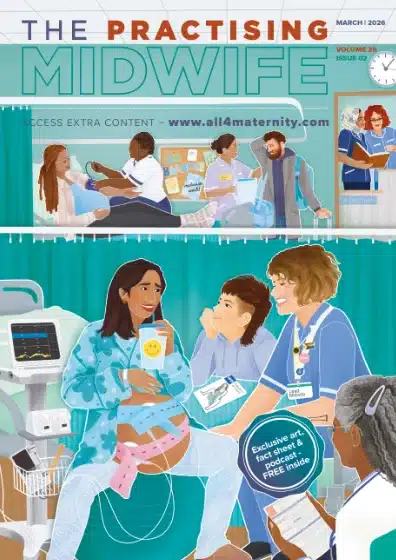
The Practising Midwife (TPM) is an international, peer-reviewed journal dedicated to sharing evidence, research, and best practice across the whole midwifery and maternity care community. Founded in 1998, TPM now serves midwives, obstetricians, maternity support workers, doulas, educators, researchers and service users; anyone committed to improving midwifery and maternity care worldwide. The journal is published as a bumper issue 6 times per year in January, March, May, July, September, November
In September 2022, we launched The Practising Midwife Australia (TPMA), published seasonally, four times per year, to share regional perspectives and strengthen global collaboration.
Our aim
The central aim of The Practising Midwife is the translation of evidence and research into safe, compassionate and effective practice. We promote interprofessional learning and innovation to improve outcomes for women, birthing people, babies and families.
What we publish
We welcome high quality, evidence-informed contributions that include:
-
Original research on all aspects of midwifery, maternity, neonatal and early parenthood care.
-
Practice and clinical focus articles that translate evidence into day-to-day care.
-
Tools, techniques and innovations supporting safe and effective practice.
-
Education features addressing midwifery and maternity education, including curriculum development.
-
Case studies, reflections and service-user perspectives that advance learning and empathy in care.



Who can contribute
We welcome submissions from midwives, students, and all professionals involved in pregnancy, birth and postnatal care — from seasoned researchers to first-time authors. Our editorial team offers supportive guidance throughout the submission process, nurturing the development of writers at every stage. Before you submit an article, please read our guidelines carefully.
Editorial quality and governance
The Practising Midwife and The Practising Midwife Australia are guided by an Editorial Advisory Board comprising midwives, academics, clinicians and service-user representatives. We follow the ethical principles of the Committee on Publication Ethics (COPE) and the International Committee of Medical Journal Editors (ICMJE).
All manuscripts undergo editorial screening and, where appropriate, peer review to ensure accuracy, transparency and professional integrity. We do not accept work published or under review elsewhere, or redundant publications as defined by COPE. Committee on Publication Ethics (COPE).
- The Practising Midwife is cited on PubMed, MIDIRS and indexed on CINAHL and SCOPUS.
- The Practising Midwife Australia is in the process of being indexed in the same databases.
For all our editorial policies, please click on the link below:
For informal enquiries or support for article ideas, please contact Managing Editor of The Practising Midwife and The Practising Midwife Australia journals.
The Practising Midwife
ISSN 1461-3123 (Print)
ISSN 2634-7407 (Online)
The Practising Midwife Australia
ISSN 2755-3728 (Online)
Types of articles
Feature articles »
We welcome contributions that offer a personal viewpoint or description of life as a midwife ‘at the coalface’ of today’s profession. These may be humorous, controversial, analytical or reflective. We are particularly interested in current issues, new developments, reflective practice and controversial topics. We are keen that articles are very much about the practice of midwifery and say something new that can be used by midwives to further their practice.
For inclusion with your submission:
- Maximum of 1700 words including the reference list.
- Article main title to be maximum of 6 words.
- 100 word summary, positioned at the start of the article.
- Appropriate sub headings throughout.
- Explanation and context should be given for any bullet points, do not supply bullet point lists on their own.
- Conclusion.
- Main body of article with the reference list positioned at the end (use sparingly). See Referencing
- Images – See General Information>Photographs, headshots, diagrams and illustrations
Essentials Series (formerly Midwifery Basics) »
A series of articles on a planned topic/theme, published across the year. We welcome submissions that address core, ‘essential’ aspects of midwifery practice. Such articles offer an opportunity to update basic skills and knowledge and address fundamental knowledge and understanding that underpins midwifery practice. These articles can include introductions to key concepts, explorations of core midwifery knowledge that is central to the role of the midwife and specific aspects of midwifery knowledge or skills. A series for 2026 has been commissioned.
For inclusion with your submission:
- Maximum of 1700 words including the reference list.
- Article main title to be maximum of 6 words.
- 100 word summary, positioned at the start of the article.
- 3-5 Care Considerations points (Reflective questions/practice points)
- Appropriate subheadings throughout.
- Explanation and context should be given for any bullet points, do not supply bullet point lists on their own.
- Conclusion.
- Reference list positioned at the end (use sparingly). See Referencing
- Images. See General Information> Photographs, headshots, diagrams and illustrations
Advancing Practice »
Very much practice based, these articles may offer a new perspective on clinical practice – or more usually explore an area of practice that tends to be encountered either by the more experienced practitioner or less often than ‘the every day’. We welcome articles that might challenge the reader in some way.
These articles should include practice challenges, i.e. reflective questions posed to the reader to increase their engagement with the content of your article. During the design process the practice challenges are highlighted at key points throughout your article.
Questions are not prescriptive but as an example, in an article about birth outside the guidelines, readers were asked: ‘How do you feel your experiences have shaped your approach to supporting physiological birth?’ ‘Can you reflect upon what fears and vulnerabilities you might have in your workplace? How might these fears be managed?’ ‘What do you feel you need in order to support women’s choices? Consider your personal and professional needs.’
For inclusion with your submission:
- Maximum 2500 words including the reference list.
- Article main title to be maximum of 6 words.
- 100 word summary, positioned at the start of the paper.
- Appropriate sub headings throughout.
- Main body of article with up to 5 practice challenge questions identified throughout the article.
- Explanation and context should be given for any bullet points, do not supply bullet point lists on their own.
- Conclusion.
- Reference list positioned at the end (use sparingly). See Referencing
- Images. See General Information>Photographs, headshots, diagrams and illustrations
Evidence Series; research articles and reviews »
We welcome both primary and secondary research (literature or systematic reviews). Occasionally, larger pieces of research may be broken down into two or more consecutive articles.
Research papers are subject to peer review. See General Information>Peer Review
A primary research article should include:
- Maximum 2500 words including the reference list.
- Article main title to be maximum of 6 words.
- 100-word summary, positioned at the start of the paper.
- Appropriate sub headings throughout.
- An introduction to include background information to support the reasons for the study.
- A brief but clear outline of the methodology, making clear the study setting, the sample, the hypothesis (where relevant) and the reason for the chosen method.
- Information of ethical approvals granted and particular ethical considerations in your study.
- Results/findings consistent with your chosen methodology. Tables and graphs may be used.
- Discussion, relate your findings to focus their relevance to midwifery practice. Also include a brief statement of limitations of the research, and implications for practice and future research.
- Explanation and context should be given for any bullet points, do not supply bullet point lists on their own.
- Conclusion.
- Reference list positioned at the end. See Referencing
- Images. See General Information>Photographs, headshots, diagrams and illustrations
A secondary research article should include:
- 100 word summary of the article, positioned at the start of the paper.
- Appropriate sub headers throughout.
- An introduction to include background information to support the reasons for the study.
- A brief outline of the methodology, to include search strategy, inclusion/exclusion criteria, study selection, quality appraisal, reflexivity (if applicable), data extraction and analysis methods.
- Results/findings consistent with your chosen methodology. Tables and graphs may be used.
- Discussion, relate your findings to focus their relevance to midwifery practice. Also include a brief statement of limitations of the research, and implications for practice and future research.
- Conclusion.
- Reference list postitioned at the end. See Referencing
- Images. See General Information>Photographs, headshots, diagrams and illustrations
a) Research unwrapped
In this long-running series, authors ‘walk’ readers through critiquing a specific piece of research. The idea is that the reader will gain a greater understanding of critiquing research, while also gaining knowledge about the specific research study being ‘unwrapped’. The studies chosen need to be recent. In doing so we can advance our knowledge and understanding of a research topic and apply it to our practice. This process is designed to assess the usefulness of the evidence in terms of decision making and application to practice.
b) Cochrane corner
This series is very long standing but more recently became a collaborative project between Cochrane UK and The Practising Midwife. A systematic review tries to search for, appraise and bring together existing research to answer a specific research question. The aim of Cochrane Corner is to highlight Cochrane systematic reviews of relevance to pregnancy and childbirth and to stimulate discussion on the relevance and implications of the review for practice.
c) Guideline commentary
This series, which complements Cochrane corner and Research unwrapped helps readers make sense of published guidelines by offering a detailed appraisal of a guideline or a specific section of a guideline, in a careful and considered manner. In doing so midwives can advance their knowledge and understanding of reviewing guidelines to inform our practice. This process is designed to assess the usefulness of the guideline and underpinning evidence, in terms of decision making and implications for practice.
d) Report review
This series, which runs alongside Guideline commentary and the other evidence bases, looks at local, national and international reports that have implications directly or indirectly for midwives. It helps readers to understand what reports mean for midwifery practice and to place report recommendations into context.
e) Understanding research
Understanding research is a series of articles aimed at dispelling the myths around research theories and practices, and exploring just what is meant by the different terminologies encountered when reading and using research articles. We will explore different aspects of research to make this knowledge accessible and relevant. It forms part of the Evidence series, and aims to help midwives to understand, use and engage with research, and consider how research matters to their practice.
Voices (formerly Maternity Voices) reflection »
We welcome shorter reflective or position pieces. Voices is a space to reflect all views from across the maternity services. These shorter articles may be written as clinical, descriptive, narrative or reflective pieces. We are particularly keen to hear from service users, obstetricians, paediatricians, and birth workers to provide a broader range of views.
For inclusion with your submission:
- Maximum 1200 words including the reference list.
- Article main title to be maximum of 6 words.
- 100 word summary, positioned at the start of the paper.
- Appropriate sub headings throughout.
- Reference list positioned at the end (use sparingly). See Referencing
- Images. See General Information>Photographs, headshots, diagrams and illustrations
Skills Summary» (TPM only)
This standard summarises core and advanced midwifery skills and can feature innovations in practice, evaluation of skills teaching and new approaches to skills learning, or explore and evaluate application of clinical skills across the maternity care setting. Skills can range across any topic, from core clinical skills, to communication skills, to more advanced skills, management and leadership.
For inclusion with your submission:
- Maximum 1700 words including the reference list.
- Article main title to be maximum of 6 words.
- 100 word summary, positioned at the start of the paper.
- Appropriate sub headings throughout.
- Reference list positioned at the end (use sparingly). See Referencing
- Images. See General Information>Photographs, headshots, diagrams and illustrations
Spotlight» (TPM only)
A Spotlight article is for any focus or topic relevant to contemporary midwifery practice, and can include summaries of primary and secondary research, service evaluations, opinion pieces, and reflections. The article should highlight a specific issue or topic and deal with it succinctly but in a focused way.
For inclusion with your submission:
- Maximum 1200 words including the reference list.
- Article main title to be maximum of 6 words.
- 100 word summary, positioned at the start of the paper.
- Appropriate sub headings throughout.
- Reference list positioned at the end (use sparingly). See Referencing
- Images. See General Information>Photographs, headshots, diagrams and illustrations
Global Perspectives» (TPM only)
We welcome articles of any type that draw attention to and explore issues that have global significance, or are written from a global perspective, or feature contexts outside the UK. We particularly welcome articles addressing local and national midwifery practice from across the globe, including indigenous and traditional maternity care.
For inclusion with your submission:
- Maximum 1700 words including the reference list.
- Article main title to be maximum of 6 words.
- 100 word summary, positioned at the start of the paper.
- Appropriate sub headings throughout.
- Reference list positioned at the end (use sparingly). See Referencing
- Images. See General Information>Photographs, headshots, diagrams and illustrations
Blog submissions
View our advice for blogs »
Blog posts are online topical pieces, written in a more relaxed style to journal articles. The tone is lighter and more conversational. Please read our guides below:
Blog articles can be about any aspect of midwifery and maternity. We are keen to:
- celebrate achievements
- disseminate clinical and academic innovation to support improvement
- highlight fundamental issues and adversity with a focus on finding solutions to support and sustain midwifery care for women.
Importantly, All4Maternity provides you with a voice to stand up and challenge the status quo. Please don’t be shy, we value your contributions.
- Submissions can vary in length from c500 to c1500 words.
- 100 word summary positioned at the start of the article.
- Appropriate subheadings throughout
- Reference list positioned at the end (use sparingly). See Referencing
- We encourage authors to add backlinks/urls to content, for the reader to find out more. This can be achieved by using the comments function in Microsoft Word. Highlight the word/term to hyperlink>add new comment>paste the correct URL.
- example here.
- Images. See General Information>Photographs, headshots, diagrams and illustrations
Are you ready to submit your blog?
To ensure your blog meets our submission standards, please read the check list on our Writers Guides before completing this form, then submit here
Inclusivity and language
View our inclusivity principles and bias free language guide »
Inclusivity
We believe that diversity is our strength and view All4Maternity as a platform to give voice to the experiences of maternity professionals of all genders, ages, races, religions, ethnicities, abilities and sexual orientations.
We believe that inclusion — honouring and celebrating the unique traits and contributions of each individual person—fosters creativity and growth. We are inclusive of the non-binary or transgender community, therefore, at All4Maternity we use both terms ‘women’ and ‘person/people’, and prefer ‘childbearing and/or birthing women, people and/or parents’, as well as referring to chest-feeding alongside breast-feeding as appropriate.
Where appropriate we will use the acronym LGBTQIA2+ (Lesbian, Gay, Bisexual, Transgender, Queer or Questioning, Intersex, Asexual or Agender, and Two-Spirit, with the “+” representing other diverse identities and experiences related to gender and sexuality.)
Examples:
-
-
- ‘Childbearing women and people can be impacted by consequences of COVID-19.’
- ‘Birthing women and people use information to make decisions’
- ‘Mothers, fathers and parents using perinatal mental health services can struggle to develop relationships’
-
Please Note: This is a principled approach, but we have some minimum standards, see Inclusivity Principles and Statement on our About Us page. In addition, we endeavour to recognise and address our unconscious biases which may limit our inclusivity principles.
We will work to uphold diversity in all levels of our publication, from authors and contributors to editors and section editors, in the spirit of participation and collaboration.
We believe that transparency — openness and honesty in our communication and actions—builds trust and underlies everything we do.
We believe that respect — for others, for ourselves, and for the work we do—is the foundation of our publication, and our work as midwives and healthcare practitioners.
We believe that kindness and compassion are powerful forces which promote healing and love and should be present in the articles we publish and in all of our interactions with others.
We believe that empathy — the ability to put ourselves in others’ shoes and understand and share others’ feelings—allows us to build bridges, and is the cornerstone of our publication, and of safe and effective midwifery care
Please ensure you respect all our guiding principles in your articles. The editors reserve the right to make necessary changes to articles to ensure our principles are upheld.
Bias free language
The Practising Midwife treats all people with inclusivity and respect. Currently we are signposting you to this comprehensive resource to guide you with the use of bias free language in your article.
Using Maternity or Perinatal Services rather than Trusts (UK only)
Required when describing generic service-providers or groups of maternity units/providers, this is to support members and readers of articles who live/work outside the UK and NHS framework. However do use the word Trust in your article if referring to an actual named maternity or perinatal organisation, if it is part of that organisation’s name.
References
View our guide for AMA style referencing »
References
Please use this guide to fulfil our submission requirements. Important Note: Total word count for all article standards INCLUDES the reference list.
We use AMA superscript numerical style, the following link can guide you.
https://www.bcit.ca/files/library/pdf/bcit-ama_citation_guide.pdf.
- We recommend the use of referencing management software, the inbuilt package in Microsoft Word is usually sufficient.
- Do not use footnotes.
- In general, aim to use references sparingly – avoid using multiple references for a single source of information
- Note the positioning of numbers (eg after full points and commas)
An example of AMA style referencing: in-text and list:
Whilst important issues, mainstream and social media are awash with the denigration of ‘normal birth’ aka physiological birth, while ignoring the statistics that normal birth in the UK is at an all-time low.1 This highlights that medicalised birth is already the norm. Despite extensive quantitative and qualitative research that emphasises improved psychological and physical outcomes for physiological birth,2,3 current debates appear to centre around a mistrust in women’s bodies and midwives’ intentions.
References
- Downe S, Finlayson K. Interventions in normal labour and birth. https://www.rcm.org.uk/media/2341/interventions-in-normal-labour-and-birth.pdf Accessed November 1, 2018.
- Renfrew M, McFadden A, Bastos MH, Campbell J, Channon A, Cheung N, Silva D, Downe S, Powell Kennedy H, Malata A, McCormick F, Wick L, Declercq E. Midwifery and quality care: findings from a new evidence-informed framework for maternal and newborn care. The Lancet 2014; 384(9948):1129-1145.
- Downe S, Finlayson K, Oladapo O, Bonet M, Gülmezoglu A. What matters to women during childbirth: A systematic qualitative review. PLoS One 2018; 13(4): e0194906.
Using AI tools in your writing
Using AI tools in your writing »
Using AI Tools Responsibly in Your Writing
At The Practising Midwife, we celebrate the authentic voices and lived experiences of midwives, students, and maternity care professionals. We recognise that some authors may choose to use AI tools (eg ChatGPT, Grammarly, or others) to support their writing process.
We have used ChatGPT 4.0 to help us further develop these guidelines benchmarking against other industry standards across publishing.
To maintain the integrity of our journal and the originality of each contribution, we ask all authors to follow the guidance below when using AI tools.
Acceptable Uses of AI Tools
Brainstorming topic ideas or titles
Clarifying grammar or structure
Assisting with summarising your own content as long as human oversight ensured
Generating outlines to help organise thoughts
Unacceptable Uses
Submitting AI-generated articles with no or minimal human authorship or insight
Using AI to simulate clinical experience, patient interactions, or reflective stories
Using AI for literature review or referencing without full author verification
Allowing AI tools to fabricate data, quotes, or sources
Disclosure Required
If you use AI in any part of your writing process, you must clearly disclose this in your submission.
This includes:
The name and version of the tool used
What it was used for (e.g. “I used ChatGPT to help me generate possible titles and refine sentence flow”)
This helps us ensure transparency, support authors with ethical publishing, and uphold the trust of our readership. Any use of AI declared as above will be noted on your published article.
By submitting to The Practising Midwife, you confirm that your submission is your own original work and that any use of AI tools has been clearly and ethically applied.
If you’re unsure how to reference your AI use, or want support in writing with clarity and authenticity, please contact our editorial team.
General information
View our general information »
Photographs, headshots, diagrams and illustrations
Permissions
We use our own commissioned house style illustrations, we do not accept briefs for illustrations from authors. However if you’d like to include illustrations from another source, it is your responsibility to obtain prior written permission to reproduce the material and to credit it accordingly. It will be at the Editor-in-Chief’s discretion if your suppled illustrations are used in your article.
Photographs need the permission of both the photographer and all subjects within the images.
Format and quality
Please do not use screen grabs from websites or social media – the quality will not be acceptable for publication and there could be copyright issues.
Images (eg diagrams, charts, illustrations):
- Supplied as separate high resolution .jpg files at a size of 500kb+ Do not include in your Word document.
- Clearly highlight where in the article your submitted images to be placed.
- Label clearly and appropriately.
Author headshots:
- Supplied as separate high resolution .jpg files at a size of 500kb+ Do not include in your Word document.
- Image to be head and shoulders only, on a PLAIN BACKGROUND (if possible white) – nothing cut off (eg hair or parts of your head), be in focus and preferably smiling!
- Clearly label with full names.
Article content
When ready to submit your article, be sure this is the FINAL version and that grammar, references and midwifery content is accurate. Although we allow for minor corrections at proofing stage, our schedule does not allow for significant content changes after submission, unless requested by the Editor-in-Chief.
Confidentiality
Please be aware of issues of confidentiality. You may require permission from individuals/institutions discussed in your article. We reserve the right to anonymise where appropriate before publication.
Copyright
All material is accepted for publication on the understanding that it has not been published before and is not due for publication elsewhere. The copyright of all material accepted for publication lies with the Publisher. Whilst welcoming all contributions, The Practising Midwife does not offer payment for unsolicited articles.
Peer review process
All original research and review papers submitted to The Practising Midwife are subject to external peer review. Papers are acknowledged and assessed for general suitability for publication, then sent for anonymous external peer review by experts in the relevant field.
Following the review, the Editor-in-Chief reserves the right to revise material or to return it to the author for amendments before accepting it for publication. We also reserve the right to amend material during production in accordance with house style and the demands of space and layout.
Shared published articles – authors
Upon publication of your article, you will receive a PDF from The Practising Midwife team. This is for your records and personal reference only. Full copies of your article may be sent privately to interested parties but cannot be published in full publicly.
Open access published articles with prior written agreement from The Practising Midwife, may be shared publicly. This is at the discretion of The Practising Midwife Editor-in-Chief.
Promotion of products or services
We cannot include references to private companies, products or services. If you are writing as an owner or employee of a company, brand names etc. will be changed to be generic. Where a further resources section is included, this is designed to provide sources of information to the reader, not to list or promote products, companies or even particular books.
Charities can appear, at our discretion, within the further resources, but only alongside a variety of alternatives, usually based in the NHS or equivalent.
Submission checklist
Preparing your article for submission »
It’s important you have read our guidelines before your submit your article, here is a check list to help you:
Article format:
- Word document (not PDF), not password protected and no ‘draft’ watermark
- Word document file clearly labelled with author last name and date of submission
- Text: Arial font size 12, text ranged left, line spacing: 1.15pt, no double spacing between sentences
- Keep your article title brief, circa 6 words
- If your article is part of a series, indicate in the title: Part 1, Part 2, etc
- Author(s) name in correct order with job title(s), pronoun(s) and social media handle(s) at top of document
- Word count is in accordance with article type
- Includes 100 word Summary at the beginning and a Conclusion at the end
- Use AMA numerical reference style: in-text superscript numbers and corresponding numbered reference list at the end
- Do not include headers, footers or footnotes
Other information:
- Written with reference to our Inclusivity Principles and Bias Free Language Guide
- Tables/diagrams (with appropriate permissions from original source) clearly labelled and uploaded as separate .jpgs, size 1Mb. Indicate in article where they are to be placed.
- Tables created in Word are uploaded as a text file, not as pictures/images or PDFs
- Bullet point lists contain explanation and context
- Author photo (head and shoulders only) supplied separately as hi-res .jpgs over 500kb in size
- Article complies with our informed consent policy and where women/families have provided permission to share their information, written consent is included with the submission.
The Practising Midwife reserves the right to amend supplied content and assets during production in accordance with house style and the demands of space and layout.
Please note we may return your article submission for revisions, if it does not comply with the above guidelines.


Joanne Rack
Editor-in-Chief / The Practising Midwife

