A Starched Cotton Fluorescent-Yellow Saree, Khopa, Belly Button and Safety Pins: Decoding the ‘Dignified Indian Nurse-Midwife’
Kaveri Mayra – Midwifery, nursing and public health researcher, Academy for Nursing Studies and Women’s Empowerment Research Studies (ANSWERS), India
Published in The Practising Midwife, Volume 23 Issue 6 June 2020 https://doi.org/10.55975/DUBM7205
Summary
This article is a personal account of my experiences of nursing and midwifery education in India. I discuss scenarios of conditioning into a profession(s) that has to maintain a ‘dignified’ portrayal as per societal norms which is gender-based and heavily influenced by patriarchy and doctor domination. This conditioning starts early in the pre-service education, which had a key role in shaping my political activism, professional choices and my influence on policy-making and on young nurse-midwives around the world.
Introduction
When you relate to The Handmaid’s Tale as a lived reality and your mind constantly compares what you are watching with your nursing (and midwifery) training, you know something is terribly wrong! Growing up as an outspoken girl and an aggressive difficult woman in India equipped me to fight against the routine atrocities. Starting my training to be a midwife and nurse only broadened the horizon of an unending struggle. The realisation happened naturally that my fate is sealed – I will never get a chance to let my guard down!
My professional struggles began when I enrolled in the nursing (and midwifery) degree course in a government college of nursing, which was mandatory residential. The degree in nursing registered me to practice midwifery and nursing, which I could not differentiate between as a student. Midwifery does not have an independent identity in India. It is parented by nursing, and nursing is forced to use the crutches called medicine, even though they are quite capable of standing on their own two feet. Add an additional whammy of gender to the pile, given the largely women-dominated nature of midwifery and nursing, and you have sorted out plans for an everlasting struggle.
As student nurse-midwives, we continued our battle through endless stigmas and stereotypes while trying to survive a back-breaking training that challenged us physically and psychologically for four years. The popular opinion is that nursing and midwifery cannot be the first option for anyone – girls make that choice after failing to enter medicine or if they are from a poor and uneducated family. Midwifery is not an option – no one knows what a midwife is and the closest description is the role of a dai, which no professionally trained nurse-midwife wants to be addressed as.
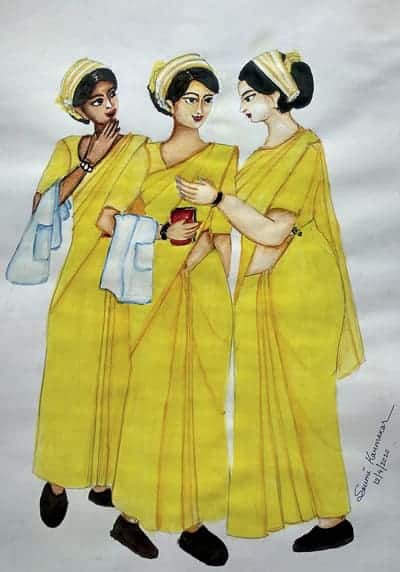
Starched fluorescent-yellow cotton pleated saree and a fake khopa
© Image by artist Soumi Karmakar
One thing that crosses everyone’s mind when talking about nurses, is their uniform. Most people would instantly use their imagination and put us in one. As student nurse-midwives, we had to wear a starched fluorescent-yellow cotton saree, with a cloth fluorescent frill around the fake khopa (hair bun), which was stuffed with scrunchies neatly tucked into a black net, and finally a white-and-yellow band (like a nurse’s cap) to be worn on the head. While my friend with inch-long hair struggled to create a khopa and ensure that it wouldn’t fall off her head while giving care, we were convinced that our portrayal had to go through this test to make us look dignified in a world that often drew parallels between our profession and prostitution. A lot was riding on us to look ‘dignified’ as per societal standards!
While modernisation affects almost everything around us, we are still considered un-marriageable because we have seen too much at a very early age. For instance, when I was 19, the experience of holding the penis of a conscious middle-aged man in the urology OT under the doctor’s order while he performed a minor surgery would probably qualify as a ‘seen-too-much’ scenario. Was I prepared for it? No! The patient had an erection when he walked away from that room, and I was horrified! But I was doing my duty. We are required to see and touch naked bodies in the process of care giving, and male bodies bring us an additional dose of shame. Doctors touch these bodies too, but they are not imagined in obscene clothing – rather, they are put on a pedestal equal to God. Search for nurses and their uniforms dominate porn websites. While the popular media still gathered laughter from the classic ‘short skirt’ jokes, we lived through the consequences while appearing dignified in our starched cotton pre-pleated florescent-yellow saree.
It does not take long to realise that we were training to be a subordinate to doctors, standing around a patient, despite learning from many of the same books and spending more practical hours in the wards in some cases. We do not have to be told that a medical student gets the first right to practise – it’s understood, ingrained, makes us step aside and patiently wait for our turn to assist a birth. Thankfully my college ensured that we all got enough practice, which is a rare scenario in India.
Thousands of nurse-midwives pass their crucial training years by observing, not doing. It’s difficult to justify the need for training when our professional role is considered an extension of every woman’s household chores. Medical students started to order us around while we were all still students, and some level of task shifting also begun around the same time. One is slowly conditioned into believing: ‘I must have done something right, why else would a “doctor’” consider me worthy of drawing blood, doing the doctor’s job!’. Meanwhile, the rest of the world completes yet another day of doctor worshipping.
The destructive belly button and the protective safety pin!
Sexual harassment was another of those challenges we were slowing getting used to, denying it in every possible way to maintain our dignity. It took a bit of self- reflection every time we were harassed because we did not want to be blamed for bringing it upon us. We were exposed to the most unusual circumstances that did not come with a guidebook to help us process our emotions and kept burdening us from a very early age.
When the ward boys slipped in pictures of white couples having sex in all kinds of positions in our inventory cupboard in hospital, our worry was that no one should find out. When India celebrated the popular festival of Holi with colours, it was deemed necessary for us to stay inside our hostel throughout the festival, for our own safety. No one would be allowed to go out, because the men outside may touch us in the pretence of playing Holi. But, hey, we did get to watch 10 movies back to back for three days in a hostel where plug points were blocked with sticks and television was not allowed. What other electronic goods do young girls need when you have a functioning light and fan in the room?! So, when the resident doctor sent me dirty messages (which he later claimed was done by his drunk doctor friend!), I considered it better to cover my waist, rather than being blamed for it.
The safety pin is a woman’s ultimate protector! Every woman’s best friend – if she wants to stay safe – it wards off evil eyes in our testosterone-laden country. It helps you cover that nasty belly button, the origin of all our miseries! So, as a concerned friend, we would always point out any amount of exposed waist to our fellow student. One exposed belly button has the power to render all the girls and women in these magnanimous professions ‘characterless’! Our sarees were an antidote to this, which I think certified our body’s purity while still screaming for attention.
I see the light!
We were conditioned to accept all these atrocities by the time we completed our education. As I moved from one struggle to another, the difference between professional and personal blurred. With an understanding of the root of these challenges, I realised the changes had to be made at every level including at the highest level of policy making, while the conditioning needed to be reversed and a lot had to be corrected on a much larger scale.
So, I relentlessly tried to utilise every opportunity by speaking up, writing and spreading awareness, sometimes at a tremendous personal cost to me. It involved losing jobs, when a research role for a nurse-midwife is unheard of. My professional activities organically moulded into addressing these struggles and atrocities. My career pathway is a testament to it rather than a liberty of choice. I drew a lot of criticism from very senior members of my own profession for being outspoken. I still do! I just chose not to turn away, and address them in the little way I can. We all have to stop considering that is a choice for the sake of our professions, so that the next generation of midwives and nurses feel inspired and aspire to be one of us.
In the last two years, I have focused on what I felt would have a greater impact on women and nurse-midwives’ lives. Youth has tremendous potential, which our planners and policy makers tend to oversee. The young are also at a stage where they are going through the conditioning and rampant demotivation, which I explained.
I strongly believe that we need to start early and strengthen the next generation of nurse-midwives who are currently in their pre-service education. Over the last two years I have addressed thousands of midwifery and nursing students in England, Switzerland, Wales, Iceland, the United States and in various states of India. I have talked about the gender-based challenges, the discrimination and the need for them to be strong and believe in standing against any atrocities targeted at them and at the women they are caring for.
I have also spoken about the policy changes required, drawing light on the issues of nurse-midwives at many high-level consultations including to the Government of India, the 72nd World Health Assembly representing the International Confederation of Midwives as a Young Midwifery Leader, with UNICEF and the Government of Zambia. I have noticed very little change in terms of involvement of nurse-midwives in policy making in India. Globally, policy makers are at least considering including us in health policy making but it’s not enough. When these mostly male doctor policy makers tell me that they agree but don’t know where to find these midwives and nurses to include them in policy making, I respectfully remind them that we are not dinosaurs! They just need to look around. When I see shame in their eyes, I see the light! This light shines brightest in the eyes of young midwives and nurses when they tell me that they were inspired to see my post on Facebook or hear my speech and they want to pursue research, or are trying to enrol in a PhD, or have made changes in their clinical practice area, or hospital policies, or have stood against their professors who did not stand for them. I see the light!
Women suffer from the lack of respect and dignity throughout their lives, for being at the bottom of a social hierarchy. Midwives and nurses, mostly women, suffer through the lack of respect and dignity while being in professions which are deemed noble, while these professionals are not appreciated for their contribution, for being at the bottom of the medical hierarchy. Political activism wasn’t a choice for me under these circumstances – that would mean I have a choice to stand down and not speak about the issues and challenges that thousands like me are going through. My political activism for midwifery, nursing and women is a necessity and a reminder for all the midwives and nurses who want to see changes, so that we can reach the end of the tunnel within our lifetime, where I see the light! TPM