








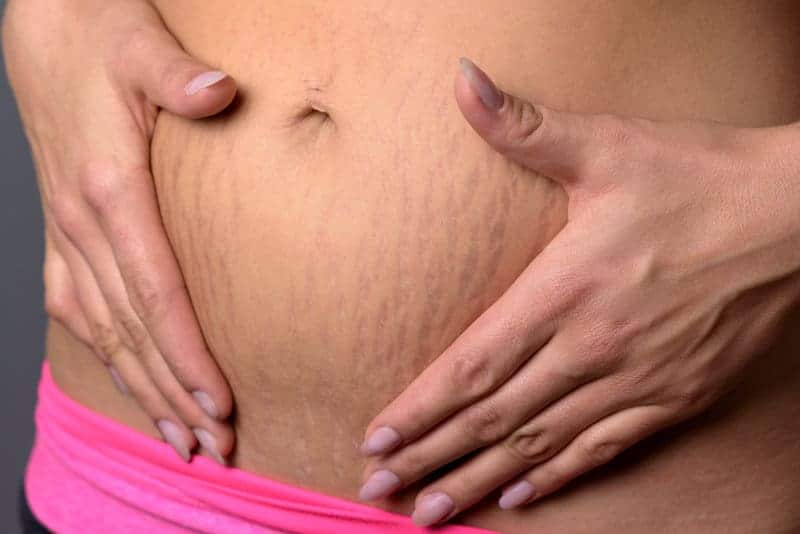
Understanding stretch marks
Hannah Tizard – Research Midwife, Editor-in-Chief of The Student Midwife Journal, Project lead All4Birth.com, Founder Bloodtobaby.com
Published in The Practising Midwife Volume 23 Issue 6 June 2020 https://doi.org/10.55975/KWAX3623
Introduction
How do stretch marks develop?
The skin on the abdomen works hard to adapt during pregnancy in order to accommodate the growing fetus. Stretch marks usually first appear around the sixth and seventh month of pregnancy1 but have been reported before 24 weeks’ gestation.2 Stretch marks affect 50% to 90% of women.3 Though not a health issue they can affect women in different ways, for example, by causing stress or becoming an aesthetic or cosmetic concern.4
The epidermis of the skin grows along with the baby and the mother’s fat deposits, which are gradually forming as well. Various hormones prepare the dermis – the layer of skin where the connective tissue is located – so that it can stretch more easily. When the dermis can no longer stretch any further, it tears as much as necessary to give the body enough space. During pregnancy, these tears are visible as red ‘stripes’. After a few months, they grow paler and are visible as thin white stripes – scars under the skin.
Why women get stretch marks is not yet well understood, however, possibilities include mechanical stretching of the skin; hormonal changes in pregnancy; genetic predisposition; and family history of stretch marks.5 Other factors may be at play too, but findings are inconsistent across research studies.
Solutions?
Topical treatments are popular, however, no one solution has been shown to work for everyone. Some women report success with regular use of creams or oils massaged into the skin – the stomach area, the breasts or the buttocks, which may help the skin to become more elastic.6 It is beneficial to start this regime before stretch marks appearing.7,8
Other tips include using good sun protection – this does not prevent stretch marks but can improve the overall health of your skin. Sun exposure can break down the skin collagen fibres possibly contributing to your chance of getting stretch marks.9
Exercise improves circulation and prevents inflammation. Exercising regularly strengthens the connective tissue, which can help to prevent stretch marks but certainly won’t make them go away.10
Like massages, contrasting showers of hot and cold water increase blood flow and improve circulation to the skin.
A healthy diet with plenty of fresh fruit, vegetables and liquids (water or juices diluted with water) will also ensure that the skin has an optimal supply of nutrients.
Medical products like Tretinoin, often called by its brand name Retin-A, can cause side effects, such as redness and peeling. Pregnant or breastfeeding women should not use this drug.11 TPM
Summary
Whether pregnant or not, the majority of men and women will get stretch marks at some point in their life. While societal pressure may imbue negative feelings about our appearance, we advocate acceptance of your stripes and using a topical treatment for comfort is probably the most empowering method of dealing with them.
References
- McKenzie A. Skin disorders in pregnancy. Obstet Gynecol Surv. 1972;27(1):22-24.
- Chang A, Agredano Y, Kimball A. Risk factors associated with striae gravidarum. J Am Acad Dermatol. 2004;51(6):881-885.
- Brennan M, Young G, Devane D. Topical preparations for preventing stretch marks in pregnancy. Cochrane Database of Systematic Reviews. 2012.
- Brennan M, Clarke M, Newell J, Devane D. Prevention of striae gravidarum: study protocol for a pilot randomised controlled trial. Trials. 2018;19(1).
- Giuliani M, Orsini G, Romano L, Cifone M. Skin Laxity and Striae Distansae: a mini-review. Aesthetic Medicine. 2016;2(2). http://wwww.aaaam.pl/upload/201905/AE_2_2016.pdf#page=35. Accessed April 18, 2020.
- Bogdan C, Iurian S, Tomuta I, Maldovan M. Improvement of skin condition in striae distensae: development, characterization and clinical efficacy of a cosmetic product containing Punica granatum seed oil and Croton lechleri resin extract. Drug Design Development and Therapy. 2017;11.
- Elsaie M, Baumann L, Elsaaiee L. Striae Distensae (Stretch Marks) and Different Modalities of Therapy. Dermatologic Surgery. 2009;35(4):563-573. doi:10.1111/j.1524-4725.2009.
- Wollina U, Goldman A. Management of stretch marks (with a focus on striae rubrae). J Cutan Aesthet Surg. 2017;10(3):124
- Schwartz E, Cruickshank F, Christensen C, Perlish J, Lebwohl M. Collagen alternations in chronically sun-damaged human skin. Photochem Photobiol. 1993;58(6):841-844.
- Boldt A. Does Exercise Make Stretch Marks Go Away? | Livestrong.com. LIVESTRONG.COM. https://www.livestrong.com/article/383935-does-exercise-make-stretch-marks-go-away/. Published 2020. Accessed April 18, 2020
- Ud-Din S, McGeorge D, Bayat A. Topical management of striae distensae (stretch marks): prevention and therapy of striae rubrae and albae. Journal of the European Academy of Dermatology and Venereology. 2015;30(2):211-222.