









How-to research series: 2. How to get hold of evidence for free and decide if it’s any use
Dr Juliet Rayment – Qualitative Research Consultant and Honorary Research Fellow, Centre for Maternal and Child Health Research, City, University of London
Website: www.julietrayment.co.uk
Twitter: @julietrayment
Introduction
Last month I started off the How-to Research series with some tips on searching for evidence. This month, I’m dealing with the ‘what next?’ – when you’ve identified articles that you think might be helpful for you, how do you get to read them and work out if they’re worth your attention?
The majority of academic articles are held behind a publisher’s paywall, asking for £20-40 per article or an institutional subscription to read them. Some of you will have access to these subscriptions through your Trust or another employer. If you’re not sure, librarians are probably the most willingly helpful people I know, so just email your library inquiry desk and ask.
Over recent decades, publishers have also offered Open Access, whereby authors pay a fee of anything up to £4700 per article for it to appear paywall-free for anyone to read. Obviously this isn’t possible for all authors, so you will often end up, frustratingly, stuck behind pages that look like this:
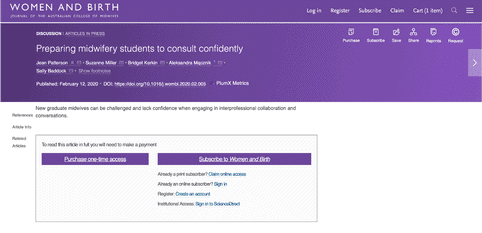
The movement for open access research is growing, making a moral argument that knowledge should be available to anyone. This has lead to the development of more and more online resources that will give you access to scientific paper without paying out.
Here are some ways you can get hold of that article you need without an institutional subscription:
- If you’re a member of a public library (and if you’re not, just join. It’s free!), you should get into ‘Access to Research’ with your library log in.
- Medrxiv is a repository for preprints – those are articles that have been submitted but not yet accepted, by mainstream journals. With it often taking a year or more from submission of an article to its publication, Medrxiv was set up to make it quicker for research to be available. This does mean that many of the articles, especially the preprints, have not yet been through a peer-review process. To try and provide some basic reassurance, authors submitting to Medrxiv must declare their study’s ethical approval and consent processes, and funding before they can post, and submissions are screened by a clinical scientist and a clinical editor.
- Many UK universities upload copies of all articles published by their staff in a repository. Check where the author works, Google the name of the university and ‘repository’ and it should be the first hit. Try searching the article’s title there.
- ResearchGate and Academia.edu are social media sites for academics. Many academics have profiles there (here’s mine), which list their published papers. Many will have uploaded open access versions of their papers, which you can download directly. You have to sign up to get access, but it’s free and you don’t need to be a researcher.
- EThOS is the British Library’s collection of all the PhD thesis produced in the UK. You can search by the name of the author or by keyword and download copies of most of them. Warning! PhD theses are LONG and many may have been published as more digestible articles elsewhere.
- Core is a central repository of published articles, bringing together sources from university repositories and others such as ResearchGate. It’s really easy to search and find what you need and it’s free to use.
- If all else fails, just email the author. People do want others to read their work and it’s always worth a go.
How do you know if an article is any good?
 So you’ve read through an article and it’s given you some useful information. How do you know if it’s reliable? There are a few ways you can assess the quality of the work you’re reading. Just like last month, I’m not going to show you how to do a full quality appraisal here – if you want to know more about that take a look at the BMJ series ‘How to read a paper’. The article on qualitative research is, ironically, behind the BMJ paywall; but you can get a full text version of it on ResearchGate. Also, for appraising qualitative papers, take a look at the CASP checklists and the information on the Centre for Evidence-based Medicine at Oxford University.
So, short of a full quality appraisal, what simple steps can you make to check what you’re reading is worth your attention? Here’s a short list focussing on qualitative evidence, with thanks to ResearchConnections and Dr Sarah Snelling for some ideas:
General considerations
Check out the journal, authors, institution. Are these all ‘real’?
Beware of fake journals.
Is the journal peer reviewed?
Peer reviewed work, including articles, books and government reports, have already been evaluated by other experienced researchers. Most journal articles, books and government reports have gone through a peer review process. This can give you some reassurance of its validity.
Who funded this project?
Is there a potential conflict of interest there? Might the funder have been looking for particular results?
Make sure references check out
Are they legitimate journals, are they recent and mainly primary literature? If you want to be sure, you can check they contain the information the manuscript says they contain.
Sample and methods
Does the paper include a description of the population they were interested in?
Is that population useful to you? It is usually not appropriate to assume that the experiences of one group of people will be the same as another – experiences of maternity services, for example, will differ because of where women live, their local health services, their ethnicity, age, sexual orientation, medical needs and many other reasons.
Do they describe how many people and who they spoke to?
This information can help you decide if the people they spoke to are likely to be representative of the population they’re interested in. For example, you might be suspicious if they say they wanted to hear from ‘all’ women, or a very general population, but failed to speak to a range of people whose experiences might have been affected by their ethnicity, age, sexual orientation or medical needs etc.
Purposive sampling (that is approaching particular participants, rather than randomly selecting them) might be completely appropriate in some cases – for example if a researcher was interested in the experiences of induction of labour of women from minority ethnic communities in a particular area. However, in other cases, you would want to keep an eye on the impact that might have on the findings. For example, open surveys on controversial topics are most likely to represent those with strong opinions.
Do the researchers describe exactly what they did?
Could you do this project again, based on what they describe, including the analysis? Be cautious about articles that don’t give a thorough description of the methods. In longitudinal studies (those carried out over a long period of time), did many people drop out? What impact could that have had on the findings?
Do the methods seem appropriate for the questions they’re trying to answer?
This is a complicated question to answer, but at a basic level, qualitative research is great for answering the ‘how?’ or ‘why?’ questions, but not much use to find out ‘how many?’. Quantitative studies will help to tell you ‘how many?’ and ‘when?’, but not ‘why or how’?’ in much detail. You’d be surprised how many papers try to use the wrong methods to answer the right question.
Do qualitative articles consider the relationships between the researchers and the participants and the impact of that on their findings?
Participants may well change their behaviour or their answers because they are a part of the study. A good example of this might be if a midwife-researcher interviews her own colleagues about their practice. Participants may try give the answers they think the researcher wants to hear or portray themselves in a positive light. Did the researchers do anything to try and prevent this? Or at least reflect on it when they interpreted the findings?
Results
Are the results clearly presented?
Were any results left out that should have been there based on methods or aims? Why?
Are the limitations of the study recognised and stated?
Phew! Are you still with me?
Finally
In the end, getting started with reading qualitative papers means keeping a healthy scepticism, checking the basics, exercising caution about using findings and never assuming that what you read is ‘fact’.
A strong gut feeling about things like an appropriate sample size and methods are one of the useful skills that expert qualitative researchers develop over time, with training and experience. That’s why they get hired. It’s hard to get this quickly, but even without any experience you can learn to spot alarm bells. So go and find some articles on your favourite topics, read them and think about the questions above. If you want to go a step further try out a CASP checklist.
I’d love to hear about what you’ve been reading and what you think of them. Also, did you find any other sources of free articles? If so, please share them in the comments so others can use them too.
Next month will be the first of the next phase of blogs on how to start doing your own qualitative research
Stay well.
Juliet 🙂

You can contact Juliet via:
Website: www.julietrayment.co.uk
Twitter: @julietrayment

