









Changing the Narrative: Do Midwives Need Culturally Sensitive Education about Female Genital Cutting?
Alicia Burnett – Third Year Student Midwife, University of West London
Published in The Student Midwife Volume 3 Issue 4 October 2020
Summary
In this two-part series, Lieqa Mahmood and Alicia Burnett draw from an interview with Female Genital Cutting (FGC)* survivor** and activist Hibo Wardere to raise awareness of FGC. In this instalment, Alicia explores the anatomy of the vulva, pretexts underpinning FGC and arguments for culturally sensitive FGC midwifery education. The Student Midwife acknowledges the limitations of exploring this complex subject in a two-part series and refers readers to the additional reading. We also extend our gratitude to Hibo for her courage, commitment and time.
*Female Genital Cutting is used in lieu of Female Genital Mutilation (FGM)
**Individuals affected by FGC are referred to as survivors rather than victims
Introduction
FGC involves alteration of the external female genitalia (vulva); specifically the clitoris, labia minora and labia majora, for non-medical purposes.1,2 It is a form of child abuse and violence against women, having been made illegal in the United Kingdom (UK) since the passing of the Prohibition of Female Circumcision Act 1985.1-3 As of July 2020, there were around 103,000 FGC survivors aged 15-49 in England and Wales.3 Cultural sensitivity delineates respect for the cultural identities of others, and culturally sensitive healthcare makes individuals feel valued, comfortable and promotes trusting client-professional partnerships.4 Midwifery education must prepare students and midwives to provide culturally sensitive care for women affected by FGC, since 49% of cases are identified by midwifery services.1,3
Female genital anatomy
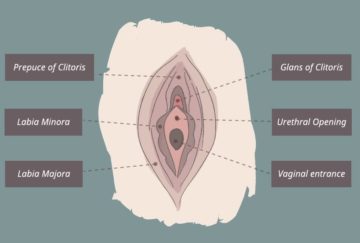
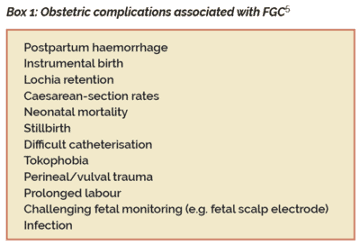
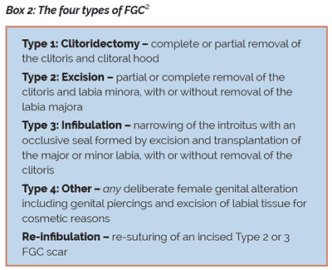
The potential obstetric complications of FGC (see Box 1) depend upon the type of FGC (see Box 2). Midwifery education must provide sound knowledge of anatomy and physiology,3 moreover, midwives must receive de-infibulation (surgical division of the tissue sealing the vagina found in Type 3 FGC) training.5 The labia majora are bilateral folds of fibrous and fatty tissue, which extend anteriorly to form the mons pubis and the anterior labial commissure directly beneath it.6,7 The labia majora terminate directly above the perineum and protect the delicate structures of the inner vulva.7

The labia minora are smaller, highly innervated, bilateral folds of tissue, which contain secretory glands and enhance sexual arousal and pleasure.6 They extend anteriorly to form the clitoral hood (prepuce) and clitoral frenulum, terminating posteriorly to form the fourchette.7 The clitoris, a complex, highly sensitive structure composed of erectile tissue, is protected by the clitoral hood and plays a vital role in sexual pleasure.6 The vulval vestibule contains the clitoral bulbs, urethral meatus, vaginal orifice (introitus) and openings of the Bartholin’s glands.6,7

A cultural legacy
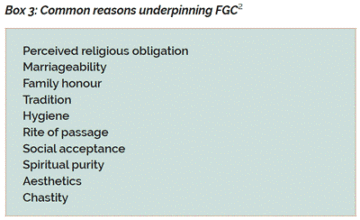
FGC is a deeply embedded cultural practice in at least 30 countries and is practised for reasons (see Box 3) that do not supersede its unlawfulness in the UK.2 Popular misconceptions are that FGC is restricted to African, Asian and Middle-Eastern countries and that FGC committed in the UK is solely because of migration from these areas.8 However, Hibo Wardere explained to The Student Midwife that FGC also occurs in South American, European, North American and Australian communities (page 9).2 To prevent overlooking at-risk women, midwifery education must accurately reflect FGC’s geographical prevalence and guidance that all women should receive FGC screening at booking appointments – irrespective of their country of origin.5
FGC screening based upon country of origin is culturally insensitive and incongruous with individualised care-planning, because not all individuals from endemic countries undergo FGC and women can feel stigmatised and racially profiled.9,10 Midwives are responsible for referring FGC survivors to specialist FGC obstetricians and midwives.5,9 However, concerns about appearing racist can deter midwives from completing FGC screening or referrals.2 Omitting FGC screening impairs survivors’ access to support services and contributes to poorer health outcomes, so as a matter of safety, the needs of women and their families must be prioritised above professionals’ discomfort.2,10
Legislation
Extra-territorial FGC (undergoing, assisting or performing FGC outside the UK) became an offence through the Serious Crime Act 2015.10 Although legislature and clinical guidance prohibits female genital surgery without clinical indication, confusion surrounds the designation of female genital cosmetic surgery as Type 4 FGC.11 Similar uncertainty exists around the legality of re-infibulation although legislation is unambiguous about its illegality in the UK.2 In England and Wales, educators should outline midwives’ statutory obligation to report FGC offences against individuals <18 years of age to the police,2 and document all cases of FGC in maternity records and discharge summaries.12
“A conversation, not an interrogation”
“Any disclosure may be the first time that a woman has ever discussed her FGM with anyone”,10 so Hibo recommends that discussions about FGC should be “a conversation, not an interrogation” to facilitate open dialogue and avoid alienating individuals or the wider community: “Women attend our FGM clinic and then go back to their community and tell the other women about it.” Moreover, Hibo highlights that some women and families view FGC as a culturally acceptable social norm, rather than a gender-based act of violence or human rights violation, so professionals must be non-disparaging and sensitive to prevent undermining attempts to forge trusting, midwife-woman partnerships.2
Although midwives must be transparent about the illegality of FGC in their professional reporting and recording duties, they should be trained to do this sensitively – ideally with input from FGC survivors and community leaders.10 Midwives should reassure FGC survivors aged ≥18 that a referral to social services or the police will not be automatically made. If the descriptors ‘victim’ or ‘Female Genital Mutilation’ cause offence, culturally acceptable alternatives should be negotiated to avoid the perception that a judgement is being made against their cultural identity.10 Hibo emphasises that “using the right word for FGC is so important. You must ask the woman directly if she has been cut and use her language to specify what you are asking. Otherwise you will put her guard up and she will think her culture is being attacked.” Midwifery educators must counsel students to avoid using Eurocentric descriptors of FGC,2 and to use culture-specific terminology from women’s country of origin (page 72)2 to avoid confusion or misinterpretation. Registered midwives should model cultural safety and promotion of emotional wellbeing by utilising professional interpreting services in lieu of family members – the woman’s privacy is paramount,9 and family members may have been involved in the trauma.10 Hibo further emphasises using interpreting family members as potentially damaging and culturally insensitive, as discussing FGC with family members can be taboo.
Additional reading |
|
Conclusion
Sound knowledge of FGC’s obstetric, anatomical and legal implications; culturally appropriate language; individualised survivor-centred care and sensitive, non-judgemental approaches are key to improving the midwifery care received by FGC survivors. Midwifery educators must commit to actualising these developments through the provision of culturally sensitive midwifery education about FGC. TSM
References
- NHS Digital. Female Genital Mutilation (FGM) Enhanced Dataset: April 2019 to March 2020, England, experimental statistics, Annual Report. https://files.digital.nhs.uk/0B/7A41CB/Female%20Genital%20Mutilation%20%28FGM%29%20-%20April%202019%20to%20March%202020%20-%20Report.pdf. Published July 23, 2020. Accessed August 11, 2020.
- Department for Education, Department of Health and Social Care, Home Office. Multi-agency statutory guidance on female genital mutilation. https://assets.publishing.service.gov.uk/government/uploads/system/uploads/attachment_data/file/905125/6-1914-HO-Multi_Agency_Statutory_Guidance_on_FGM__-_MASTER_V7_-_FINAL__July_2020.pdf. Updated July 30, 2020. Accessed August 11, 2020.
- Nursing and Midwifery Council (NMC). Standards for pre-registration midwifery programmes: realising professionalism: standards for education and training. https://www.nmc.org.uk/globalassets/sitedocuments/standards/standards-for-pre-registration-midwifery-programmes.pdf. Published November 18, 2019. Accessed August 11, 2020.
- Tucker C, Marsiske, M, Rice K, Jones J, Herman K. Patient-Centered Culturally Sensitive Health Care: Model Testing and Refinement. Health Psychol. 2011;30(3):342-350.
- Royal College of Obstetricians and Gynaecologists (RCOG). Female Genital Mutilation and its Management. https://www.rcog.org.uk/globalassets/documents/guidelines/gtg-53-fgm.pdf. Published July, 2015. Accessed: August 15, 2020.
- Coad J, Pedley K, Dunstall M. Anatomy and physiology for midwives. 4th ed. London: Elsevier; 2019.
- Rankin J. The female reproductive system. In: Rankin J, eds. Physiology in childbearing: with anatomy and related biosciences. 4th ed. London: Elsevier; 2017:33-42.
- Johnsdotter S, Mestre, R. Female genital mutilation in Europe: Public discourse versus empirical evidence. Int J Law Crime Justice. 2017;15:14-23.
- Nursing and Midwifery Council (NMC). Standards of proficiency for midwives. https://www.nmc.org.uk/standards/standards-for-midwives/standards-of-proficiency-for-midwives/. Published November 18, 2019. Accessed August 11, 2020.
- Department of Health. Female Genital Mutilation Risk and Safeguarding: Guidance for professionals. https://assets.publishing.service.gov.uk/government/uploads/system/uploads/attachment_data/file/525390/FGM_safeguarding_report_A.pdf. Published May, 2016. Accessed August 16, 2020.
- Dyer C. FGM: surgeons who do cosmetic genital surgery may risk prosecution. BMJ. 2019;367:l6094.
- NHS England. Female Genital Mutilation Prevention Programme: Requirements for NHS staff. https://www.england.nhs.uk/2014/12/fgm-prevention/. Published December 8, 2014. Accessed August 12, 2020.


