








Widening Access: Is There Space for Men in Midwifery?
Samuel Todd – Assistant Lecturer in Midwifery and Professional Midwifery Advocate, Birmingham City University
Usaama Ssewankambo – Fourth-year Student Midwife, Lira University, Uganda
Published in The Student Midwife Volume 4 Issue 2 April 2021
Summary
Historically, midwifery has been a female-dominated profession,1 and there is ongoing debate about whether men should be allowed into birthing spaces, and whether male midwives are what birthing people and families want. However, ‘midwife’ as a professional title means ‘with woman’ rather than ‘women with woman’,2 therefore, we should examine whether men experience gender discrimination when studying to become midwives or working in midwifery settings. Sam Todd and student midwife Usaama Ssewankambo discuss what inspired them to become midwives and strategies to make midwifery a more accessible career option for men.
Usaama Ssewankambo: ‘I found it easy to fit in’
I have always wanted to be a healthcare professional, but the thought of being a midwife had never crossed my mind until I completed high school; when my favourite biology teacher and stepmother influenced me to start thinking about a career as a midwife. Immediately after my final exams, my teacher, who doubled as my school’s career guidance counsellor, spoke to me about my career plans and informed me about a new opportunity to study midwifery at Lira University in Uganda. The midwifery programme was open to women and men, and there was the prospect of obtaining a state scholarship to cover the cost of the programme if you achieved the stipulated grades. Prior to this, my stepmother, who is a practising nurse-midwife, had spoken to me about the same opportunity. She believed in my academic ability and was sure I would get the grades to secure a state scholarship for the midwifery programme – and she was right! Despite their encouragement, I was worried about how others would react to my decision to become a midwife. I also kept asking myself: ‘How could a man be a midwife?’ Initially, my friends and some of my family members struggled to comprehend why I chose midwifery. Some of them poked fun at the idea and insisted upon referring to me as a ‘mid-man’ or ‘mid-husband’. Nonetheless, I decided to give it a shot because it was a bachelor’s degree programme. Traditionally, trainee nurses and midwives in Uganda study at certificate or diploma level, so completing a bachelor’s degree would give me a competitive edge in the job market. However, in other countries where bachelor’s degrees are common midwifery qualifications, the prospect of a bachelor’s degree programme alone is unlikely to be enough to attract male applicants.
 Unlike Sam, who was the first male to undertake and complete the BSc (Hons) in midwifery at Birmingham City University, I found it easy to fit in when I started my midwifery training because there were quite a few other men on the programme – almost one third of my class were male. My female colleagues were very friendly and welcoming and I was recognised and respected as their colleague, rather than being mistaken for a visitor or somebody’s husband!3 There is evidence of sexist discrimination towards male students, including lecturers telling students that men should not be midwives because they know nothing about childbearing or women.3 Although I have only met supportive midwives, midwifery professors and students, this is not the experience of every male student, and universities must have easy, accessible systems for reporting gender-based discrimination. Most clients are happy for me to care for them, but occasionally my presence causes awkwardness. Many women and families refuse to refer to me as a trainee midwife and call me a ‘doctor’ instead, because using this misnomer is presumably more comfortable than accepting my identity as a male student midwife. Even though I am proud to be a student midwife, I do not correct people when they refer to me as a doctor, to prevent exacerbating their discomfort. Whereas these interactions do not have a negative impact upon me personally, they could be de-moralising for other male students. Therefore, universities and practice educators should prepare male students to navigate similar scenarios. Male students and midwives can be received with apprehension in maternity settings.1 I anticipate that I will be rejected by some women and female colleagues. Nonetheless, I respect women’s preference to be cared for by female midwives, because I have been taught that midwifery is all about empowering women to make their own decisions and respecting them. Furthermore, women and birthing people have the right to refuse care or treatment from any healthcare professional.4 Midwives and educators can normalise the concept of men being midwives by setting the expectation that women may be cared for by male students if this aligns with their personal preferences.
Samuel Todd: ‘midwifery should be viewed as a genderless profession’
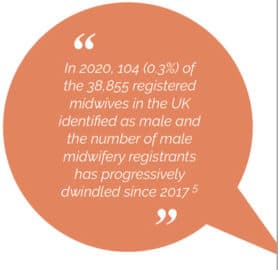
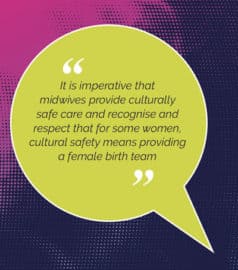 My mother and younger brother were probably the biggest influence upon my decision to become a midwife. During my mother’s pregnancy with my younger brother, she developed pre-eclampsia and at 32 weeks’ gestation, following a series of eclamptic seizures, my younger brother was born via emergency caesarean section. These events increased my awareness of the complications women can experience during pregnancy and prompted me to explore midwifery as a career. My ambition was fully supported by my mother, and although encouragement from family and friends increases male applicants’ likelihood of applying for midwifery training, I advise other men not to let societal views of what a midwife ‘should be’ affect their decision to explore midwifery. Midwifery should be viewed as a genderless profession, however, as Usaama mentioned earlier, it is imperative that midwives provide culturally safe care and recognise and respect that for some women, cultural safety means providing a female birth team. In 2020, 104 (0.3%) of the 38,855 registered midwives in the UK identified as male and the number of male midwifery registrants has progressively dwindled since 20175; this under-representation of men in the UK’s midwifery workforce is arguably a deterrent for prospective male applicants. There is also evidence that non-inclusive learning environments impair under-represented groups’ sense of belonging, attainment and retention at higher education institutions (HEIs).6,7 To encourage men to envision themselves as aspiring midwives and academics, HEIs should integrate men into their academies and prospectuses to make their institutions visibly inclusive. HEIs should also look at how midwifery programmes are promoted to increase the number of male applicants. Furthermore, common sources of information about midwifery careers such as the NHS Health Careers and Universities and Colleges Admissions Service (UCAS) websites could normalise the existence of male midwives by referring to them in their resources.
 Despite the scarcity of UK-based male midwives, career prospects for male midwives are excellent. Since qualifying in 2012, I have worked in clinical and academic positions including being a rotational midwife, Band 7 Homebirth Team Leader, Band 7 Sign Up to Safety Maternity Lead and Assistant Lecturer. I have noticed a small increase in men pursuing midwifery within my region and hope that male midwives such as myself serve as role models and examples of what men wishing to pursue midwifery can achieve. Despite all these accomplishments, the most fulfilling element of my job is being able to support women and birthing people during childbirth. Having supported women in all birth settings, working within a homebirth team has transformed my practice and perspective the most – there is no greater achievement than being welcomed into a family’s home and supporting a woman in her choices to have a physiologically and psychologically safe birth. Anecdotally, many female student midwives pursue a career in midwifery due to their personal experiences of pregnancy and childbirth, however, research is required to understand whether witnessing childbirth or becoming a father influences men’s decision to consider midwifery as a career option.
Conclusion
 Men can be deterred from entering midwifery for numerous reasons including a lack of support from friends and family, sexist discrimination from midwives, peers and educators and a lack of acceptance from birthing people and their families. But as Usaama, Sam and the 0.3% of successful male UK midwifery registrants demonstrate,4 some men are interested in entering the midwifery profession, successfully complete midwifery training and have note-worthy careers. In the interests of widening men’s access to midwifery, organisations responsible for healthcare education should seek input from aspiring and registered male midwives to determine how they can be supported to access and complete midwifery training. Additionally, further research must be conducted into why the UK’s number of registered male midwives has declined in recent years as a way to promote diversity within the modern midwifery workforce. TSM
References
- Morton E. How Man-Midwives Armed With Rusty Forceps Shook Up Obstetrics: Men in the delivery room were not well received. Atlas Obscura website. https://www.atlasobscura.com/articles/how-man-midwives-armed-with-rusty-forceps-shook-up-obstetrics. Published June 29, 2016. Accessed December 27, 2020.
- Lewis L. Do men make good midwives? Nurses.co.uk. https://www.nurses.co.uk/nursing/blog/do-men-make-good-midwives/. Published May 20, 2019. Accessed December 27, 2019.
- Johnson S. ‘My tutor said it wasn’t a job for a man’: my journey from roofer to midwife. The Guardian. https://www.theguardian.com/society/2019/may/09/tutor-not-job-man-roofer-male-midwife-nhs. Published May 9, 2019. Accessed December 28, 2020.
- International Confederation of Midwives. Essential competencies for midwifery practice 2018 update. https://www.internationalmidwives.org/assets/files/general-files/2019/02/icm-competencies_english_final_jan-2019-update_final-web_v1.0.pdf. Published January 2019. Accessed December 28, 2020.
- Nursing and Midwifery Council. Registration data reports. Mid-year update 1 April-30 September 2020. Permanent register data tables. https://www.nmc.org.uk/about-us/reports-and-accounts/registration-statistics/. Published September 2020. Accessed December 28, 2020.
- Universities UK and National Union of Students. Black, Asian and minority ethnic student attainment at UK universities: #closingthegap. https://www.universitiesuk.ac.uk/policy-and-analysis/reports/Documents/2019/bame-student-attainment-uk-universities-closing-the-gap.pdf. Published May 2019. Accessed December 27, 2020.
- Universities UK. Tackling racial harassment in higher education. https://www.universitiesuk.ac.uk/policy-and-analysis/reports/Documents/2020/tackling-racial-harassment-in-higher-education.pdf. Published November 2020. Accessed December 27, 2020.

