









Qualifying as a Midwife in Argentina
Raquel Justiniano Gonzales – BS Midwifery, Master’s in Public Health Student
Published in The Practising Midwife Volume 24 Issue 7 July/August 2021 https://doi.org/10.55975/VXNU5378
Summary
It is common for newly qualified midwives to begin our professional practice with insecurity, doubting our capacity and the importance of the role we play in the health system. This often remains the same throughout our careers. Unfortunately, the training we receive is still based on a hegemonic-medical, controlling and interventionist approach. After decades of immersion in this model, there is also distrust in pregnant people themselves of their ability to give birth, or even how, where and with whom. In this article, Raquel Justiniano Gonzalez looks at Argentina’s current midwifery situation and what steps are being taken to achieve progress.
Introduction
To speak about midwifery in Argentina is to recognise its diversity. There are different models and approaches and one of the most prevalent is the hegemonic-medical model. Shortly after graduating as a Bachelor of Midwifery, I began an intense search for information and tools that would complement my professional training to provide comprehensive care as a midwife because – to be honest – I felt insecure. Although it does not have to be this way, it is common for newly qualified midwives to begin our professional practice with insecurity, doubting our capacity and the importance of the role we play in the health system, which often remains the same throughout our careers. Unfortunately, the training we receive is still based on a medical-hegemonic, controlling and interventionist approach and, after decades of immersion in this model, there is also distrust in pregnant people themselves of their ability to give birth, or even how, where and with whom.
Over time, I understood that this model controls our sexual and reproductive processes and interferes in the effective response and mitigation of inequalities in access to healthcare for women and families. Following this model without questioning its actions and repercussions, it is difficult to see more humane and dignified ways of caring for health, which go hand in hand with a growing new scientific evidence. The openness to recognise horizons that we do not yet know is fundamental. A critical analysis of the state of maternal/neonatal health and of sexual and reproductive health and rights in Argentina and globally is vital in order to understand where we are and where we want to go as midwifery professionals. Perhaps this will serve as a motor to continue investigating, discovering and learning from other models of care that could help us apply them within our context.

Midwifery in Argentina
Midwifery in Argentina, as in the rest of the world, is an ancient practice. However, the professionalisation that was developed in a historical and socio-cultural context has its first records in the late 18th and early 19th centuries. As the process of medicalisation of childbirth and the transfer of births to the institutions was installed, the practice of midwives began to be regulated, even before institutional training projects.1,2,3 Midwifery went through great challenges and obstacles linked to the patriarchal system. Midwifery training was considered a practice of the female gender and, in order to access this formal education, it was a requirement to know how to read and write – an unusual skill to have, given that many women back then weren’t allowed to go to school. There were ups and downs in access to formal education. Institutions were often closed to women because medical training was a priority for a specific sector of society. Later, the permission of a legal guardian or husband had to be obtained in order to study.4,5 Thus, midwifery continued for some decades to be practised outside the health system, mainly in vulnerable communities. As a new state-dependent health system was put in place, midwifery became considered as a role to assist the doctor: sometimes paid, many other times unpaid.6 In 1967, Law 17.132 was enacted – and which remains in force – in which the practice of midwifery is configured as a collaborative activity of medicine.* This law limits our practice as collaborators in the care of pregnancies, births and postpartum, and puts doctors responsible in charge of care.
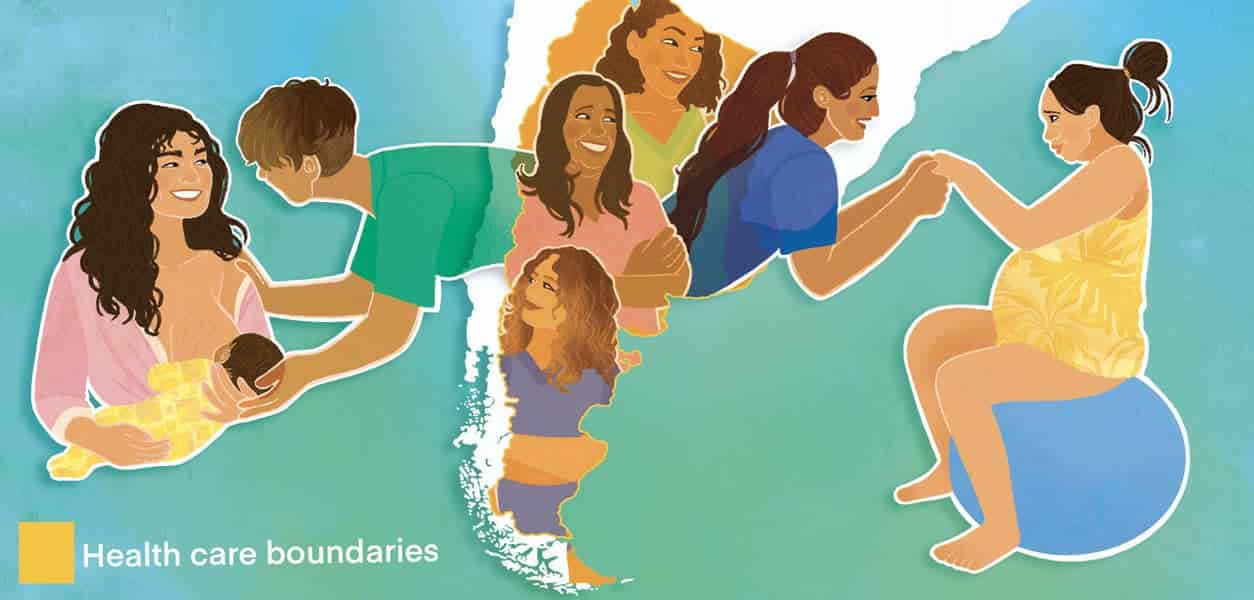
Despite the fact that the law limits the professional practice of midwives, in recent decades our competencies have expanded far beyond attending births. Today, our professional training enables us to provide assistance in: sexual and reproductive cycles from adolescence to menopause; family planning; counselling; sexual education with a focus on rights and gender; prevention of sexually transmitted infections; prenatal and postnatal care; breastfeeding and childcare; research; and administration of health services, among others. These competencies, aligned with the standards of the International Confederation of Midwives (ICM), make us the ideal professionals to cover 87% of the basic sexual and reproductive health services of the population, according to the United Nations Population Fund (UNFPA).7
Advocacy, research and leadership
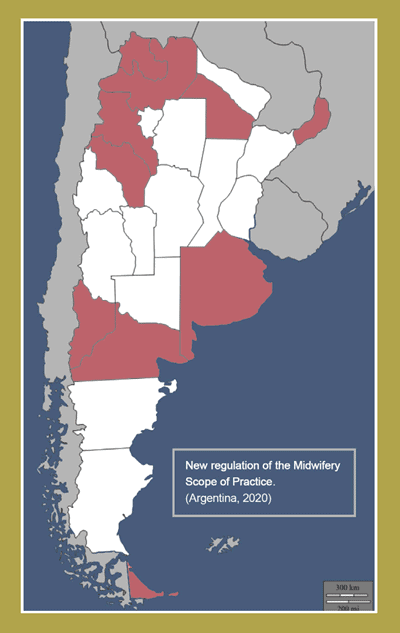
Although our scope of practice is broad, sexual and reproductive health and maternal/perinatal health are areas in which enormous inequalities in access to care are evident, so morbidity and mortality rates have not improved. Professional midwives exercise their expertise within and outside the health system, because of outdated regulations and restrictions in most provinces of the country that limit practice within all our midwifery competencies. Argentina is a federal country that is made up of 24 jurisdictions. Fourteen of them still remain linked to Law 17.132, which has limitations in the professional scope. Thanks to the strong work of midwives on advocacy and leadership, 10 jurisdictions managed to update the law, so that all our scope of practice is contemplated. Various groups and associations are working hard to achieve new national legislation. It is a struggle, following several years of demand for autonomy, for full exercise of the profession to be recognised. In 2019, by unanimous votes, the approval of new legislation was achieved in the Chamber of Deputies. It was expected to pass through the Senate in 2020, but due to the pandemic it was postponed. Unfortunately, the draft legislation lost parliamentary status again in 2021.
This situation slows growth in the midwifery profession and exacerbates the gaps in meeting essential needs in terms of maternal and neonatal health and sexual and reproductive health. With a national enforcement law that contemplates our full scope of practice, midwives throughout the country would have been able to provide comprehensive service to women and families, and thus contribute to improve health outcomes that have been set back due to the pandemic. Our advocacy work in the coming years will have to double efforts. We cannot be discouraged. We need to strengthen leadership and advocacy, and give more support to scientific research in midwifery that can influence changes in public health policies and midwifery practices. What we do and how we organise ourselves will be key in the following years, so we need all the support we can get to be able to achieve this. In May 2020, the College of Midwifery of the Province of Buenos Aires formed a Research and Leadership Committee to plan actions that strengthen these two areas: research and leadership. The objective is that Argentine colleagues as well as those from Latin America participate and coordinate joint actions to strengthen research and leadership. Work is also being carried out to open a new midwifery careers headquarters, since we urgently need to increase the number of midwifes throughout the country. Today there are 13 institutions concentrated in just one sector of the country, so access to education should be a priority.
Midwifery continued for some decades to be practised outside the health system, mainly in vulnerable communities
Conclusion
We believe midwifery can provide more to the community and contribute to the improvement of the sexual and reproductive health and rights of the population. Important milestones have been achieved, but there are still many goals to help change and promote the growth in our profession. TPM
References
- Cowen M. El caso Verónica Pascal: Medicina y mala praxis en la Buenos Aires Rivadaviana. V. Paper presented at: Jornadas de Sociología de la UNLP, December 10-12, 2008, Memoria Académica La Plata, Argentina. http://www.memoria.fahce.unlp.edu.ar/trab_eventos/ev.5971/ev.5971.pdf.
- Gonzalez Leandri R. El Consejo Nacional de Higiene y la consolidación de una elite profesional al servicio del Estado. Argentina, 1880-1900. Anuario de Estudios Americanos. 2004;61(2):1-23.
- Vassallo J. Reflexiones metodológicas sobre la historia de género a partir de la causa de María Ascención Barrientos, por hechicería. Córdoba el Tucumán, siglo XVIII. Coordenadas. Revista de Historia local y regional; Río Cuarto. 2016;3(2):1-22.
- Gonzalez A. ‘La profesión de obstétrica: género y subordinación.’ In: La producción oculta. Mujer y antropología; III Congreso Argentino de Antropología Social. Buenos Aires; Editorial Contrapunto: 1990.
- Cillo A. Entre colegas. Distrito I. Módulo I, Capítulo II. ‘Incumbencias y ejercicio profesional de la obstétrica, una mirada hacia nuestra historia.’ La Plata: Colegio de obstétricas de la Provincia de Buenos Aires; 2004: 27-71.
- Ramacciotti K. y Valobra A. El dilema Nightingale: controversias sobre la profesionalización de la enfermería en Argentina 1949-1967. 2017;37(2):367-387.
- ONU/UNFPA. Las parteras profesionales son clave para mejorar la salud materna y neonatal. www.un.org. https://www.un.org/sustainabledevelopment/es/2017/05/las-parteras-profesionales-son-clave-para-mejorar-la-salud-materna-y-neonatal/. Published 2017.
Further reading
*To learn more about the state of midwifery education and scope of practice in Argentina, please refer to the following documents:
https://www.argentina.gob.ar/sites/default/files/obstetricas._ejercicio_y_formacion_2019.pdf
https://global-midwives-hub-directrelief.hub.arcgis.com/pages/ffe9d8f120594e95a14bdf435c2e1d8d


