








Book Review: Complex Social Issues and the Perinatal Woman, edited by Laura Abbott
Dr Phoebe Pallotti – Policy Officer, Birthrights
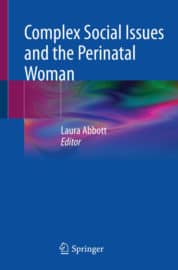 This is a much needed and timely volume, dealing essentially with the nuanced care needed for women and birthing people facing intersectional inequalities. The book opens with a clear statement from the editor of how essential a grounded and informed understanding of complex social issues is to any professional working in the maternity services.
Whilst the book deals with different vulnerabilities and inequalities in each chapter, much of the content is vital to underpin all care provision. For example, the first chapter by Naomi Delap on trauma-informed care feeds into current conversations about both supporting survivors of trauma and preventing primary trauma from birth and re-traumatisation.
In a country where 4% of women will go onto develop diagnosed PTSD from birth (and many more with other psychological harms) this is an essential text for midwives and students alike.
Tawanda Bvumburai’s work on racism and the experiences of people of colour in the maternity system is contemporary and well timed with the current work around the latest MBRRACE-UK report. These discussions are then supported by Jennifer Parker’s excellent discussion of the gaps in perinatal mental-health care and the avoidable harms that come from a service which, in many places, is patchy and under resourced.
Suzanne Reynolds discusses homelessness, a particular problem in childbearing as starting or continuing a family is a life event we all associate with home.
Women and birthing people who are deprived of this are at a much higher risk of both physical and psychological harm in childbearing.
Carolyn Hill develops the themes in the preliminary chapters with her work on parents who are seeking asylum or have refugee status, thus encapsulating both the work of Delap and Reynolds on the profound effects of being pregnant or having an infant in these circumstances.
People in the immigration system are likely to have increased obstetric, psychological and social needs while facing a service which is under resourced, especially for people who have no recourse to public funds. Women who are seeking asylum are seven times more likely to have severe obstetric complications (Pallotti and Forbes, 2016) and the least likely to be able to access midwifery support.
Karen Mills’ chapter on substance misuse is illuminating but does not successfully answer the question of how we balance the parental need for support with safeguarding concerns for the infant; although in fairness this is a tension which most clinicians find difficult to resolve.
Celia Wildman examines intimate partner and family violence and the profound effect this can have on pregnant people’s mental health, birth outcomes and infant development.
Editor Laura Abbott contributes an excellent section on the specific challenges faced by pregnant women and people in prisons, based on her seminal PhD work. Angelina Namiba et al then discuss the care needed for pregnant people living with HIV, which is a very important update to a rapidly changing field and the piece addresses much of the stigma which still surrounds the disease.
Paulina Sporek de Lacerda provides a very gentle discussion on her life-long work on supporting deaf women and pregnant people, which will be new to many readers but vital in understanding the specific needs of this population.

Abbi Ayers considers the very complex issue of how infant-feeding choices can be supported for trauma survivors and lends a much-needed dose of non-judgemental pragmatism to the contested topic of infant feeding.
The collection ends with Denise Marshall’s uplifting story of the history of Birth Companions, a charity advocating for women in the criminal justice system and demonstrates how tireless campaigning and grass-roots support can make a real difference to women and pregnant people in the perinatal period who face such challenges.
Overall, this is an anthology underpinned by both a feminist discourse and an ideology of compassionate care.
Taken as a whole, this is a must read for anyone interested in intersectional inequalities, discrimination and multiple vulnerabilities.
The themes, whilst they stand alone as well researched scientific commentaries, develop aspects of care provision, such as trauma informed care, and as a whole are a useful and timely contribution to midwifery practice.
The fact that many of the inequalities and socio-economic disadvantages described are often co-existent, for instance substance abuse, racism and imprisonment, is clearly elucidated and the book as a whole provides both a roadmap to a just maternity-care system and a very important contemporaneous commentary on the current evidence. TPM
- Editor Laura Abbott
- DOI https://doi.org/10.1007/978-3-030-58085-8
- Copyright Information Springer Nature Switzerland AG 2021
- Publisher Name Springer, Cham
- Softcover ISBN 978-3-030-58084-1
- eBook ISBN 978-3-030-58085-8
- Number of Pages 247

