








Group Care: First 1000 Days
Deborah Billings (she/her) – Senior Advisor, Group Care Global, USA
Social linkedin.com/in/deborah-billings-a838566/
Eline Vlasblom (she/her) – Project leader, GC_1000, TNO, The Netherlands
Social linkedin.com/in/eline-vlasblom-06638922/
Ashna Hindori-Mohangoo (she/her) – Principal Investigator, Foundation for Perinatal Interventions and Research in Suriname (Perisur)
Social linkedin.com/in/ashna-hindori-mohangoo-7819721b/
Jedidia Abanga (she/her) – Programmes Coordinator, Presbyterian Health Services, Ghana
Social linkedin.com/in/jedidia-abanga-ba272653/
Published in The Practising Midwife Volume 27 Issue 4 July 2024, Pages 8-11
https://doi.org/10.55975/DTUW8534
Summary
Group care (GC) during pregnancy and early parenthood improves outcomes, including satisfaction with care, both for healthcare providers (group facilitators) and clients (group participants). Global evidence for the impact of GC is growing. Implementation, however, is generally small-scale and not scaled-up. The GC for the First 1000 Days project (GC_1000) aimed to bridge this gap by implementing antenatal and postnatal GC in health systems in seven countries around the world and systematising lessons learned. Tools are available to integrate GC into health care systems.

Introduction
As a midwife, you are aware of the challenges that your colleagues around the world face when working to offer person-centered antenatal care to pregnant people; and you understand how those challenges are often exacerbated when offering services to communities living in contexts where resources are difficult to access. Midwives also know that the needs of parents and newborns do not stop with birth.
The Group Care for the First 1000 Days project1 aimed to address these challenges by implementing sustainable antenatal and postnatal group care (GC) in health systems in seven countries around the world. The project received funding from the European Union’s Horizon 2020 research and innovation programme (grant agreement No. 848147) to support the work of ten organisations from January 2020 through to June 2024. The main goals of GC_1000 have been to transform the ways in which antenatal and postnatal health care services are delivered and experienced so that health care providers, women/parents and their families are more satisfied with care, thereby making a significant positive impact on their health and wellbeing; and to document the process through which implementation of GC is feasible, sustainable and able to be scaled-up.
The GC model is person-centered care offered in groups and is described in detail in the article authored by Rising and van Groesen in this issue.
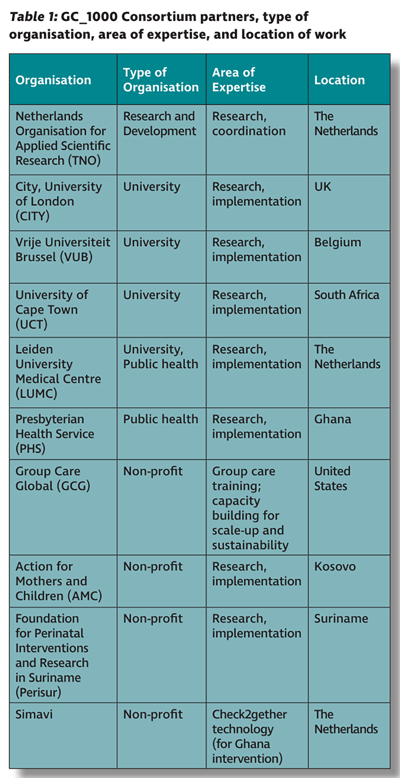
The GC_1000 project was carried out by a consortium of 10 partners, each with an area of expertise that complemented the others. Partners collaborated with health care providers and the systems in which they work and collaborated with one another across all seven countries (Table 1).
“The Group Care for the First 1000 Days project1 aimed to address these challenges by implementing sustainable antenatal and postnatal group care (GC) in health systems in seven countries around the world.”
GC_1000 in action
The project focused on four action areas, comprising what is known as implementation research:
- Understanding local contexts and health systems norms and capacities; adapting those systems in ways that shifted antenatal and postnatal care from individual client-provider visits to GC delivered with keen attention to health system resources as well as local norms and cultural practices.
- Capacity-building with health care providers to implement GC. This included training midwives and other health care providers to facilitate group sessions with pregnant women (and in some settings, with parents of babies up to one year) and any systems changes that needed to take place with scheduling, space for care and referrals.
- Documenting the process of implementing GC and its impact on satisfaction with services, both for providers and participants, systems changes needed to make GC possible and lessons learned within and across different contexts and settings.
- Co-creating and disseminating tools that can support health care providers, policymakers, researchers and others to implement GC in their settings. These tools pay close attention to acceptable, feasible and sustainable ways to integrate GC into health systems and practices as well as to scale-up GC.
Group care implementation
While the world went through a COVID-19 pandemic, the Consortium successfully managed to implement GC in four lower-middle to upper-middle income countries and in three high-income countries, focusing on pregnant people and parents with babies living in vulnerable situations. Some of the participating countries had experience with GC, while GC was new in other settings. During the project, 78 antenatal groups and 15 postnatal groups were carried out in 28 facilities in seven countries. Below we highlight experiences from two of the countries, namely Ghana and Suriname.
Ghana
In Ghana, group antenatal care was implemented for the first time in the Upper East Region, in the Binduri district, a rural area where many pregnant women have limited access to quality care. Twenty-four health staff comprising midwives and Community Health Nurses were trained in November 2022 and the first antenatal group started in December 2022. In Ghana the Check2gether backpack was included in the project.2 This portable kit, which combines non-invasive diagnostic tests and a smartphone app, enabled women and midwives to access on-site, easy-to-read results that identify signs of high-risk pregnancies. For women, this saved them time and money since they did not have to travel to another clinic or lab to have tests taken. For midwives, Check2gether allowed them to engage directly with women to take the tests and to interpret them.
One pregnant woman who participated in the GC sessions said:
‘During my first birth, I didn’t know all this, so my preparation was inadequate but through GC, my second birth was properly organised.’ (Original language Kusaal. Translated by Jedida Abanga)
By the end of the project, 24 groups had taken place across six sites. Midwives and pregnant women reported positive experiences and increased attendance to 8+ antenatal visits (90% in group care, versus 52% in the district). All sites want to continue with group care.
Suriname
GC in Suriname started in 2014 in hospital sites. During GC_1000, the model was scaled-up in primary care sites and included postnatal GC in the capital city, Paramaribo and in district Wanica. During the project, the model was implemented in two antenatal and four postnatal sites, which carried out five antenatal groups and 11 postnatal groups.
Women’s partners were invited and encouraged to participate in GC. One partner noted, ‘For me it was also the involvement in the pregnancy as a partner. There are topics which you usually would not discuss at home. But in GC, it lets you participate as a couple and makes you think: how can we handle that?’
One important lesson was that intrinsically motivated staff that believe the model has benefits for themselves and for pregnant women and parents with babies are very important for implementation success.
Quotes from two midwives facilitating antenatal GC illustrate this point:
‘I was so enthusiastic about this model of care that anywhere I saw a pregnant woman; I would go to her and say: “Do you know this type of care? Come! We facilitate it, it is for free, you have to come”.’
‘The economic situation in Suriname has worsened and is not getting better, but I think people are happy to belong somewhere, to tell their story. This motivated me to start group care!’
While making great progress and expanding the model to new sites, sustainable integration of GC in the health system requires long-term commitment and perseverance.
“I was so enthusiastic about this model of care that anywhere I saw a pregnant woman; I would go to her and say: “Do you know this type of care? Come! We facilitate it, it is for free, you have to come.”
Call to action: join the global group care community of practice
The collaborative work carried out by the GC_1000 Consortium and health care providers, policymakers and researchers throughout the world has generated a wealth of lessons learned, strategies and new questions. To share these insights and to create a space for ongoing discussion with a wider audience, we established the GC Community of Practice (GCCoP). This is an online community, housed within the World Health Organization’s IBP Network.
The GCCoP connects people who want to implement, sustain and scale-up GC in their health care settings. These connections will support all CoP members to share resources, strategies and innovations so that collectively we can make group care a reality throughout the world.
Since December 2023, global discussions have been convened on topics ranging from managing the challenges of facilitating and implementing GC, to identifying influential GC stakeholders and extending GC through the First 1000 Days. The GCCoP welcomes your active participation. By July 2024, resources including a toolkit on implementing GC will be available for no-cost download.
To find out more and to join: https://groupcare.global/cop/
Why is GC_1000 important to midwives: lessons learned
Lessons learned from intensive, cross-cutting, multidisciplinary and systems-level collaboration show clearly that the experiences of midwives and other professionals facilitating GC are important to implementing and sustaining this innovative model. Primary lessons learned include:
- GC Facilitators, mainly midwives, are generally highly satisfied with implementing GC, noting that the sessions allow them to have time with women and families to listen to and learn from them.
- Health care providers who become champions of GC are critical to systems-level changes that are sustainable. This includes their role in proposing and implementing changes in policies and resource allocation so that, for example, groups have a place to meet that fosters group cohesion.
- Site-specific as well as system-level steering committees – comprised of group facilitators (midwives), past group care participants, other health care providers, community members and other stakeholders – that meet regularly to guide group care implementation also serve as an important collective champion of the model that provides continuity and stability to implementing group care (see Advancing Practice article by Van Damme, et al.).
- Barriers to implementation exist in each context, but they can be overcome. Tailoring the way the model is implemented in each context is important. For example, adaptations included modifying session content, scheduling and delivery methods within the context of the core components of the model to maintain fidelity to the model.
- Advocacy and strategic efforts are needed to embed GC into the standard healthcare protocols and national policies to ensure long-term sustainability and broader acceptance.
Importantly, the voices of midwives who implement GC and directly experience its benefits, both for themselves and the women and families they serve, need to be heard and considered in policy-level discussions. TPM
For more information
Suriname: Manodj Hindori ma************@*****ur.org
Ghana: Jedidia Abanga je**********@***il.com
Kosovo: Okarina Gorani ok************@*******th.org
South Africa: Marsha Orgill ma***********@****ac.za
The Netherlands: Marlies Rijnders ma**************@*no.nl
Belgium: Katrien Beeckman ka**************@*******el.be
United Kingdom: Christine McCourt ch*****************@*****ac.uk
Group Care Global: Sharon Rising sr*****@*******re.global
CenteringZorg: Katja van Groesen ka*************@***********rg.nl
References
- GC_1000. https://groupcare1000.com/. Accessed April 30, 2024.
- Check2gether (GC_1000). Simavi. https://simavi.nl/en/ programmes/check2gether. Accessed April 30, 2024.