








Group Care: Pregnancy, Postnatal and Beyond
Amy Creaser (she/her) – Research Fellow, My First 1000 Days project, University of Leeds
Social @amy_creaser
Christine McCourt (she/her) – Professor of Maternal Health, University of London
Social @profmccourt
Alice Kininmonth (she/her) – Research Fellow, University of Leeds
Social @alicekini
Linda McGowan (she/her) – Professor of Applied Health Research, University of Leeds
Social @linda_leeds
Published in The Practising Midwife Volume 27 Issue 4 July 2024, Pages 42-45
https://doi.org/10.55975/PGVC8709
Summary
Centering-based group antenatal care (gANC) has been shown to be of value during pregnancy. But what about the postnatal period and beyond? In this article we discuss approaches to applying group care beyond pregnancy and immediate post birth to families with children in their early years.
Child health inequalities
Child health inequalities in the United Kingdom (UK) are marked, with notable regional disparities.1 Higher levels of deprivation are associated with increased risks of childhood obesity, infant mortality rates, delayed cognitive development and intellectual disabilities.2 The first 1,000 days of a child’s life, from conception to their second birthday, has been deemed a window of opportunity for child health and development.3 Previous research has shown that parenting support programmes during pregnancy up to the early years increase the chances of positive outcomes across child developmental domains.4 In the UK, midwives provide immediate postnatal care up to ten days after birth. Health Visitors (now Public Health Nurses) then maintain contact until the child is five years old. In the first two years, at least three visits are conducted to monitor family and child wellbeing, including developmental assessments.
The Group Care during the first 1000 days (GC_1000) consortium have developed materials and implementation strategies to implement (and scale-up) centering-based group care into antenatal and postnatal care (see Article of the Month). These approaches have been implemented in a variety of healthcare systems and countries with a focus on adaptations needed by different populations and contexts.
“Midwives and health visitors reported that this new experience of working together was enjoyable and enhanced communication and understanding of each other’s roles.”
Group care in pregnancy and beyond
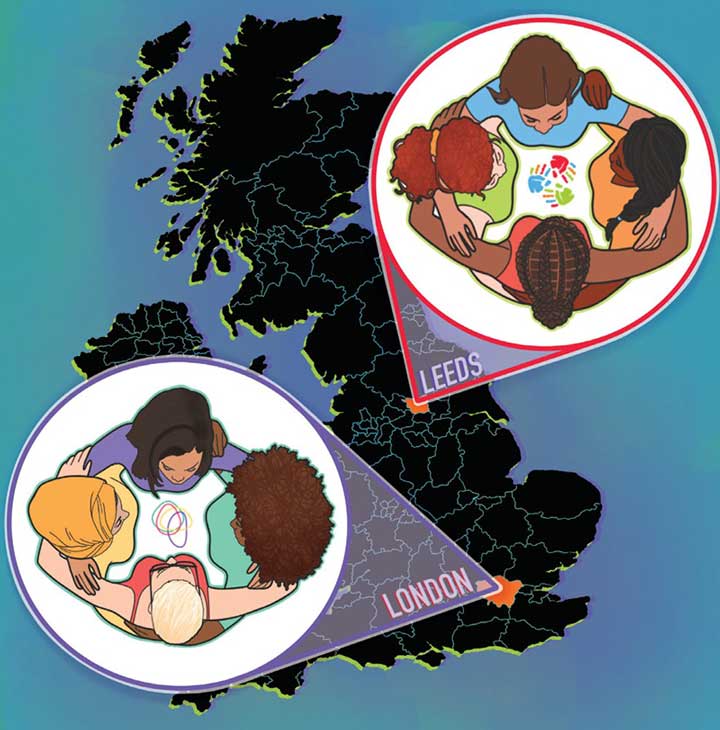
In the UK, a Centering-based group care model called Pregnancy Circles had been trialled as part of the REACH Pregnancy Programme.5 Two health services which had been involved in REACH contributed to the GC_1000 programme, focusing on scaling-up and adapting the modeI. One, in the South-East of England piloted Parenting Circles, an integrated model where one or more antenatal sessions and the initial postnatal session is co-facilitated by a health visitor and a midwife; health visitors then continue the group with support from nursery nurses for six months. Challenges included midwives and health visitors working in different organisations, with different catchment areas and record systems. Midwives and health visitors reported that this new experience of working together was enjoyable and enhanced communication and understanding of each other’s roles. Participants enjoyed the interactive approach to information provision and conducting their own routine health and baby health checks, with support. Here are some examples of feedback sent by different women in one service:
‘Becoming a mum for the first time was probably one of the most scariest things because everything was all new to me. Attending the pregnancy circles really helped with my anxieties and worries, it made me feel so much more confident with what was to come!’
‘I have to admit I was skeptical at the beginning about the level of care the baby and I would receive with the appointments being in a group. But very early I realised how helpful it was to interact with other future mums, going on the same journey as me.’
“I have to admit I was skeptical at the beginning about the level of care the baby and I would receive with the appointments being in a group. But very early I realised how helpful it was to interact with other future mums, going on the same journey as me.”
Important lessons were learned to help guide other services interested in implementing Parenting Circles, which achieved high levels of continuity of provider and group support from pregnancy to the early months of parenting, incorporating healthcare, group interaction and support. The second site, in a socio-economically disadvantaged community in Essex, integrated Pregnancy Circles with case loading midwifery teams, enabling the continuity of support with group care to continue into the intrapartum experience. This was also a highly novel approach for the UK and adaptations were needed to enable integration but the positive experience meant the service committed to scale-up the approach. The next step, currently in process, is to implement Parenting Circles, extending the continuity to longer-term postnatal support, and implementing this across the local systems, involving three Local Authority health visiting services as well as National Health Service (NHS) maternity services.
Extending group-centered care to families with children in their early years
Although existing models have included a diversity of people, including those needing language or signing interpreters, they have not explicitly included parents/caregivers and children with disability, even though these groups could also benefit from the group-care approach. Numerous barriers to engaging in healthy behaviours that are crucial within the first 1000 days (e.g. engaging in play, feeding and nutrition) have been identified for children with disabilities.6
In Leeds, we intend to adapt the model to suit the UK health and social care context and to address the current economic situation. The My First 1000 Days project (MF1000Days) will include components embedded within the existing Centering- based group care model but will also focus on four (additional) evidence-based components: food and nutrition, physical activity, cognition and language development, and disability inclusivity (see Figure 1).

The MF1000Days study started in January 2023 and will run for three years. Initially, we will focus on children from birth up to two years with the intention of linking with Pregnancy Circles in local maternity services once they are fully established. The project is active and is divided into two Phases.
In Phase 1 (currently ongoing) we have held key stakeholder meetings and reviewed current policy context. We are undertaking a scoping review of the research literature to identify studies which have looked at the development, implementation and impact on child/maternal health outcomes using the centered parenting care model. In addition, we are also conducting interviews and focus groups with key informants, including but not limited to health visitors, family support workers, children’s centre managers and staff, third sector organisations and families who might benefit from the model to explore their views and expectations. This information will be analysed and synthesised to inform the content and delivery of the group sessions in Phase 2 of the study.
Phase 2 of the project aims to develop an evidence-based centering-based group-care parenting model adapted to suit the local health and social context in Leeds. To test our model in the real world we will conduct a feasibility study implementing eight groups in two sites. It will involve measuring a range of important outcomes including feasibility, fidelity, cost benefit, the experiences of parents and care providers, and whether they think it is a workable and acceptable model. This will help us to decide if we can then scale up and conduct a larger study in the future. TPM
References
- Pickett K, Taylor-Robinson D, et al. The Child of the North: Building a fairer future after COVID-19. NHSA and N8 Research Partnership. Published 2021.
- Nath S, Hardelid P, Zylbersztejn A. Are infant mortality rates increasing in England? The effect of extreme prematurity and early neonatal deaths. J Public Health. 2021;43(3),541-550. doi.org/10.1093/pubmed/fdaa025.
- Karakochuk CD, Whitfield KC, Green TJ, Kraemer K. The biology of the first 1,000 days. 2018;518. doi.org/10.1201/9781315152950.
- Darling JC, Bamidis PD, Burberry J, Rudolf MC. The First Thousand Days: early, integrated and evidence-based approaches to improving child health: coming to a population near you? Arch Dis Child. 2020;105(9):837-841. doi.org/10.1136/ archdischild-2019-316929.
- REACH Pregnancy Programme. https://blogs.city.ac.uk/reach/. Accessed May 02, 2024.
- Sapiets SJ, Hastings RP, Stanford C, Totsika V. Families’ access to early intervention and supports for children with developmental disabilities. J Early Interv. 2023;45(2):103-121. https://doi.org/10.1177/10538151221083984.

