








Implementing Group Antenatal Care: The Global Experience
Stephanie Suhowatsky (she/her) – Principal Technical Advisor, Maternal Health, Jhpiego, Maryland, USA
Social linkedin.com/in/stephanie-suhowatsky-2486491/
Brenda Onguti (she/her) – Independent consultant, Tennessee, USA
Social linkedin.com/in/brenda-onguti-92278b19/
Veronica EA Apetorgbor (she/her) – Deputy Director of Nursing Services, Dodowa Health Research Centre, Ghana Health Service, Accra, Ghana
Social linkedin.com/in/veronica-apetorgbor-a2b677306
Esnath Kapito (she/her) – Senior Lecturer, Kamuzu University of Health Sciences, School of Maternal Neonatal and Reproductive Health, Malawi
Published in The Practising Midwife Volume 27 Issue 4 July 2024, Pages 46-49
https://doi.org/10.55975/XPFV6441
Summary
There are over 100 million pregnancies in low and middle income countries (LMICs) each year, and each pregnant person has a right to high-quality antenatal care (ANC).1 Coverage of four or more ANC contacts is only 68%, far short of the global target of 90% by 2030.2 Underutilisation of ANC limits opportunities to improve outcomes. Group care is considered a promising strategy to change this. It is estimated that over 500,000 stillbirths and more than five million small and vulnerable newborn births in LMICs could be prevented each year by high coverage of eight preventive interventions during ANC.3

Introduction
In 2016, World Health Organization (WHO) issued new recommendations aimed at improving quality and use of ANC, including a minimum of eight ANC contacts.4 WHO also recommended group ANC (gANC) in the context of rigourous research, due to limited studies from high-income countries (e.g. US, Sweden, Iran). LMICs that adopted the eight-contact ANC recommendation are challenged to increase ANC retention. gANC as a client-centered, transformative service delivery model is considered a promising strategy to operationalise the eight-contact guidance. Since 2016, more trials of gANC in LMICs have published results that demonstrate increased ANC attendance and higher levels of maternal satisfaction, compared to individual ANC (see Table 1).
GANC evidence in LMICS
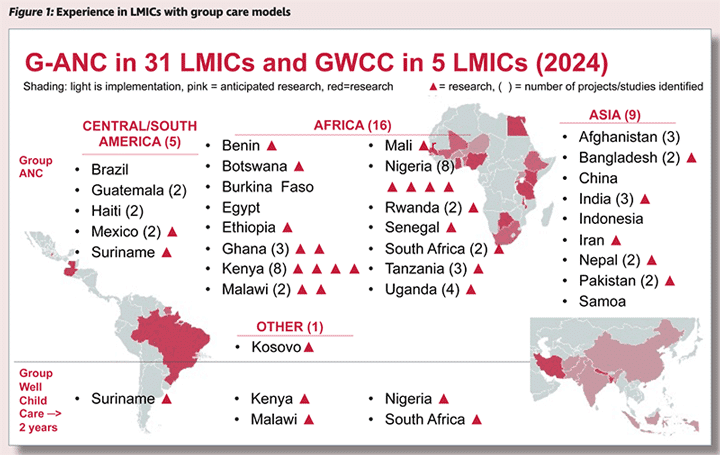
gANC has been adapted, implemented and tested in more than 60 projects or studies in 30 LMICs since 2008 (see Figure 1). Studies include several adequately powered clinical trials, a seven-country implementation study and numerous pilots. Over 50 papers on gANC implementation in LMIC settings have been published from 2010 to 2024 including four integrated/ systematic reviews. Table 1 summarises findings from LMICs by outcome.5
Nearly all of these studies report that participants and health care providers find gANC to be highly acceptable and feasible. Multiple studies and systematic reviews report positive ratings of satisfaction, effects on service utilisation and preference for gANC over individual ANC. Some gANC models continue beyond birth, such as the GC_1000 Days continuity model.6 Little has been published to date from studies of these models in LMICs.
Experience with gANC in LMICs has found that it is feasible and effective. There is sufficient evidence that it works well when implemented in public health facilities in the following conditions: several ANC providers per shift (at least two to three to be able to conduct gANC meetings and care for other ANC/maternal health clients); moderate ANC caseloads (i.e. 30 to 100 new ANC clients per month); mean gestational age at intake (i.e. ANC1) is around 20 weeks; health care providers are interested; and there is high fidelity to gANC principles (see Essentials article by Rising and van Groesen). In these conditions, there is no need for pilot studies in new settings, and direct implementation is advised. Research on gANC however is needed in high ANC volume hospitals, very low ANC volume facilities, at the community level, private sector facilities and humanitarian settings.
Group care beyond birth evidence in LMICS
As presented in Figure 1, there are few known models of group care beyond birth that have been adapted, implemented and tested in LMICs. A recent scoping review, which includes high-income country studies due to a lack of publications from LMICs, reported that group well-child care (GWCC) is associated with improved healthcare utilisation (e.g. attendance, immunisation rates), parental outcomes (e.g. psychological wellbeing, satisfaction), and clinical outcomes (e.g. self-efficacy).5 GWCC and continuity models need further testing in LMICs for feasiblity, acceptability and effectiveness.
Experience and evidence on scale-up of gANC in LMICS
The transition from introducing to scaling gANC in LMICs has been slow. The first studies on gANC scale-up process and its outcomes will report findings this year in GC_1000 countries (i.e. Suriname, Ghana, South Africa, Kosovo; see Article of the Month) as well as Kenya and Nigeria.6 There is optimism to build this evidence base as national and sub-national governments increase scale-up of gANC.
In Nigeria, gANC has been scaled up since its introduction in 2016. gANC is implemented in ten of the 36 states, plus the Federal Capital Territory. Approximately one million pregnant women/parents in five states participated in gANC in 2021– 2022.7 In 2022, 100% of health facilities were implementing gANC in three states as the standard for routine ANC. States have sustained gANC at scale since 2023 with minimal external funding and no technical assistance.
In Kenya, gANC has been piloted in 11 of the 47 counties, with several now focused on scaling up to increase coverage. Scale- up of gANC is underway in Afghanistan and Burkina Faso.
As gANC continues to be implemented as the routine/standard service delivery model at larger scale across various LMICs, there are opportunities to harmonise and aggregate gANC data across countries to aid in our understanding of gANC’s sustainability and effectiveness at scale.

Accelerating Scale-Up Of Group Care Models In LMICS By 2030
In February 2024, the global gANC community came together to accelerate scale-up of gANC in LMICs. Over 125 researchers, government officials, technical experts and implementers from 24 countries met at a three-day Global Catalyzer event in Kenya to consolidate the evidence and diverse experiences to date. The Roadmap to Accelerate Scale-up of Group ANC by 2030, to be released in June 2024 on www.ganccollaborative.com, is a global strategy to unify and amplify efforts to increase the availability of gANC across LMICs. It recommends:
- Updating the WHO recommendation on gANC which will increase adoption into national policies.
- Prioritising research to fill evidence gaps.
- Disseminating the evidence on gANC in all LMICs at the national and sub-national levels to generate interest in gANC to increase retention and operationalise the eight-contact ANC recommendation.
- Advocating for governments and donors to secure the political commitment and resources for gANC implementation at scale.
- Strengthening coordination and collaboration to share learning.
The Roadmap recognises the wealth of gANC implementation experience in LMICs that can lead scale-up and foster South-to-South collaboration. The long-term goal is to ensure that pregnant people in LMICs have access to gANC because it is a service delivery model that delivers a positive pregnancy experience, greater maternal satisfaction and increased ANC attendance. At scale, gANC can help accelerate progress on national and global goals by 2030.
Conclusion
Evidence suggests that gANC results in greater satisfaction for both clients and providers in LMICs and increases ANC attendance. Its integration into health systems, however, has been slow. The gANC Global Catalyzer event and subsequent Roadmap set out priorities for accelerating gANC scale-up. These efforts will aid in increasing gANC coverage, operationalising eight ANC contact policies and improving maternal and newborn health outcomes in LMICs. Global evidence and local expertise exist. It is now time to increase availability and access to this effective care model in LMICs. TPM
“Evidence suggests that gANC results in greater satisfaction for both clients and providers in LMICs and increases ANC attendance. Its integration into health systems, however, has been slow.”
References
- Numbers. Healthy Newborn Network. https://www. healthynewbornnetwork.org/numbers/. Updated December 2023. Accessed April 29, 2024.
- Improving maternal and newborn health and survival and reducing stillbirth: Progress report 2023. WHO. https://iris.who.int/ bitstream/handle/10665/367617/9789240073678-eng.pdf. Published 2023.
- Hofmeyr GJ, Black RE, Rogozińska E, et al. Evidence-based antenatal interventions to reduce the incidence of small vulnerable newborns and their associated poor outcomes. The Lancet. 2023;401(10389):1733-1744. doi.org/10.1016/s0140-6736(23)00355-0.
- WHO recommendations on antenatal care for a positive pregnancy experience. WHO. https://www.who.int/publications/i/ item/9789241549912. Published November 28, 2016..
- Group Antenatal Care. Evidence Base for G-ANC in Low-Resource Settings. Updated summary of G-ANC research fi ndings in lowand middle-income countries, 2024. Jhpiego. https://static1. squarespace.com/static/5c1833055ff d2029298aac7b/t/6632b24893 46342b489e7a36/1714598472415/G-ANC+LMIC+Evidence+Briefer+A pr2024_USL.pdf. Updated April, 2024. Accessed May 1, 2024.
- Martens N, Crone MR, Hindori-Mohangoo A, et al. Group Care in the first 1000 days: implementation and process evaluation of contextually adapted antenatal and postnatal group care targeting diverse vulnerable populations in high-, middle- and lowresource settings. Implement Sci Commun. 2022;3(1):125 (2022). doi.org/10.1186/s43058-022-00370-7
- TAConnect. Improving Maternal and New-born Outcomes: Over 900,000 Pregnant Women Enrolled in GANC In Nigeria. TAConnect. https://taconnect-ng.org/2023/03/07/improving-maternal-andnew-born-outcomes-over-900000-pregnant-women-enrolled-inganc-in-nigeria/ Published March 07, 2023. Accessed April 29, 2024.
- Sadiku F, Bucinca H, Talrich F, et al. Maternal satisfaction with group care: A systematic review. AJOG Global Reports. 2024;4(1):100301. doi.org/10.1016/j.xagr.2023.100301.
- Grenier L, Suhowatsky S, Kabue MM, et al. Impact of group Antenatal Care (G-ANC) versus individual antenatal care (ANC) on quality of care, ANC attendance and facility-based delivery: A pragmatic cluster-randomized controlled trial in Kenya and Nigeria. PLOS ONE. 2019;14(10). doi.org/10.1371/journal. pone.0222177.