





Down syndrome – Enabling a Positive Perinatal Experience
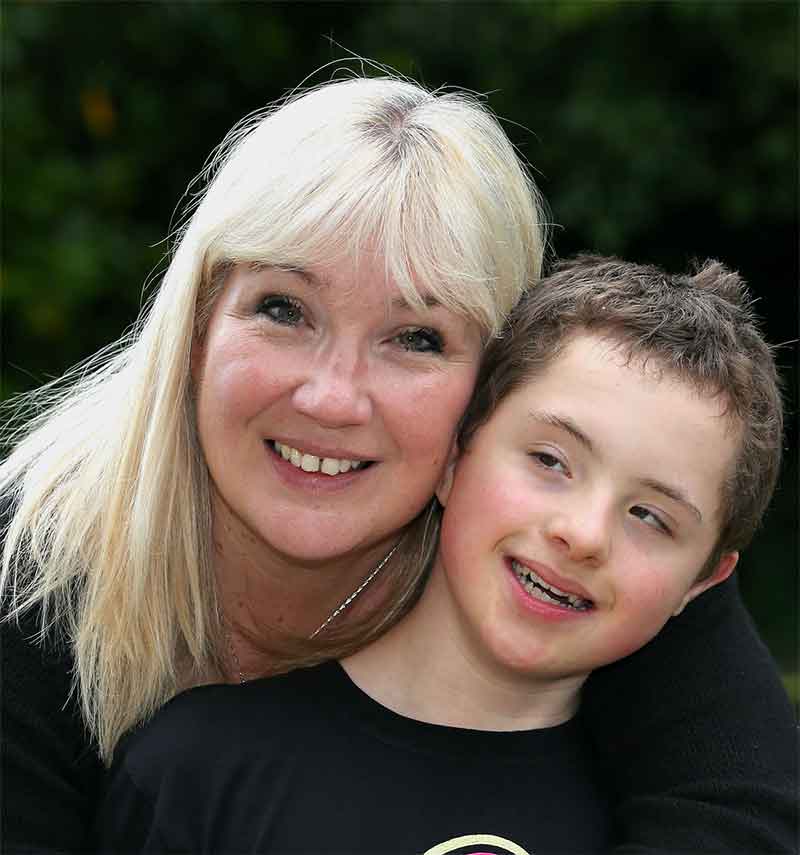
Lucienne Cooper (She/her) – Training Manager, Down Syndrome UK
Social @PositiveaboutDS
Introduction
Down Syndrome UK has found that when Down syndrome is suspected or detected at any point during the pregnancy or birth, childbearing and/or birthing women and people can experience negativity which can be associated with poor perinatal mental health. ALL new and expectant parents of babies with Down syndrome should have a positive maternity experience, it’s quite easy to achieve; language, knowledge and education – simple.
Sorry it’s bad news..
During their pregnancy, some women and birthing people who have antenatal screening hear these words:
‘You are young, I’m sure you would want a normal baby as it would be easier for you.’
‘It’s positive, you know most people when they find out don’t carry on with the pregnancy, as the condition is too much for them to cope with.’
‘It’s bad news unfortunately, wish I had better news, termination is available by the end of the week, wish there was something I could do to help.’
At 37 weeks pregnant some people are told:
‘It’s not too late, you can still terminate.’
‘Are you sure you still want to go through with this?’
‘Have you considered adoption; your other children don’t need to be burdened.’
A healthy baby has been born and these are the words the parent hears:
‘I’m sorry but it looks like there may be a problem.’
‘I’m so sorry, this must be devastating news for you.’
‘I’m afraid this isn’t the news you were hoping for’
‘Does your baby look normal to you?’
Doesn’t every new parent deserve to hear ‘Congratulations!’?
Sadly, these are all recent actual experiences of new and expectant parents of babies with Down syndrome.
As a woman, and as a parent to someone with Down syndrome, I believe that expectant and new parents deserve so much better. Down syndrome is no longer a life limiting condition. Thanks to the availability of early intervention programmes, advances in health care and research into the unique learning profile of people with Down syndrome most people with Down syndrome can live content and fulfilling lives. Despite living in the UK in the 21st Century, with increased awareness, inclusion and acceptance towards many, there is still a negative stigma towards Down syndrome.
Recent research
Down Syndrome UK, together with the University of Warwick, has carried out research (see below) around how women were given the news their baby has Down syndrome. We asked women/birthing people who had their baby with Down syndrome in 2019-2022 and found that less than 8% were given the news in a positive manner whether this was a high chance screening result, antenatal diagnosis or a post-natal finding. Generally, only around half were given the news in a neutral way and a large number (32-45%) of respondents reported that being told their baby had or was likely to have Down syndrome was a negative experience.
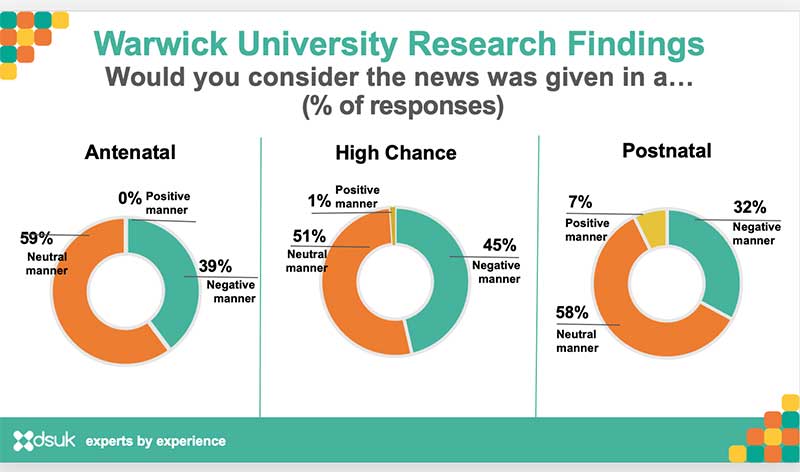
Further investigation into recent maternity experiences highlights that only 34% felt their mental health was supported antenatally and this reduces to 26% for those with a postnatal diagnosis. More than one third of the respondents 37%) reported that the negative attitude of a health care professional had a profound effect on their mental health.1
Shocked? We are too! This is why we developed Positive About Down Syndrome (PADS), the aim of which is remarkably simple…. PADS works hard to ensure EVERY expectant and new parent of a baby with Down syndrome has access to the information and support that they deserve from health care professionals, as well as ongoing peer support and expert advice when their baby arrives.
What’s the solution?
With your help we can achieve this, it is very straight forward…. Please ensure you have a contemporary knowledge of what life with Down syndrome is like in the 21st century. Down syndrome is no longer the life limiting and disabling condition people feared for their children. Research shows that 99% of young adults with Down syndrome are happy with their lives, 97% like who they are, 96% like how they look and 99% love their families…. what parent wouldn’t want that outlook for their child.2
Obviously, parenting a child with a disability isn’t without challenges, you could argue that parenting any child isn’t without challenges but us parents of children with Down syndrome are in quite a privileged position…… we know very early on about the condition, potentially even before birth. With this early identification comes early support and there is a LOT of support available. Down syndrome has been around for hundreds and hundreds of years and through the decades a myriad of knowledge and research has been gathered. We know the common medical conditions people with Down syndrome can have, and medical advances have enabled the majority of those who have heart surgery to go onto live fulfilling and ordinary lives post-surgery.
Research into how people with Down syndrome learn has been ongoing since the 1980’s. We now know about their unique learning profile, and so teaching methods in schools can generally be geared towards helping our children reach their full academic potential. We now have specialist speech and language therapists who are able to support the speech and language delays associated with Down syndrome.
Many parents have access to Down syndrome specific early intervention programmes which we believe can make a significant impact for our children to reach developmental milestones. There are unfortunately local disparities in the level of services individual families access across the UK but the information, advice and support Down Syndrome UK provides has shifted this to online making access to support more of an even playing field and less dependent on where you live and how loud you shout.

I wish Down Syndrome UK (DSUK) was around when I had my Billy, it would have made such a difference to me. Due to the lack of support, the lack of information given to me and my own out of date attitude to Down syndrome, for the first 2 years of Billy’s life when I looked at my precious baby all I could see was Down syndrome and to me, at that time, was something that I didn’t want in my family. After the epiphany of understanding that that I wasn’t alone and that parenting a child with Down syndrome is not a bad path, just a different one, once I recognised that Billy is a welcome and wonderful addition to our family, I was determined to help spread the valuable word of the ‘Lived Experience’ the maternity training programme developed by DSUK.
Language, knowledge and education – simple
Having a positive maternity experience makes the world of difference to our families, for me it would have been two years of my life back, for some, it is longer. We are here to guide and support you to ensure you know the reality about Down syndrome, and so you can be the person who makes that positive difference to a family.
‘Our midwife was amazing and I can’t thank her enough, she was calm, reassuring and knowledgeable about Down syndrome. She really put us at ease and gave us time to respond.’
‘I was very emotional and she just knew the right things to say, “this isn’t sad, it’s just unexpected.’
‘I knew nothing about Down syndrome, I felt totally overwhelmed, I remember the midwife saying that she knew there was a great local Down syndrome group support nearby, she had all the information at hand, instantly I felt less alone.’
‘I felt I was given typical antenatal care. I was offered additional mental well-being support throughout and by the time he arrived I felt I was ready for the Down syndrome journey!’
References
- Rutter T, Stinton C, Hastings R. Down syndrome in maternity care: Mothers’ experiences of mental health support. To be published 2024
- Skotko BG, Levine SP, Macklin EA, Goldstein RD. Family perspectives about Down syndrome. Am J Med Genet. 2015; A:1–12.