









Building Bridges and Storytelling in Australia
Karen Henry – Midwifery Lecturer, University of Suffolk, UK and The Practising Midwife Editorial Advisory Board Member
She/her
Social @Karen_Henry_Midwife
Convergence of Rebellious Midwives Conference
Karen Henry
A couple of weeks ago I travelled to Sydney in Australia to attend the Convergence of Rebellious Midwives conference, arranged by Australian midwife and podcaster Melanie Jackson. As I sit here on my 25-hour flight home, I have much to think about and reflect on that I wanted to share.
Many, many speakers were inspirational including Ina May Gaskin and Hannah Dahlen who, all had one simple message – midwives should be with women and, care should be woman centred. It sounds simple yet, it seems that somewhere along the way, this has been forgotten in the midst of rising medical interventions and risk management to reduce stillbirth rates. Which, incidentally despite the rise in medicalisation, have remained stable with an actual increase in neonatal and childhood mortality.1
One of the key speakers was All4Maternity’s CEO Anna Byrom whose session was titled ‘Building Bridges’. From the title, I thought this was going to be another talk about how midwives and obstetricians need to work together and not in silos which, of course, is important for the safety of women and babies as highlighted in several UK maternity reports and several talks since. Yet, no, this was not the case, and I was slightly surprised and moved by what happened during her talk. Anna talked about her childhood, where she was born, who she is as a person; a mother and daughter plus, she shared her journey into midwifery which was inspired by seeing her mum being a midwife whilst growing up.
..to be a midwife means to be with women and in order to do this, women want to know who we are..
You might ask why this matters and the answer is simple – she was telling us about herself so we could get to know her more and in essence, she was humanising herself. This matters because to be a midwife means to be with women and in order to do this, women want to know who we are, building a relational bridge if you will to ‘being with women’.
We’ve all been on journeys to get to where we are today, some more treacherous than others. Some of our stories are wholesome with lessons we can pass on, some of us have had experiences we would rather forget but, our stories and experiences shape who we are. They are our road map for where we have been which often influences where we are heading too as well.
..our stories and experiences shape who we are
Anna talked about how midwifery education is skills based, placement based, and proficiency based where students often see themselves as a homebirth midwife, a delivery suite midwife or a community midwife, categorising themselves in relation to the area of work yet, do you hear students saying they are a woman centred midwife? Probably not, and partly this might be because of the dehumanisation that occurs in midwifery where we are defined by our status ‘the student’, ‘the Band 5 midwife’, ‘the Band 6 midwife’ etc with lists of tasks to complete before the end of a shift.

This made me consider whether we as midwives get to know the students we work with. Do we ever consider the students story of how they came to midwifery training? Do we reflect on how far they have travelled on the road to midwifery or do we simply assess their skills and proficiencies. The students are not robots they are humans with stories which make them unique. When we are dehumanised ourselves, we might then dehumanise others. For example, the list of tasks to get done before the end of the shift might be performing an ARM or a CTG on a woman but who is she – what’s her story? Do we know the women we care for? Or do we refer to them by their means of care ‘the induction in room 5’? Or do we call them by their name, know their partners name, know some of their story?
..we must recognise our own humanity to see it in others
The same can be said for our colleagues. Do we know who they are, where they have been, where they are going to. Do any of your colleagues know much about you and your journey? Part of revalidation involves reflective writing which to be honest, are often based around something we’ve done wrong, a lesson we have learnt or, a means of learning something new, but I would like to ask the question, are your reflections reflective of you, the person? If I read one of your reflections, would I get to know a little of who you are? If not, why not?
During her talk, Anna spoke about how we must recognise our own humanity to see it in others – essentially, we need to be human to connect with others and feel connected. During the talk, I was sat on a table with 9 other people. It was mid-afternoon, and we had engaged in small talk with one another. Anna asked the audience which consisted of 525 midwives, doulas, birth workers and a couple of doctors to turn to the person next to them and place an arm on their shoulder to show that we need to build bridges between each other, to connect, human to human. Anna then asked us to give one person a hug. What happened in the room was almost magical, people were laughing and smiling and the room felt warm like it was almost filled with oxytocin: like when you witness a woman becoming a mother – it’s emotional. Suddenly, the people on my table were talking, not the usual small talk of ‘where are you from’ but deeper discussions than before Anna’s talk. Magical things happen when we connect with each other.
When I left Sydney, I kept thinking of Anna’s talk and it came to my mind again and again as I travelled to Uluru and Port Douglas and learnt more about Aboriginal culture. You see, stories are very much part of the culture. One such story is Tjukurpa story about the snakes of Uluru. I have searched online so I can retell the story however, this act is forbidden as the stories are the intellectual property of the Aṉangu indigenous people who live at Uluru, and I will respect this.
Stories are powerful..
Story telling is integral to the Anangu people shared by elders and passed on from generation to generation. Stories are a way for learning about the law, individual identity, plus, the roles and responsibilities. Children learn from an early age the importance of family which should be fought for and protected. Young women come together with their grandmothers, mothers, sisters and aunts for personal reflection, spiritual rejuvenation, and emotional healing. They are taught how to collect and prepare bush food and how to make bush medicines. One thing that struck me whilst hearing the Tjukurpa story is that children learn early on about how their inner resources of intuition should lead the way and be acted upon on. Stories also act as maps of the world. Stories are told and retold to children so that if they ever found themselves at Uluru for instance, the children would recognise where they are through the markings in the stone. They would know where the waterhole is to sustain life and they would know which way to travel next.
You might be asking yourself what this has to do with midwifery, and my answer is everything. Stories are powerful, what’s your birth story? What shapes your perception of birth? How are women learning of birth? Are midwives trusting their own intuition and navigating care from their inner resources or are we working as robots, ticking boxes until we reach the end of our shift? Do we trust women’s intuition and more importantly, do we encourage women to be guided by their intuition?

If there’s one thing I learnt in Uluru is that women are wise, we need to allow our stories to be shared so we can relate to women: this means we need to be able to build bridges, be human with raw vulnerability. We need to trust our intuition. Women are wise. As Ina May Gaskin said during her talk, ‘experiential knowledge is expert knowledge’
After visiting Uluru, I visited the Daintree Rainforest in Queensland and heard several sentences from Aboriginal stories which I think should be related to how we view women and birth.
“Look after the land and it will look after you”
“Be kind to the land and it will provide. We are its guardians, its children, its protectors”
“We don’t own the land, it owns us”
Make of these sentences what you will but what I took from them is that midwives need to walk the journey with women, not steer or shape it. We don’t own their experience, they do. Midwives are the guardians and protectors of future health and wellbeing. Protecting birth now shapes future health in terms of mortality, morbidity, epigenetics, the microbiome, plus, mental and physical health. Most of all, connecting to one another will build relational bridges and allow relationship-based midwifery care and experience.
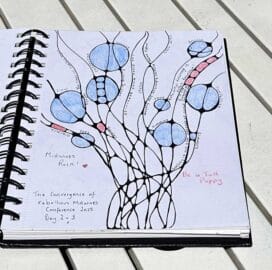
Find out more about the Convergence of Rebellious Midwives here: https://www.melaniethemidwife.com/the-convergence-of-rebellious-midwives
References
- UK. (2025). ‘Official Statistics: Child and maternal health profiles, statistical commentary: March 2025 update’ Available at: https://www.gov.uk/government/statistics/child-and-maternal-health-profiles-march-2025-update/child-and-maternal-health-profiles-statistical-commentary-march-2025-update Accessed 29th August 2025.

