








Book Review: Dilemmas and Decision Making in Midwifery, a Practice-based Approach
Edited by: Kenda Crozier, Julia Hubbard
Published: May 2023
Publisher: Routledge
ISBN: 978-191-5080-233
Paperback
164 pages
RRP : £19.99
Review by: Julia Andrew, PMA and Personalised Care Facilitator
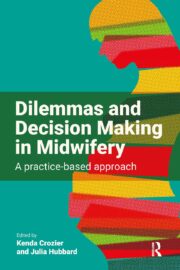 Like most practising midwives, I face dilemmas and decision-making on a daily basis. Even when we think we have ‘been there, done that, bought the t-shirt’, something completely new will present itself to us, expecting us to navigate it with safe and rehearsed expertise. This book presents such scenarios to us, so that we might prepare for them in advance and reflect on them once we have faced them. Each scenario is a real case study, told through the lens of the midwife, and in some cases, the simultaneous narrative of the student or childbearing woman or person is also empathetically shared.
This book should be in the toolkit of every Professional Midwifery Advocate, midwifery leader or educator and team facilitator. It guides group conversation, provokes thought, teases out emotion and spotlights a different perspective. It does not shy away from addressing workplace culture, hierarchy, bullying and the impact this has on both psychological safety and safe care provision. Nor does it shy away from topics that need more attention such as the misalignment of maternity records with gender identity. The scenarios are distributed across three parts with a helpful nod to the Nursing and Midwifery Council’s NMC Code. This makes it invaluable to aid revalidation and reflective discussions.
The book could be viewed as a guide and framework. Don’t expect it to dig so deep to resolve these dilemmas – they are for you to explore. I would also suggest that this is a book for dipping in and out of. To the neurotypical brain, I am sure it would fare mostly well, but to many it may feel chaotic. In addition to the narrative, viewpoints, reflections, actions and guided discussions there are boxes, alerting the reader to a corresponding value, model/approach, theory or evidence. The content of each box is crucial to the plot, but the impact may be lost in the noise.

I urge every midwifery practitioner to access a copy of this book and use it to its full potential. Use it in the way it is intended: stimulate thoughts, unleash the conversation and buy the t-shirts.
This book should be in the toolkit of every Professional Midwifery Advocate, midwifery leader or educator and team facilitator.

