









Born Where We Feel Safe: Listening to Families
Sarah Wall (she/her) – Service User Voice Representative, North East and Yorkshire, NHS England
Published in The Practising Midwife Volume 29 Issue 3 May 2026, Pages 34-36
https://doi.org/10.55975/VSPU6613
Summary
Having personally birthed in all four birth settings, I have experienced first-hand how choice around place of birth has narrowed. To explore this further, I collated the views of almost 1,500 women and birthing people from across the North East of England and Yorkshire. Their message was clear: choice matters, safety is related to personal perspective, and most would prefer a midwife-led option if they were genuinely available to them. True informed choice is fundamental to both safety and experience, and without all four birthplaces being open and offered, women and birthing people are being denied their rights.
Introduction
As a mum of four children, I have had what is now considered quite a unique set of birth experiences. I, through both default as well as choice, have experienced birth at each of the four different options. My first, born in 2012, was at a freestanding midwife-led unit. Sadly, before the birth of my second in 2014, that unit had closed, so I transferred my care to the nearest alongside midwife led unit, an hour and fifteen minutes’ drive from our home. For our third in 2017, I opted out of any planned travel and had a home birth. By the time we had our fourth in 2022 my only available option was to birth at an obstetric unit.
Navigating the ever-changing landscape around choices of place of birth for me and my babies became an ever more anxiety inducing tightrope walk balancing factors such as, where was most comfortable and appealing, how far we had to travel, discussed risks (my babies went past their due dates) and where I felt the safest.
Choice around place of birth is not just nice to have, it is a fundamental decision that supports both the physical and psychological safety of a family. Every woman or birthing person has the right to make their own choices around where to have their baby so that they are not only in the safest place for them, but also to feel that they are in the safest place for them and their baby.
In addition to a busy family life, for the last eight years I have had the privilege of working with perinatal services and systems as a service user voice representative. In my role I have listened to countless experiences of childbirth and perinatal care, and I take seriously the great responsibility I have in ensuring that those voices, representing families across our communities, are heard.
The erosion of choice around place of birth that I have personally experienced is sadly not unique or special to me or where I live.
Listening to service users’ voices
To explore this further in October 2023 I undertook a service user engagement survey to understand the preferences and thought processes of women and birthing people from across the North East and Yorkshire region with regards to place of birth.
The survey responses represent an opportunity to understand the unfiltered perspectives of almost 1,500 birthing people from across our region. There are noted limitations to this work that must be recognised, namely it was only available digitally and was not translated into any other languages. This obviously means that there is a level of bias within the survey data that I am transparent about and proactively continue to try and mitigate through future work. Nevertheless, what we do have is high volume of perspective from women and birthing people from across our region. My ambition is to reflect their messages as openly and honestly as I can to inform system and service decision making around the availability and offering of place of birth choices.
It is my aim through this work that every family has the best opportunity to the best possible birth experience they can have. I believe that place of birth is one such fundamental decision to enable that to happen.
As already mentioned, we had a great response rate to our codeveloped service user experience survey, in total 1,439 people offered their perspective through our region’s Maternity and Neonatal Voices Partnership networks.1
Everyone who responded had given birth within the last five years and there was a relatively even split between first and subsequent births.
Throughout the survey we asked a number of both quantitative and qualitative questions to understand specific birth choices around place of birth as well as the additional context surrounding them.
“It is my aim through this work that every family has the best opportunity to the best possible birth experience they can have.”
Findings
When asked, ‘Were you offered a choice around where to birth your baby?’ only 54% of respondents answered ‘Yes’ (see Figure 1). When asked around the detail of that choice, only 9% had been offered the choice of all four places of birth, that are recommended to be available to all in accordance with NICE guidelines.2
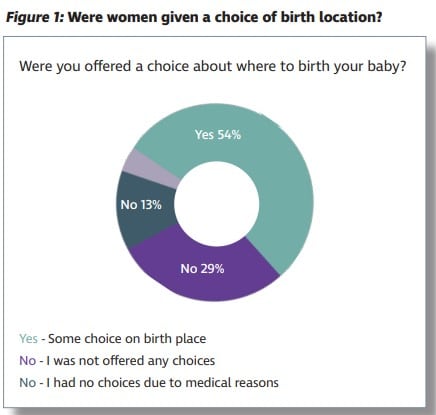
A quarter of respondents felt they weren’t involved at all in any decision around place of birth and overwhelmingly 92% responded that they felt having a choice is important.
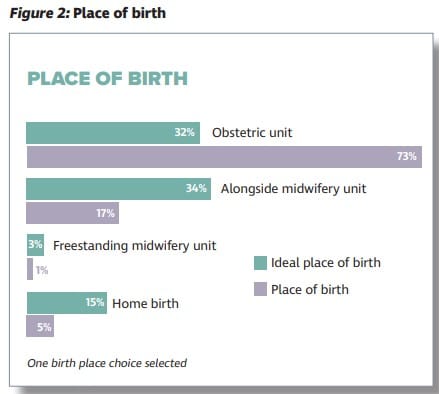
We asked where respondents would have ideally given birth versus where they actually did, the results demonstrated a clear desire for midwife led birthplace options and a stark difference between those who’s ideal place was in an obstetric unit (32%) versus those who actually birthed there (73%). (See Figure 2).
To explore this further we asked the, in hindsight, question of, ‘Would you have rather given birth somewhere other than where they did?’. Of those who birthed in a midwife-led unit or at home the vast majority would not wish to have altered their choice around place of birth (92% and 97% respectively). However, of those who birthed in an obstetric unit only 56% of them were happy they made the right choice around the place of birth.
The data becomes even more interesting as we explored the context questions where, what could be described as a complex picture of everyone women’s personalised needs and wants, became more apparent. This was seen most clearly in the responses regarding safety. Safety is often viewed in a set position, as in there are factors that improve safety and factors that decrease it, and that these are the same for every birthing person. However, what we saw from the survey was that women gave ‘safety’ as their reason around choice of place of birth for all four place options. The feeling of being safe was often given as being as important, or sometimes more important, than any other safety indices. For example, many responses to why women chose to birth in a midwife-led setting were along the lines of ‘because I felt safest at home, away from hospital timelines and unnecessary interventions’ and equally those who chose an obstetric unit birth told us, ‘I felt it was the safest in case of medical issues’.
Conclusion
In conclusion, from our survey of the experiences of women and birthing people from across the North East and Yorkshire it was very clear that choice around place of birth is very important and, if given true informed choice, most would ideally choose to birth in a midwife-led setting. We also learn that the decision-making process around choice is an incredibly personal one, and that there is a lot more opportunity for women to be better involved in making it.
If we really want safe and personalised care for all families then all four birth places need to be available, open and offered. Without choice, we have no choice and that is a breach of our human rights3 and a potential missed opportunity for a more positive experience of birth. TPM
References
- NHS England Maternity and neonatal voices partnership guidance. NHS England. https://www.england.nhs.uk/long-read/maternity-andneonatal-voices-partnership-guidance/. Updated November 28, 2023.
- Intrapartum care for healthy women and babies. Clinical guidance (CG190). NICE. https://www.nice.org.uk/guidance/cg190. Updated December 14, 2022.
- Human rights in maternity care. Birthrights. https://birthrights.org. uk/wp-content/uploads/2021/08/Human-rights-in-maternity-careFINAL-1.pdf. https://birthrights.org.uk/factsheets/human-rights-inmaternity-care/. Published May, 2021.

