









Book Review: Risk and Uncertainty in Maternity Care
Dr Mandie Scamell, Senior Lecturer in Midwifery, City and St George’s, University of London
Dr Kirstie Coxon, Reader in Maternity Care, University of Lancashire
She/her
Socials kirstie_coxon_research
Raymond De Vries, Professor Emeritus, University of Michigan, USA
Introduction
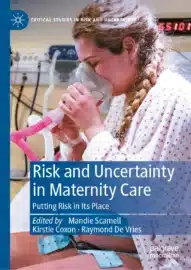 Pregnancy and birth are increasingly described as sites of risk. Risk to mother. Risk to baby. Risk to professionals. Risk to organisations. But what do we really mean when we talk about risk in maternity care: Who decides what is risky? What are the consequences of those decisions?
These questions sit at the heart of Risk and Uncertainty in Maternity Care, a newly published edited volume that brings together critical scholarship from midwives, social scientists, bioethicists, and obstetricians working across the UK, Europe, Australia, and the United States.
The starting point of this book is simple but rarely acknowledged: risk is not just something to be managed by maternity care, it is something maternity care produces, sustains, and proliferates.
The authors use critical studies of risk to invite both those who use and those who provide maternity care to think about risk as much more than an objective description of possible futures. The stories and analysis presented here show how our understandings of risk generate certain forms of intervention, legitimise particular kinds of expertise and choice, and reorganise responsibility and blame, all of which limit how pregnant women are able to do pregnancy and birth.
Risk is not neutral
One of the central arguments of the book is that risk is never just technical. Risk is:
- socially produced
- politically mobilised
- morally charged
What counts as a “risky” body, a “risky” decision, or a “risky” form of birth is shaped by gender, race, class, professional hierarchies, and institutional anxieties, not just epidemiology.
Across the chapters, contributors ask:
- Whose risks are prioritized and whose are rendered invisible?
- How does “risk talk” silence women’s embodied knowledge and their lived experience?
- Why does “choice” so often disappear precisely when uncertainty is greatest?
Listening to women in a system organised around fear
A recurring concern in the volume is how women experience risk‑dominated maternity systems, particularly women who are racialised, socially marginalised, or positioned as “non‑compliant.”
Connecting maternity care provision and the lived experiences of that care with the critical theories of risk illuminates how risk, as a dominant organising principle, quietly slides into coercion, especially when everyone involved believes they are acting in the name of safety.
Drawing on empirical research and theory, the authors offer language for experiences that many women, midwives, and obstetricians recognise, but often struggle to articulate.

Why this matters now
In an era of:
- rising intervention rates, with little evidence of clinical benefit
- poor experiences of care
- intensified regulatory scrutiny
- high‑profile maternity scandals, and
- deep professional anxiety
…there is an urgent need to pause and ask harder questions about how risk is being used and to what ends.
Risk and Uncertainty in Maternity Care does not offer simple solutions. Instead, it creates space for critical reflection across disciplines and professions, insisting that uncertainty is not a problem to be eliminated, but a condition to be worked with honestly and ethically.

