









Early Career Midwives’ Perineal Care Learning And Practice

Beatrice Bennett
Fiona Cross-Sudworth – Midwifery Research Fellow, University of Warwick
Beatrice Bennett – Quality and Safety Midwife, Honorary Research Fellow, University Hospitals Birmingham
Dr George Bouliotis – Associate Professor of Statistics, University of Warwick
Fleur Burden – Midwife, University Hospitals Coventry and Warwickshire
Anna Clements – PPI Expert, The MASIC Foundation
Jennifer Hall – PPI Expert, The MASIC Foundation
Dr Hema Mistry – Associate Professor of Health Economics, University of Warwick
Dr Jo Parsons – Assistant Professor, University of Birmingham
Lizzie Phillips – Specialist Pelvic Health Midwife, University Hospital Plymouth NHS Trust
Matt Smith – eLearning Systems and Content Manager, Royal College of Midwives
Dr Sara Webb – Head of MIDIRS, Royal College of Midwives
Lisa Fox – Research Midwife, University Hospitals Birmingham
Dr Beck Taylor – Clinical Associate Professor in Public Health, University of Warwick
Summary
Developing confidence and competence in perineal care is challenging for student and newly qualified midwives. The FutureSuture study aimed to understand women’s and midwives’ perspectives and experiences of perineal care. It found there are many influences on how early career midwives develop perineal care skills and a multifactorial approach is required to support early career midwives to develop their confidence and competence. These findings have informed the co-production on an eLearning module to support early career midwives develop their skills in perineal trauma management and repair.
While rates vary between and within countries, most primiparous women who give birth vaginally will sustain perineal trauma or require an episiotomy. Women sustaining injuries can face life-long physical, social and/or mental health impact.1 In the UK, qualified midwives are required to be able to perform an episiotomy if needed, to correctly identify the extent of perineal trauma sustained, and if a first- or second-degree perineal tear/episiotomy is present, to suture where appropriate using evidence-based suturing methods.2 Despite perineal care being a key midwifery skillset, developing competence and confidence can be challenging. There is much evidence to suggest perineal care training requires improvement. This includes it having low priority in pre-registration training3, and midwives having low confidence in providing perineal care3,4
We conducted a descriptive qualitative interview study with the aim of understanding women’s and midwives’ experiences and perspectives about how to develop and sustain skills, competencies and confidence of newly registered midwives in perineal care. The study was carried out as part of the FutureSuture research programme, funded by NIHR Research for Patient Benefit, and findings were used to inform co-production of a perineal care training package for early career midwives in the UK National Health Service. We interviewed women who had a vaginal birth and experienced a labial, first- or second-degree tear or episiotomy in the previous year, alongside student and newly qualified midwives, midwifery lecturers, consultant midwives, practice development midwives and preceptorship support midwives. Two Patient Public Involvement and Engagement (PPIE) Leads from perineal trauma charity MASIC were involved in the study, contributing to study design, recruiting and leading a PPIE group providing input into materials, interpretation and write-up.

Key findings included limited opportunities to learn basic suturing skills in the classroom and in the clinical areas. This was exacerbated by insufficient or poor-quality models or instruments to practice on, fewer vaginal births, service pressures and a junior workforce all competing to develop perineal management skills. Additionally fear and anxiety about asking for support, and concern about the impact on women, prevented midwives from seeking opportunities to practice suturing. Women expressed willingness to support midwives’ learning and emphasised the need for personalised and comprehensive information about perineal care throughout their care. Dedicated senior midwifery support roles (preceptorship support midwives) improved newly qualified midwives’ skills development.
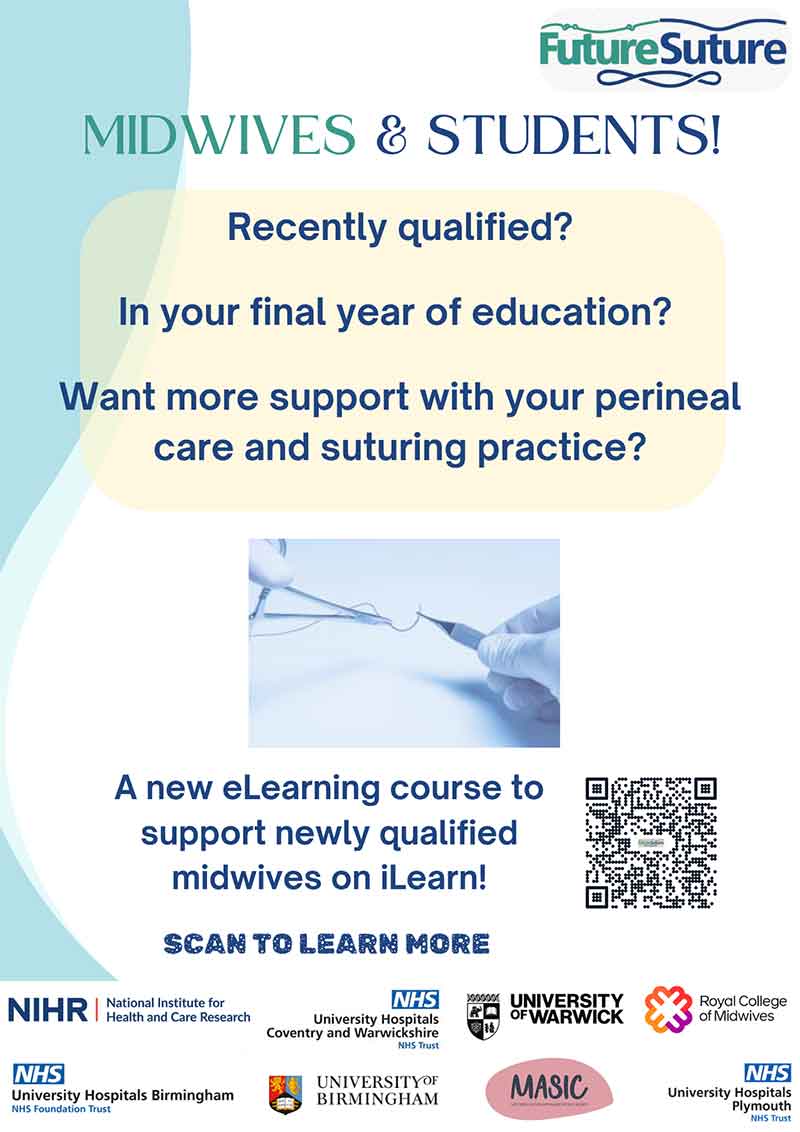
We found there are many influences on student and newly qualified midwives’ developing perineal care confidence and competence. It requires a multifactorial approach to provide learning support and ensure opportunities to develop competence and confidence in perineal care. This has informed the co-production of an eLearning course, with women and midwives, to address some of these challenges. The eLearning course is currently undergoing pilot testing. We are looking for final year students and newly qualified midwives to help us evaluate the FutureSuture course.
References
- Bick, D., Hall, J. & Keighley, M. R. B. (2022) The impact of severe perineal trauma on a woman’s relationship with her child: a hidden consequence. Midwifery, 108 103323.
- Nursing and Midwifery Council (2019) Standards of proficiency for midwives. [online] Available from: https://www.nmc.org.uk/globalassets/sitedocuments/standards/2024/standards-of-proficiency-for-midwives.pdf (Accessed 9th July).
- Hunter, C. & Bick, D. (2019) Early-career midwives experiences of perineal assessment and repair. British Journal of Midwifery, 27 (1): 43–48.
- Webb, S. S., Skene, E. R., Manresa, M. & et al. (2021) Evaluation of midwifery pelvic floor education and Training across the UK and Spain. European Journal of Obstetrics & Gynecology and Reproductive Biology, 256 140–144.

