









A Letter to Yvette Cooper, Health Secretary
 Jo Gould – Doctoral Research Fellow, City St George’s, University of London
She/her
Social http://linkedin.com/in/jo-gould-73ab6435
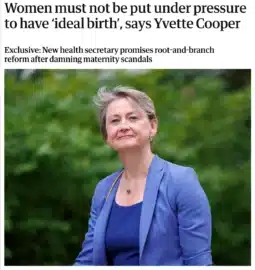
In a recent interview with the Guardian newspaper, Yvette Cooper, the newly appointed Secretary of State for Health in England, stated that women should not be put under pressure to have an ‘ideal birth’. This comment was linked in the article to ‘normal birth ideology’, continuing a trend of inaccurate and damaging reporting of the current issues in UK maternity services. I felt compelled to write to her to offer my personal reflections on the issues as I see them, as a mother, grandmother and midwife. Here is my letter:
07 August 2026
Dear Ms Cooper,
I apologise for adding to what will no doubt be a huge amount of correspondence in your first weeks as Secretary of State for Health, but I felt compelled to make contact after seeing your recent interviews and press coverage which appeared to highlight women being pressurised into particular types of births.
I am a mother of five, a grandmother, and a midwife of almost thirty years. I initially trained to be an architect, but experienced a traumatic first birth. In my second pregnancy I experienced continuity of midwifery care. I was listened to respectfully and my choices and autonomy were upheld during my subsequent birth. I believe this was a result of this model of care, which was a world apart from the fragmented care I received during my first pregnancy and birth. I then decided to become a midwife. I understood from my own and others’ experiences at the time, the critical difference that skilled, personalised and compassionate care can make at the very beginning of motherhood and family life. I have practised this approach clinically as a midwife, in clinical education in the NHS and in the last 12 years as a midwifery academic. What I have learned through my diverse midwifery experience, is that when clinicians put women at the centre of what they do, truly listen to them and facilitate information and choices, they are likely to provide the right care. Sometimes this is a straightforward birth at home in a birth pool, sometimes it is to have an epidural sited on admission to the obstetric unit due to a previous issue with inadequate pain relief. Sometimes it is an elective caesarean section because of previous birth trauma. Most importantly, truly listening facilitates the right choice for each and every woman.
I have been heartbroken to see the terrible decline in maternity services during my career. One of the worst aspects has been the fact that it has been increasingly challenging to care for women in the way I was able to do in the early years of my midwifery career. So many colleagues have left the profession, or are planning to leave due to the fact that they can no longer provide what they see as appropriate care for women and babies.
Previously, midwives were largely able to provide very good continuity of care in the antenatal and postnatal period at the very least. Continuity of midwifery (or relational) care has largely disappeared and most women see a different midwife at every appointment in their pregnancy and post-birth.
The issue with the disappearance of this model, is that continuity builds trust and a sense of psychological safety in women at a uniquely vulnerable point in their lives. It is also extremely rewarding for midwives in terms of job satisfaction in their demanding professional lives. Skilled midwifery is all about building ongoing relationships through pregnancy, birth and postnatally, considering each woman’s needs holistically, going beyond purely skilled physical measurement and monitoring, to psychosocial wellbeing. Psychological safety is at least as important as physical safety in pregnancy and birth, and there has been an abject failure to recognise and embed this in maternity services. Your predecessor, James Murray, recognised the concept of medical misogyny in the failure to listen to women in the wake of the Amos investigation, and I believe that he is correct.

The Amos Review (and other maternity inquiries over a long period) have highlighted some terrible and complex issues in maternity that must now be urgently addressed. However, focus on the pursuit of ‘ideal’ or ‘normal’ births, in my opinion, risks misdirecting attention to a phenomenon that is primarily to do with sub-standard care, i.e. poor teamwork, poor leadership, poor decision-making and referral practices (which should absolutely be addressed). The singling out of ‘ideal’, ‘normal’ or ‘vaginal’ births as responsible for many of today’s problems will risk the failure to adequately address other, more pressing areas in maternity that are prevalent and extremely widely reported in the investigations, such as capacity, staffing pressures, systemic racism, workplace culture and so on.
Today’s chronically underfunded, centralised, highly medicalised, industrial scale maternity units are largely dehumanising for both those who provide and those who receive care. It is impossible to deliver safe and personalised care to women, babies and families when population-based risk management of pregnancy and birth dominates, to the detriment of any individual person’s choice about what is right for them personally. To make such a choice often puts women in the position of opting for ‘out of guidance’ care, at odds with her care providers and under pressure to receive care that may not feel right, or be right for her. This is wrong. To re-humanise care, the strategies set out in ‘Better Births’ in 2016, especially community health hubs, with linked obstetricians and continuity of midwifery care teams should be a top priority for the Government. The evidence regarding continuity models speaks for itself and is making a significant difference when it is implemented for women with the poorest health outcomes: women of Black and Asian ethnicity and those from the poorest socio-economic backgrounds.
A final reflection on the pressure for ‘ideal’ types of birth. I absolutely recognise that women themselves feel under pressure to achieve certain types of birth, primarily due to pressure from particular types of antenatal education, from celebrities, social media and so on. This must be addressed. But to conflate this pressure with what is actually going on in maternity systems is, I believe, a mistake. At the moment, women cannot choose to have a homebirth, or birth in a midwifery led unit, because those services are being withdrawn and closed across the country due to chronic underfunding and midwifery shortages. Women are frequently electing to have caesarean sections because they don’t feel safe to go through labour and birth in the current climate and this is reflected in UK caesarean section rates of 45% (and rising). We are now an outlier in Europe and there has been no demonstrable improvement in outcomes for mothers and babies associated with this increasing rate.
The evidence for homebirth and midwifery led units has been embedded in NICE guidance for healthy women and babies for many years now, but they are options that are increasingly unavailable for women who wish to access them. Evidence for the effectiveness of midwifery models of care is reflected in the latest World health Organisation guidance. The United Kingdom should not be going so unquestioningly in the opposite direction. The reduction in choice for continuity of care and birth in out of hospital settings is leading some women to believe that opting to freebirth is a safer option than going into a hospital to give birth when this is the only choice available to them. This is a failure on the part of the maternity services.
I am desperate to see the reforms that are urgently needed to improve care for women. I implore you to look hard at the evidence and make the right choices, to work with women and families from all backgrounds and with diverse experience. Please don’t let your judgement be dominated by those with the loudest voices. If you would like links to any of the evidence that I have discussed above, I am more than happy to forward, I didn’t include them as I didn’t want my letter to read like an academic assignment!
Thank you in anticipation of what I know will be your dedication and hard work on behalf of women, babies and families who use maternity services in the United Kingdom.
Kind regards,
Jo Gould,
Registered Midwife & Doctoral Research Fellow
Centre for Maternal and Child Health, School of Health and Medical Sciences, City St George’s, University of London

