

Midwifery Continuity of Carer: What Makes Different Ways of Working Sustainable for Midwives?
Sophie Hicks, Principal Investigator, King’s College London, RM, MSc
Dr Claire Feeley, King’s College London, RM, PhD, MSc, BSc (Hons), HEA Fellow
Dr James Harris, RM, PhD, Nursing and Midwifery Council (NMC)
 As a midwife and maternity leader, I have spent many years working alongside colleagues delivering care across a range of maternity settings. During that time, I have seen first-hand the passion midwives bring to supporting women, babies and families, but also the challenges that can make different ways of working more or less sustainable.
Like many people working in maternity services, I have followed the national conversation around Midwifery Continuity of Carer (MCoC). Some midwives describe continuity models as the reason they stay in the profession. Others have found them difficult to sustain alongside workforce shortages, on-call commitments and competing demands.
We have heard a great deal about continuity as a policy, but much less about the experiences of the midwives expected to deliver it. That realisation inspired the Midwives Working Arrangements and Practice Survey (M-WAPS), a national study being undertaken as part of my NIHR Pre-Doctoral Fellowship at King’s College London.
Understanding the Workforce Behind Maternity Care
Midwifery Continuity of Carer has been a significant feature of maternity policy across England and Wales for over a decade.
The principle is straightforward. Women and birthing people receive care from a known midwife, or a small team of midwives, throughout pregnancy, birth and the postnatal period. Research suggests this can improve experiences of care and support the development of trusting relationships between families and healthcare professionals.
However, implementing continuity in practice has proved more complex.
Across England and Wales, maternity services have introduced, adapted, paused and redesigned continuity models in response to local circumstances. At the same time, services have faced workforce shortages, retention challenges, increasing complexity of care, financial pressures and the continuing impact of national maternity reviews.
As maternity services continue to evolve, understanding the experiences of midwives themselves has never been more important.
Although there has been considerable debate about how maternity care should be organised, there is still relatively little contemporary evidence exploring what influences midwives’ willingness and ability to work within different models of care.
Understanding these experiences matters. After all, conversations about the future of maternity services must include the people who will actually deliver them.

The M-WAPS Study
The Midwives Working Arrangements and Practice Survey (M-WAPS) aims to better understand the factors that influence how midwives think and feel about different ways of working.
This includes Midwifery Continuity of Carer, homebirth services and other models of maternity care. The study is not seeking to determine whether one particular model is better than another.
Instead, M-WAPS aims to understand the realities of practice.
We want to know:
- What attracts midwives to different models of care?
- What makes these ways of working sustainable?
- What challenges do midwives experience?
- What support, resources or organisational changes might help?
The study is informed by implementation science approaches, including the COM-B model and the Theoretical Domains Framework. These approaches help researchers understand not just what happens in practice, but why.
By exploring the professional, organisational and personal factors that influence decision-making, M-WAPS aims to build a clearer picture of what supports or hinders different ways of working within maternity services.
Who Can Take Part?
The survey is open to:
- Registered midwives practising in England and Wales
- Student midwives undertaking their training in England and Wales
We are keen to hear from people across all areas of maternity care, including:
- Community maternity teams
- Labour wards
- Homebirth services
- Continuity teams
- Birth centres
- Specialist services
- Education and research
- Leadership and management roles
We want to hear from everyone, regardless of their views or experiences. You may currently work within a continuity team, you may have worked in one previously, you may be interested in working in these models in the future, or you may feel they are not right for you. All of these perspectives are valuable.
Student midwives are equally important. The expectations and priorities of the next generation of midwives will help shape the future maternity workforce.
Why Does This Research Matter?
The maternity workforce is changing.
Expectations around work-life balance, wellbeing, flexibility and career development continue to evolve. At the same time, maternity services are adapting to ongoing workforce and operational pressures.
To build sustainable maternity services for the future, we need to understand not only what works for women and birthing people, but also what works for the workforce.
By providing contemporary evidence about the experiences and perspectives of midwives, M-WAPS aims to contribute to future workforce planning, service development and implementation strategies that better reflect the realities of clinical practice.
Can You Help?
The online survey takes approximately 10 minutes to complete and participation is entirely voluntary.
If you are a registered midwife or student midwife in England or Wales, we would love to hear from you.
You can support the study by:
Taking Part
If you are eligible, please consider completing the survey and sharing your experiences.
Share the Survey
The success of the study depends on hearing from a broad and diverse range of midwives and student midwives. Please consider sharing the survey with colleagues, students and professional networks.
Help Promote the Study
You can help us reach more participants by sharing the study through social media, maternity networks, professional organisations and online communities.
Even if you cannot participate yourself, sharing the survey may help us reach someone who can.
Together We Can Build a Better Understanding of the Midwifery Workforce
The future of maternity care depends not only on policies and models of care, but on the people who make those models possible.
Your voice, experiences and perspectives matter.
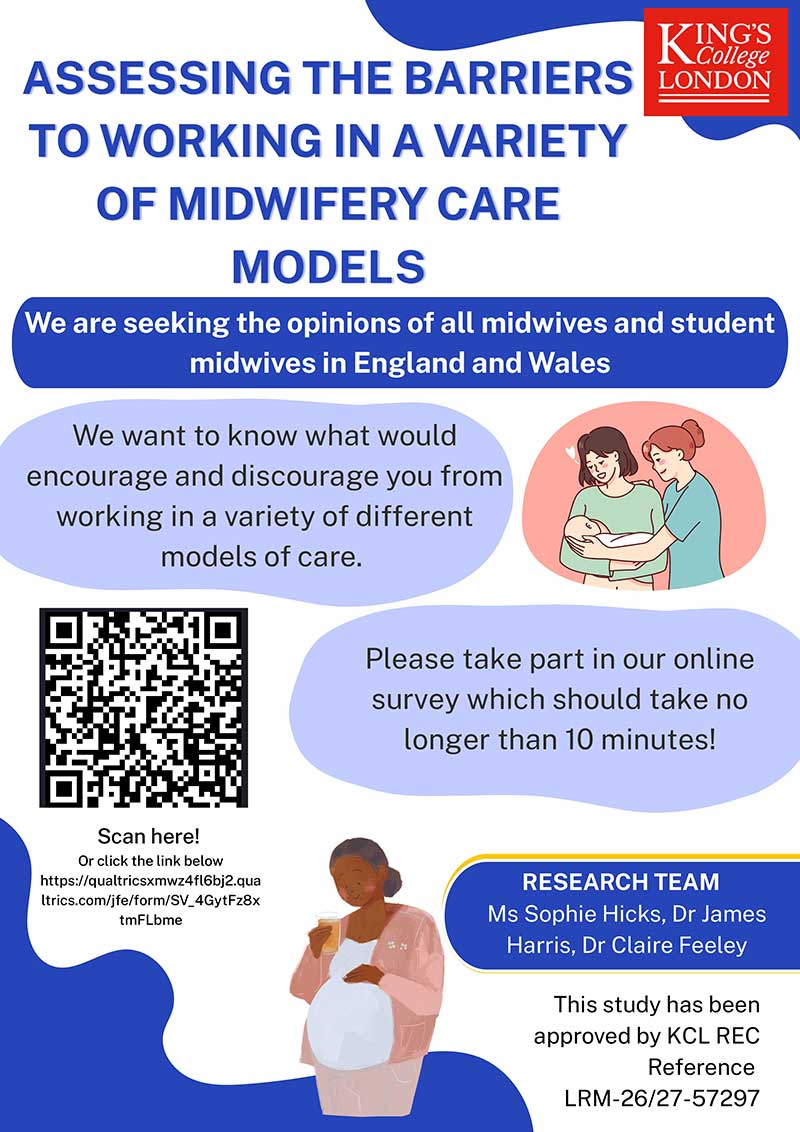
To take part in the M-WAPS study, please scan the QR code or follow the survey link below.
https://qualtricsxmwz4fl6bj2.qualtrics.com/jfe/form/SV_4GytFz8xtmFLbme