








A Quest for a Physiological Twin Birth
Sarah Fisher (she/her) – Women’s Health Advocate, Peer Researcher and PPIE Adviser
@SarahFisherPPIE
Published in The Practising Midwife Volume 26 Issue 11 December 2023, Pages 31-34
https://doi.org/10.55975/JSMY4716
Summary
In 2019, I achieved my dream twin birth. In comparison with the stressful journey I had been through to exercise my choice of a more physiological birth, the labour was easy! As a busy mum-of-three it has taken me until now to find the space in my life and head to put my experience into words. I hope my reflections will help make midwives and obstetricians more aware and improve care for other women.
Induction
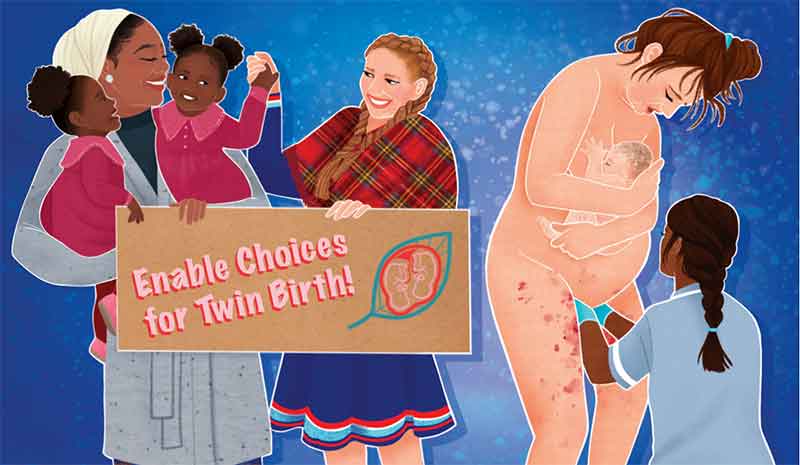
To a bystander the labour may have looked fairly straightforward. At 38+3 weeks, two sweeps hadn’t got things moving so, incredibly uncomfortable and struggling to sleep, I felt the time was right for induction. Six hours in, my waters were broken to speed up mild contractions. Things then progressed quickly, and little more than three hours later I birthed my first twin, my son.
Before his sister arrived, we enjoyed a lovely one-to-one cuddle and his first feed. Keen to avoid syntocinon before her birth, it seemed to do the trick to latch him on and to sit more upright because although my contractions slowed, they didn’t stop. An hour later my daughter was born breech whilst I was still holding her brother. I was elated and so relieved to have birthed them myself.
‘With just gas and air and courage’ was how daddy relayed the news. But in reality it had taken so much more.
Despite being pregnant with two babies, I’d felt confident that my body would pull through if given the chance. I was fortunate to be healthy and pregnant with the lowest risk, dichorionic diamniotic (DCDA) twins, meaning each baby had their own placenta and amniotic sac. I already had one vaginal birth, coping well with Entonox, despite augmentation of labour. Whilst some women fear lack of pain-relief, I was the opposite. It was the thought of one intervention leading to another, culminating in a potentially traumatic instrumental birth that got my anxiety rocketing. On top of that, I worried about how I’d look after two babies following a caesarean plus their big brother. Trying to avoid those scenarios would help give us all the best start, I felt.
Yet my plans and hopes didn’t fit well with the NHS vision of multiple birth. My first scan at 13 weeks delivered the unexpected news that I was expecting twins and my care and subsequent appointments immediately switched from midwives to obstetricians. Extremely shocked and anxious, I didn’t even register that at the time. At the next appointment, enquiring about birth options I was informed that for uncomplicated DCDA twins, if the presenting twin is head-down, vaginal birth is suggested. But in practice it didn’t feel encouraged. Rather, it felt beyond the comfort – and perhaps experience – of my care providers.
I went on to see many different obstetricians due to a lack of continuity. Discussions were very risk-focused, albeit well- intentioned. With blanket recommendations of induction at 37 weeks due to increased risk of stillbirth (despite learning from my own research that the small increased risk starts from 38 weeks for uncomplicated DCDA pregnancies) and an epidural, I felt I was being set up for an instrumental delivery. I didn’t want interventions on a ‘just in case’ basis. I was more concerned about the less serious yet far more likely unintended consequences and adverse outcomes that intervention might bring. Namely trauma, a difficult recovery, smaller babies and breastfeeding challenges.
The medicalisation tightrope – early induction, epidural and time- restriction
I wanted to avoid earlier induction to optimise my chances of going into labour naturally and the likelihood of coping without pain-relief, including epidural, and to give my babies more time to grow and develop. The latter was particularly important to me to help breastfeeding. With my older son I’d had to overcome many breastfeeding problems I felt were largely due to disturbances and an unfavourable environment immediately after birth.
An epidural was recommended to make assisted births and an emergency caesarean quicker and easier, due to the increased chance of needing intervention with twins. But intervention was what I was trying to avoid, and I knew an epidural would make it more likely. I wanted sensation so that I could work with my body. I met with an anaesthetist which only made me more certain, and I was prepared to take the small additional risk of an emergency caesarean under general anaesthetic.
I wanted flexibility, and to hold and suckle baby one to aid my contractions
Another tricky point was the potential length of time between the births. The hospital’s guidance stated that following the first birth, if twin two’s fetal heart rate remained normal, syntocinon should be started if there weren’t contractions after 20-30 minutes, and an assisted delivery should be considered if the second baby wasn’t born within 30mins of the first. I was concerned that such a limit was unlikely to allow a spontaneous birth. If monitoring wasn’t detecting anything of concern, I didn’t see a need to speed things along. I wanted flexibility, and to hold and suckle baby one to aid my contractions.
What made a positive difference?
I’ll be eternally grateful to Arezou Rezvani, then consultant midwife at my hospital. Frustrated and dismayed at 34 weeks, I contacted her and she offered to meet to discuss labour ward options. I had already been told that the birth centre wasn’t an option because it was on a different floor and a busy lift could delay a transfer. Patiently and generously she gave me her time and enabled me to exercise choice. As some of my preferences were contrary to the maternity unit’s and NICE guidance, after speaking with senior consultants following a healthy 35 week scan, she signed them off, shared with necessary staff, and added them to my file to prevent obstacles on the day.
Other women are unlikely to know their options, or how to navigate the system
My experience came from a place of multiple privilege. I previously worked at maternity charity National Childbirth Trust. I had knowledge and contacts to draw on for support, including friend and maternity activist Mary Newburn who put me in contact with a doula and a consultant midwife experienced in vaginal birth for twins. Other women are unlikely to know their options, or how to navigate the system. Additionally, the Multiple Births Foundation was based at my chosen hospital. Jane Denton, then director, was a rock to me.1 Jane provided emotional support and the consistency that I was lacking from care providers, accompanying me along the way for much of my journey, in addition to being a helpful contact at the hospital.
Fortunately, in labour the midwife I was blessed with was Laura Forster. Despite limited experience with twins, she was warm, encouraging, respectful of my choices and worked confidently to achieve them. I’m sure it’s no coincidence that my dream birth was attended by my dream midwife. We reconnected recently and she shared the following: ‘Your birth was a joy to attend and has made me reflect that the art of midwifery can sometimes be a little lost with guidelines and rules. The twin births I had previously been present at, at least twin two’s delivery had always been taken over by the obstetric team… Yours was the first I had the privilege of assisting to deliver both babies and you will be pleased to hear it has not been the last!’
I’m also thankful for hypnobirthing. Having practiced with Natal Hypnotherapy birth preparation audio tracks religiously during my first pregnancy, I was happy to discover versions specifically for twins or multiples, available for both vaginal and caesarean birth.2
“Fortunately, in labour the midwife I was blessed with was Laura Forster. Despite limited experience with twins, she was warm, encouraging, respectful of my choices and worked confidently to achieve them. I’m sure it’s no coincidence that my dream birth was attended by my dream midwife.”
Change is needed
Despite this support and privilege, it was tough. The effort required for all the research, the multiple appointments, and the resultant stress when I should have been relaxing, meant there were times I felt it would be easier to have a caesarean. It’s no wonder that so many women carrying twins opt for, or end up with, a caesarean. The confidence I felt in my ability was continually undermined by discussions that revolved around risk, presented in stark terms.
In 2019, my hospital was setting up a specialist multiple pregnancies team, as recommended by NICE.3 More needs to be done to ensure that these teams are in place and provide women with true options for informed-choice. Soon after learning I was expecting twins I’d have really welcomed an appointment with a midwife who was experienced and positive about physiological birth. Furthermore, continuing care from the same midwife and consultant obstetrician team who understood and supported my preferences, with back-up from their team, would have made a big difference to the struggle and uncertainty I faced.
Generally, I found the little information easily available to parents was basic and lacking nuance, especially in relation to risks and birth options. It’s no wonder that many women, myself included, look for support and positive examples to Facebook groups like ‘Birthing Multiples Naturally’ and some, with money, hire doulas or opt out of the mainstream system and book independent midwives. A physiological multiple birth should be a choice available to all, not only to a privileged minority.
An autistic afterword
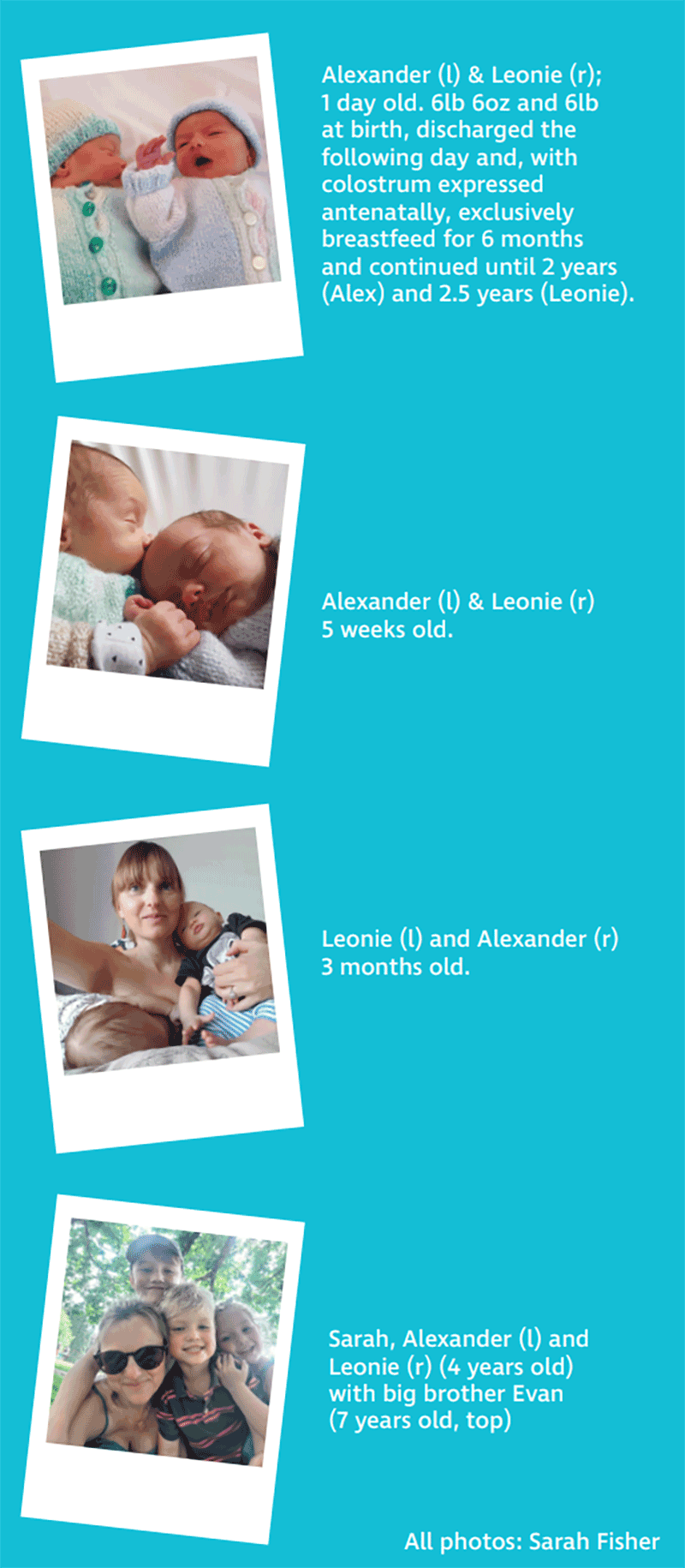
Since having my three children I have learnt that I am autistic. Had I known this at the time and disclosed it to health professionals, I can’t help wonder what impact it would have had on my experience of exploring and negotiating my birth choices and in turn, upon the births and outcomes.
Autistic pregnant women and mothers have multiple specific and varying needs
Ideally, I would have benefited from midwifery continuity, having the opportunity to develop a trusting relationship with a midwife who was kind, flexible and accommodating. Business as usual would have been a far less favourable scenario. If that were the case, would my questions, in-depth research, attention to detail and desire to explore and consider different scenarios have been dismissed as fixation and a mere manifestation of my autism? For although the consultant obstetricians and the anaesthetist that I saw antenatally didn’t necessarily agree with my preferences, importantly, they granted me time for discussion and patience for my questions. What I do know is that it was the support and care from the specific individuals named in this article that made all the difference.
Autistic pregnant women and mothers have multiple specific and varying needs, and are particularly vulnerable if their individual needs aren’t met. That’s a separate story which I’ll refrain from further comment here, except to point to work and initiatives by the autistic health professionals and researchers that form the Maternity and Autism Research Group (MARG).4 TPM
Acknowledgement
I’d like to express my thanks and immense gratitude to all individuals mentioned and to acknowledge Mary Newburn’s additional support with this article.
References
- The Multiple Births Foundation corroborated with Birmingham City University to establish the Elizabeth Bryan Multiple Births Centre. For more info see: bcu.ac.uk/EBMBC. Accessed July 24, 2023.
- Hypnobirthing for Birth – Effective Birth Preparation Audio Tracks. Natal Hypnotherapy. https://natalhypnotherapy.co.uk/product/ hypnobirthing-effective-birth-preparation/. Accessed October 11, 2023.
- Twin and triplet pregnancy NICE guideline (NG137). NICE. https://www.nice.org.uk/guidance/ng137/resources/twin-and-triplet-pregnancypdf-66141724389829. Published September 04, 2019.
- Welcome to the Maternity Autism Research Group. MARG. https://www.maternityautismresearchgroup.co.uk/. Accessed July 23, 2023.