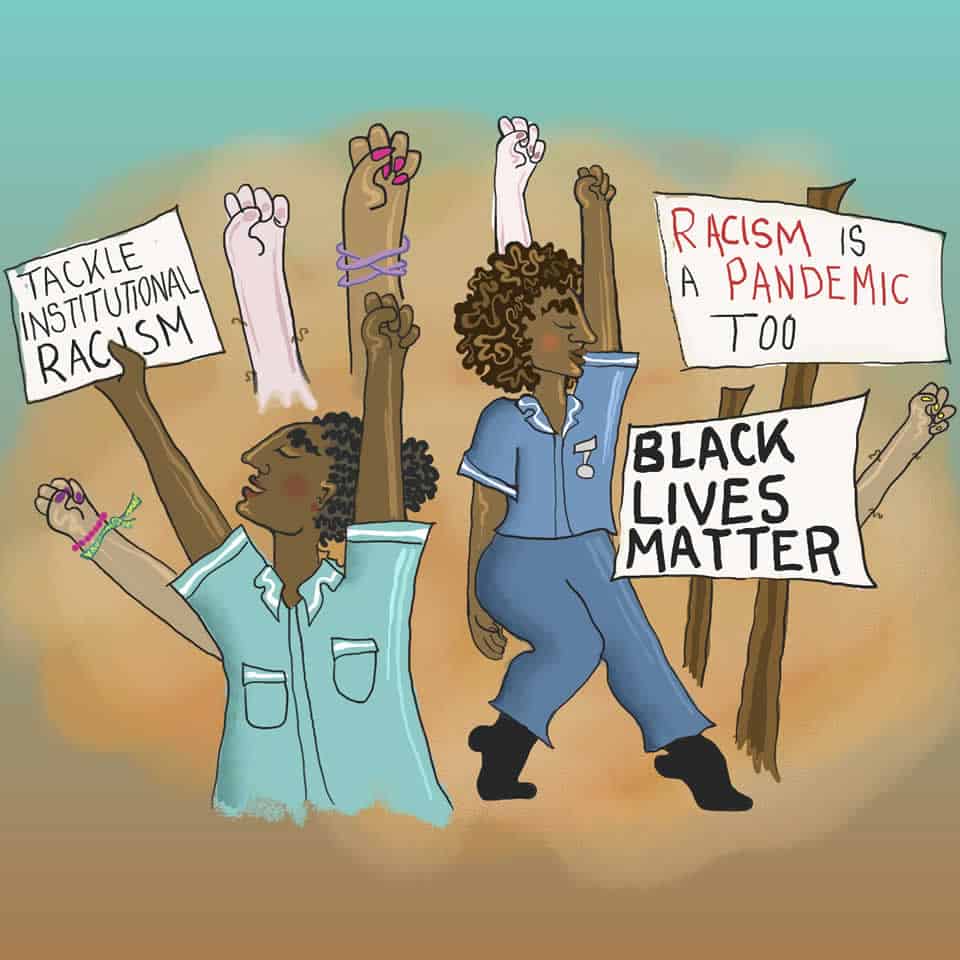


An Open Letter to Midwives: Black Lives Matter
Matilda Oluyemi – Student Midwife, Robert Gordon University. Instagram: @matildaaforever.

Jyll Skinner – Student Midwife, Robert Gordon University. Twitter: @rethought.

Claire Vigot – Student Midwife, Robert Gordon University. Twitter: @claire_vigot.

Dear Midwives,
It’s time, and past time, to have a discussion about race. In our work, we follow a midwifery model of care, but much of our practice aligns with an obstetric model built upon a racist, white supremacist foundation. A revered father of gynaecology, J. Marion Sims, used enslaved black women — without informed consent and without the use of readily available anaesthesia — to further research into surgical solutions to vesicovaginal fistulas. How often have we asked or reached for a Sims speculum without knowing the origins of its creation or name? Even if you have never used that implement, it is very likely that you have referred to the position used to relieve compression of a prolapsed cord as the ‘exaggerated Sims’.
Textbooks have historically cited “thicker black skin” as justification for providing inadequate analgesia (or none at all). Echoes of the belief that Black people are invulnerable to noxious stimuli can be found in the lower rates of pain relief given to Black women in labour. Black people in general are noted to have higher rates of heart disease, diabetes, hypertension and mental illness, and pertinently for us as midwives, Black women are dying at five times the rate of their white counterparts during the perinatal period.
Echoes of the belief that Black people are invulnerable to noxious stimuli can be found in the lower rates of pain relief given to Black women in labour.
You may have seen the “five times more likely to die” statistic being repeated since the 2018 and 2019 MBRRACE reports were published, but this sickening phenomenon isn’t new – racial disparities in UK maternity services pre-date the ubiquitous MBRRACE statistics. The other statistic that may not be as widely known is that Black babies are dying at twice the rate of white babies. So, why is this happening? Since Arline Geronimus’ work on weathering was published in the 1990s, many researchers have looked into the effects of white-centred societies on Black people. Enquiries into the cause of Black maternal mortality in various countries with predominantly white populations have been conducted.
In some of these countries the disparities in maternal and neonatal outcomes have persisted in spite of social factors thought to promote health and higher life expectancies, for example, in US studies, Black women with advanced degrees are still far more likely to die during childbirth than white women without any tertiary education. We may feel as though the days of slavery and colonialism are behind us, but the legacy of those racist institutions loom large over Black populations: as the murder of George Floyd in the United States earlier this year brutally demonstrates, slavery and colonialism have paved the way for police brutality and hate crimes in the contemporary, post-colonial world.
You may have seen the “five times more likely to die” statistic being repeated since the 2018 and 2019 MBRRACE reports were published, but this sickening phenomenon isn’t new – racial disparities in UK maternity services pre-date the ubiquitous MBRRACE statistics.
Where, you may ask, are the midwives brutalising women and babies or committing hate crimes? Surely, all of us try our best to be “nice” and “kind” to all women? And yet, none of these behaviours are preventing Black women from dying during childbirth. Midwives ‘don’t see colour’, but Black babies still die twice as often as white ones. We may not be committing overt offences, but passively allowing racism to harm Black women is killing them. By only committing ourselves to being “kind” and “nice”, we are excusing ourselves from acknowledging the pain caused by midwives and other healthcare professionals that also commit themselves to being “kind” and “nice”, but choose to ignore the voiced concerns of Black women, or remain ignorant to signs of deterioration that present in Black women and babies. ‘Not seeing colour’ can erase entire histories, cultural heritages and personal identities, by invalidating the everyday challenges faced by Black women. It also ignores the microaggressions faced by Black staff. Even if it makes us uncomfortable, we must understand that we are racist even if we do not want to be.
Surely, all of us try our best to be “nice” and “kind” to all women? And yet, none of these behaviours are preventing Black women from dying during childbirth.
So, what can we do? What can we objectively start to change RIGHT NOW? Seek out anti-racist literature instead of non-racist literature. Sit and examine your discomfort and acknowledge that the world is made for white people, and you have never noticed it until now. Act on this better understanding, speak up against jokes, stereotypes, and mockery. You may have thought that “being kind” was all that mattered, but now you know better, and as Maya Angelou said, ‘when you know better, do better’. Do not treat Black people, particularly Black women, as a free resource: the internet and social media are full of Black women volunteering their time to dispel racist tropes and ignorance. For a little money, we can hold the works of anti-racist writers in our hands — consider this an investment in improved obstetric outcomes for Black women and their babies. We would not expect a woman with a hospital acquired infection to research treatments or care pathways and teach us how to do our jobs. This is what we ask of Black women when we ask them how to resolve our own unconscious and conscious biases. Do the work.
Do not treat Black people, particularly Black women, as a free resource: the internet and social media are full of Black women volunteering their time to dispel racist tropes and ignorance.
Remember, always think: ‘if this woman was white, would I have thought or reacted the same way?’ Racism is like a string coiled tight in our brains that will take years to pull out, but the longer – and harder – you pull, the better. Believe Black women’s pain and concerns. Be an advocate for anti-racism. Protect Black women. Empower them. Black women are dying because of our ignorance and willingness to look the other way. Teach others what you learn about the challenges faced by people of colour, even when it’s uncomfortable. We are midwives. We came into this profession because we care; we should care about racism and working towards anti-racism too. Do the best you can until you know better. Then when you know better, do better.
Recommended Resources:
-
Medical Apartheid: The Dark History of Medical Experimentation on Black Americans from Colonial Times to the Present by Harriet A. Washington
-
Medical Bondage by Deirdre Cooper Owens
-
Reproductive Injustice: Racism, Pregnancy, and Premature Birth by Dana-Ain Davis
-
Black and British: A Forgotten History by David Olusoga
-
Brit(ish): On Race, Identity and Belonging by Afua Hirsch
-
How to Be an Antiracist by Ibram X. Kendi
-
Me and White Supremacy by Layla F. Saad
-
Why I’m No Longer Talking to White People About Race by Reni Eddo-Lodge
-
I Am Not Your Baby Mother by Candice Brathwaite
-
‘Yo, is This Racist?’ – Podcast
-
‘Seeing White’ – Podcast