









Athlete Mothers – New Challenges and Considerations for Care
Sarah Stevenson (she/her) – Midwifery Lecturer, Northumbria University
Published in The Practising Midwife Volume 27 Issue 1 January 2024, Pages 26-28
https://doi.org/10.55975/NRJQ4938
Summary
The achievement of the England women’s football team, reaching the World Cup Final, epitomises elevation in profile and appreciation of women’s sport in recent times. But can midwifery care for this unique group keep pace with their progression as athletes, and does it matter?
High intensity
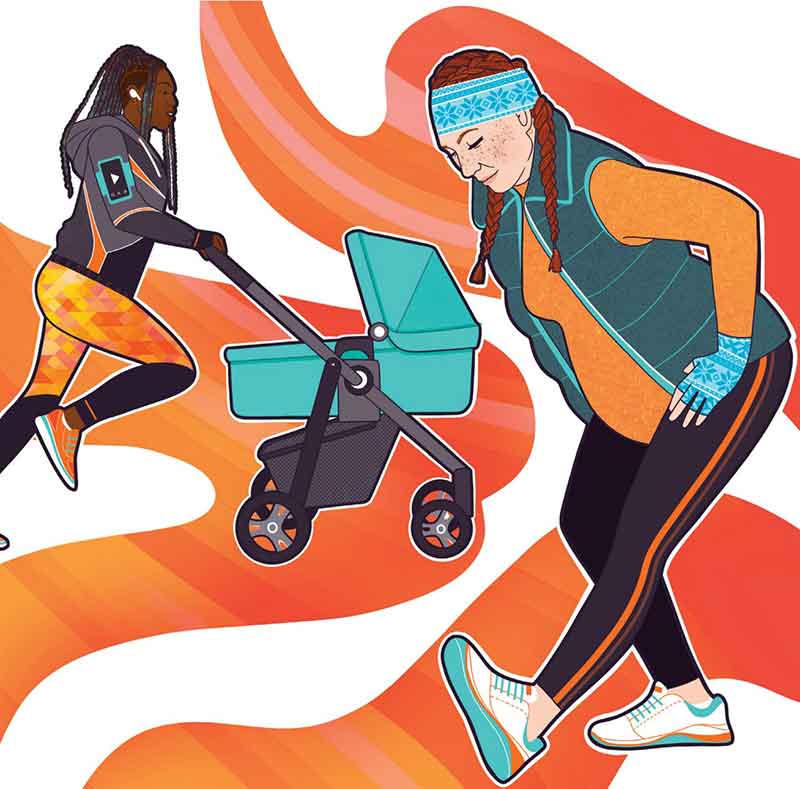
Women train and compete in sport with unparalleled dilemmas, including decisions over pregnancy timing and how motherhood may alter their athletic career. Physical and emotional challenges experienced during pregnancy, early parenthood and return to sport, have emerged through stories of high-profile stars. However, differences from the wider population in emotional response, bonding and postnatal depression (PND) are lacking in studies. Existing recommendations on physical activity in pregnancy do not fully consider high intensity training which is normal to these athletes.
Midwives’ responsibility for evidence-based, individualised care for all women entering maternity services includes elite athletes. Ensuring they are not left behind in quality care provision, midwives should be central in much-needed research and its application to practice.
This article recognises diversity and inclusivity in sport, pregnancy and parenthood. It is appreciated there are multifactorial issues and challenges for all sports people and parents regardless of identity and self-description. These are research areas themselves, however, this piece focuses on cis- gendered female athletes.
Women in sport
The Women’s Football World Cup Final 2023 was watched by 14.4million UK viewers, exceeding figures for the tennis Wimbledon Championships Men’s Singles Final.1 This achievement is made the more impressive considering it was 2018 before a women’s UK league became fully professional, and 2022 before Newcastle United Women played competitively in the club’s St James’ Park stadium.2,3 I was a young tennis player with high aspirations when one-time Wimbledon Champion Richard Krajicek aired the view that women players were ‘fat, lazy pigs’, and by playing shorter matches than men in Grand Slams they had no right to claim equal prize money.4
Growing up interested in sport in the 1980s and 1990s, I experienced how entrenched stereotypes, such as certain sports considered unsuitable for women, or women’s abilities and spectator enjoyment considered inferior, resulted in lack of investment, scarce female athlete research, and limited grass-roots opportunities. As a midwife I have seen healthcare parallels, with under-representation of women in health research and clinical trials, and it being 2022 before a National Women’s Health Strategy was established.5
Women attaining recognition as elite athletes have done so while overcoming considerable barriers, only to face further challenges and uncertainty in pregnancy. The British Association of Sport and Exercise Sciences acknowledge this, highlighting gaps in knowledge, medical provision, and absence of defined support pathways for women in elite sport.6 This appears little different to my experience of pregnancy 20 years ago, where my midwife recommended ‘staying active’, but was completely unable to advise regarding continuing high intensity training and coaching, which was my norm and income. I felt confused, worried about harm to my baby, and pressure from poor maternity benefits as a self-employed coach. Later, I developed Pubis Symphysis Dysfunction, believing I was at fault for continuing sport.
The need for holistically developed support pathways, with equal emphasis on individuals as athletes and pregnant women/mothers, is clear to me from my experience. I believe this makes it vital that midwives, advocating for all women in pregnancy and birth, are involved in research needed to inform pathways, development of guidance, and training to promote confidence and competence for midwives working with athletes.
Athlete mothers
Contrasting past times, where delaying pregnancy until after the competitive career of female athletes was encouraged, or seen as an end to elite sport participation, there are increasing examples of sportswomen mothers.7,8 High-profile stars such as Serena Williams (tennis), Allyson Felix (athletics) and Katrina Gorry (football), are examples from diverse sports successfully returning. They have spoken publicly about discrimination, personal and professional challenges in choosing motherhood at the height of sporting careers. This includes reduction in sponsorship and no scope for adjustments in schedule to enable breastfeeding.9,10 While some governing bodies are instigating change, such as the Rugby Football Union with paid maternity leave, other organisations are slow to act, highlighted by footballer Sara Bjork Gunnarsdottir suing Olympique Lyonnais for failing to follow FIFA maternity regulations.11,12 The call is now being made for athlete mothers’ voices to be represented in research as well as the media.
Midwives and research
Existing research appears predominantly conducted in Sports Science and Medicine, published in corresponding journals, concerned with effects of aerobic exercise and safety. Systematic review and meta-analysis conclude evidence informing current recommendations is low quality, with inconsistent terminology and thresholds classifying exercise intensity.13 Additionally, research into elite athletes, with significantly different heart rate and VO2 max baselines, is extremely scarce. The advice for athletes who train beyond current guidelines of frequency, intensity and duration, is that they should be closely observed for maternal and fetal wellbeing.14 What this means for midwife antenatal contacts is not explained. Midwives’ expert pregnancy knowledge and experience places them uniquely to advise athletes in pregnancy. However, it is perhaps unsurprising given the research gaps, and lack of midwife researchers currently, that many do not have confidence, knowledge or training to provide this.15
Focus for midwives
Further interest includes increased injury risk returning to sport, such as high rates of ACL injury in women’s football, raising questions around postnatal recovery advice given by midwives, especially considering mode of birth. Emotionally and psychologically, there is an urgency for qualitative evidence from athletes.16 Little is known about prevalence and presentation of postnatal depression in female athletes, outside of individuals such as Serena Williams. There is a better understanding of comparable rates of conditions such as depression and anxiety in the general population, with some possible increased likelihood of sleep and other mental health disorders.17,18 Growing evidence on the benefits of physical activity in PND has resulted in practice encouraging this. As pre-existing depression is a risk for PND, added to experiences of athletes including pressure to resume sport and possible internal conflict of self-perception in roles of mother and athlete, do midwives need to consider PND as a greater risk, and would physical activity be an appropriate intervention?
With these questions remaining, I feel there is clear imperative for midwives placing themselves at the heart of multi- professional research and collaboration to advance practice working with elite female athletes, showing equal dedication to our role in their care as they demonstrate in sport. TPM
“The need for holistically developed support pathways, with equal emphasis on individuals as athletes and pregnant women/mothers, is clear to me from my experience. I believe this makes it vital that midwives, advocating for all women in pregnancy and birth, are involved in research needed to inform pathways, development of guidance, and training to promote confidence and competence for midwives working with athletes.”
References
- Women’s World Cup final: England v Spain watched by peak BBC TV audience of 12million. BBC Sport. https://www.bbc. co.uk/sport/football/66567881. Published August 21, 2023. Accessed August 21, 2023.
- Independent report Raising the bar – reframing the opportunity in women’s football. DCMS. https://www.gov.uk/ government/publications/raising-the-bar- reframing-the-opportunity-in-womens- football/raising-the-bar-reframing-the- opportunity-in-womens-football. Updated July 17, 2023. Accessed August 23, 2023.
- Newcastle United Women: The history. Newcastle United. https://www.nufc.co.uk/ news/features/newcastle-united-women- the-history/ Published April 26, 2022. Accessed August 23, 2023.
- Krajicek throws fat in fire with comments on women players. UPI Archives https:// www.upi.com/Archives/1992/06/26/Krajicek- throws-fat-in-fire-with-comments-on-women- players/2680709531200/. Published June 26, 1992. Accessed August 23, 2023.
- Women’s Health Strategy for England. DHSC. https://www.gov.uk/government/ publications/womens-health-strategy- for-england/womens-health-strategy- for-england. Updated August 30, 2022. Accessed September 29, 2023.
- A Bump in the Road? The BASES Expert Statement on Pregnant and Postnatal Athletes. British Association of Sport and Exercise Sciences. https://www.bases. org.uk/imgs/9729_bas_bases_tses_ winter_2022_online es_pg8_9908.pdf. 2022;74:8-9.
- Sundgot-Borgen J, Sundgot-Borgen C, Myklebust G, Sølvberg N, Monica K. T. Elite athletes get pregnant, have healthy babies and return to sport early postpartum. BMJ Open Sport Exerc Med. 2019;5(1):e000562. doi.org/10.1136/bmjsem-2019-000652.
- Palmer FR, Leberman SI. Elite athletes as mothers: managing multiple identities. Sport Management Rev. 2009;12(4):241-254.
- Berated to celebrated: how the perception of motherhood in athletics has evolved. World Athletics. https://worldathletics.org/ women-in-athletics/news/motherhood- athletics-sport-felix-fraser-pryce. Published March 11, 2023. Accessed August 23, 2023.
- Leicester J. Pioneering mothers are breaking down barriers to breastfeeding in Olympic sports. ABC News. https:// abcnews.go.com/Health/wireStory/ breastfeeding-olympians-top-careers- motherhood-102010282. Published August 04, 2023. Accessed August 23, 2023.
- New maternity, pregnant parent & adoption leave policy for England Women players. England Rugby. https://www. englandrugby.com/news/article/new- maternity-pregnant-parent-adoption-leave- policy-for-england-women-players. Published February 16, 2023. Accessed August 23, 2023.
- A groundbreaking maternity case. FIFPRO. https://fifpro.org/en/supporting- players/conditions-of-employment/ maternity-and-parental-provision/sara-bjork- gunnarsdottir-s-maternity-case-shows-all- players-need-protection-even-those-at-high- profile-clubs/. Published January 18, 2023. Accessed August 23, 2023.
- Beetham KS, Giles C, Noetel M, et al. The effects of vigorous intensity exercise in the third trimester of pregnancy: a systematic review and meta-analysis. BMC Pregnancy Childbirth. 2019;19(1):281. doi.org/10.1186/ s12884-019-2441-1.
- Bø K, Artal R, Barakat R, et al. Exercise and pregnancy in recreational and elite athletes: 2016/2017 evidence summary from the IOC expert group meeting, Lausanne. Part 5. Recommendations for health professionals and active women. Br J Sports Med. 2018;52:1080-1085. doi. org/10.1136/bjsports-2018-099351.
- Hayman M, Raeburn M, Alley S, Cannon S, Short C. What exercise advice are women receiving from their healthcare practitioners during pregnancy? Women Birth. 2020;33(4):357-362. doi.org/10.1016/j. wombi.2019.07.302.
- Davenport MH, Nesdoly A, Ray L, Thornton JS, Khurana R, McHugh T-LF. Pushing for change: A qualitative study of the experiences of elite athletes during pregnancy. Br J Sports Med. 2022;56(8):452- 457. doi.org/10.1136/bjsports-2021-104755.
- Rice SM, Purcell R, De Silva S, Mawren D, McGorry PD, Parker AG. The Mental Health of Elite Athletes: A Narrative Systematic Review. Sports Medicine. 2016;46(9):1333- 1353. doi.org/10.1007/s40279-016-0492-2.
- Montero A, Stevens D, Adams R, Drummond M. Sleep and Mental Health Issues in Current and Former Athletes: A Mini Review. Front Psychol. 2022;13:868614. doi.org/10.3389/fpsyg.2022.868614.

