









Blacktown Midwives: Prioritising Perinatal Mental Health Support
Rachel Sheridan – MAPS Midwife, Western Sydney Local Health District
Social @rachelms91
Published in The Practising Midwife Australia Volume 02 Issue 04 April 2024, Pages 08-11
https://doi.org/ 10.55975/NJOQ6499
Summary
The increasingly comprehensive psychosocial screening tools used in pregnancy have been instrumental in highlighting the experiences of expectant parents with mental health issues to their midwives. We are privy to revelations about the significant trauma that some have endured. I would like to share with you my experiences working in MAPS (Midwifery Antenatal Postnatal Services), a model providing midwifery continuity of care (MCoC) to more vulnerable families at Blacktown Hospital. I will share insights into how working within this model continues to influence my practice and work-life balance.
Background on MAPS
The New South Wales (NSW) Health MAPS model was introduced at Blacktown Hospital in March 2022. The team currently consists of five midwives, including myself, working either part-time or full-time across the week. The no-exit MCoC model was set up for women and families who have been or are currently impacted by:
- Mental health issues
- Domestic Violence (DV)
- Substance misuse
- Isolation and/or lack of support
- Childhood abuse
- Birth trauma
- Department of Communities and Justice (DCJ) involvement
- Social issues including housing or financial concerns
- Intellectual disability
Referrals for MAPS are received from the Women’s Health Clinic (WHC) at Blacktown and from Safe Start meetings held and chaired weekly by one of our MAPS midwives. The NSW Health Safe Start model was introduced to identify families at risk of, or with, perinatal mental health problems. Support is then implemented using a multidisciplinary team approach. The team of multiple health and social care professionals, including those from mental health and social work, will collaborate and communicate to create a care plan that best meets the family’s needs. Being cared for by the MAPS team is often a recommendation that forms part of the care plan of some of these families.
Living up to our definition
The word midwife means ‘with woman’. After working in models of care and midwifery settings outside of MAPS, I have observed several factors to impact negatively on a midwife’s ability to spend needed time with a parent or family. With often questionable staff ratios and more complex medical needs in midwifery care, a greater demand is placed on the workload of midwives. Furthermore, working in a hospital or co-located midwife clinic with a sizeable and often changing caseload of pregnant women we are often restricted to 20 to 30-minute appointments. In these situations, little time is left to discuss with the woman how she is managing emotionally and socially.
It was decided that the size of a MAPS midwives’ caseload of pregnant women would need to accommodate additional time required to explore the identified psychosocial risks and offering and implementing additional support. I appreciate considerably the time I have with expectant parents and the families I look after. I aim to use this time in any way that would benefit them appropriately whether that is talking through current stressors and/or providing birth education. By encompassing a relationship-based care approach in MAPS, the established relational continuity can improve a women’s overall care experience.1 The woman remains the focus of the care provided and not the tasks that need to be ticked off at that appointment.
‘She helped me with my anxiety and took the time to really listen and explain what to expect and what could happen throughout my pregnancy journey.’ (Blacktown Hospital MAPS Quality Survey 2022/2023)
Bringing midwifery home
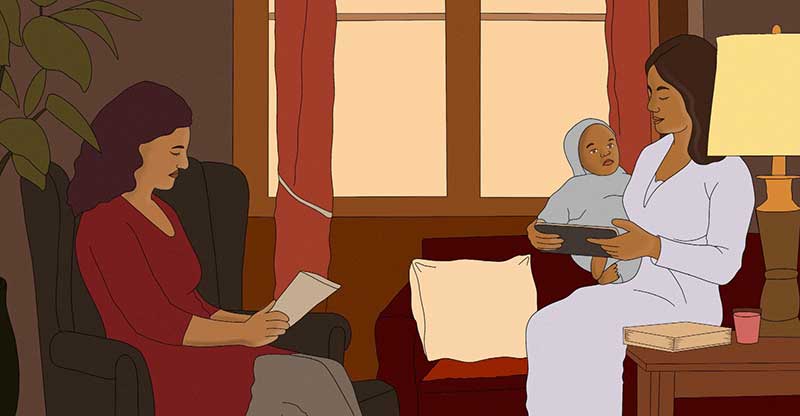
MAPS appointments are mostly attended to in the woman’s home. We have so far received great feedback from the families about this service, with one in three MAPS women unable to drive themselves to the hospital or an outreach clinic for appointments.
‘I was able to be in the comfort of my own home and I feel the midwife/patient relationship was so much easier to build along with my family they were able to be involved and ask their own questions.’ (Blacktown Hospital MAPS Quality Survey 2022/2023)
“She helped me with my anxiety and took the time to really listen and explain what to expect and what could happen throughout my pregnancy journey.”
We are welcomed and trusted into the woman’s own space which is a privilege for midwives. During our time spent in the home, we incidentally find areas of support the family could greatly benefit from. We learn more about the relationship dynamics present in the home. We understand that the perinatal period can be a very vulnerable time for these families. Having potentially difficult discussions in a more familiar and safe space for the family can facilitate more in-depth and productive conversations surrounding mental health and social issues.2
Unfortunately, working independently in the community can have its downfalls. We can attempt to mitigate certain risks through completing a home safety checklist. However, working in unfamiliar environments in isolation can place us in unpredictable situations. As mandatory reporters we occasionally find ourselves in a position where we need to escalate our concerns about poor housing conditions and/or child safety in the home. It is not unusual for MAPS midwives to see women in our allocated clinic room in the hospital, when safety risks are identified e.g. cases of domestic violence and problematic drug use in the home. It is vital we look after ourselves as community health workers to ensure we can continue to provide our services.
“By incorporating a more strength-based approach in conversations with the woman and her family I find that focusing on what they are doing well encourages personal growth, fulfillment and discovery. I believe this gives each parent a better opportunity to be the parent they want to be, regardless of the difficulties they are facing.”
Changing thresholds and conflicting interests
Throughout my career, I have been exposed to the considerable diversities in which people live. I understand more about the challenges and barriers individuals face which can have a significant impact on their ability to care for themselves and others. By incorporating a more strength-based approach in conversations with the woman and her family I find that focusing on what they are doing well encourages personal growth, fulfilment and discovery. I believe this gives each parent a better opportunity to be the parent they want to be, regardless of the difficulties they are facing. ‘I received unconditional support, no judgement, kindness and compassion which are so crucial to me as someone whose mental health can be vulnerable at times.’ (Blacktown Hospital MAPS Quality Survey 2022/2023)
Whilst maintaining an open-minded approach about how people want to live, it has always been my priority to keep safety at the forefront of my decision making. I find myself more clinically discriminating in situations where there are conflicting interests. For example, caring for a mother who has significant mental health concerns which may inhibit her ability to parent safely. I have found myself in situations where I have needed to have potentially very distressing conversations with the woman about child protection concerns. Throughout my career I have always been transparent about any concerns I have had. In my experience I have found this to work better in maintaining a therapeutic relationship than escalating and reporting concerns without their knowledge of me doing so. I also make it clear that I am a mandatory reporter early in the relationship to avoid even more difficult conversations later.
Work-life balance
Having worked in all different models of care, I find my current role to be the most flexible and rewarding. Structuring my own workday allows me to allocate more of my time to the families who need substantial support. Not working within a rigid clinic setting I can also move appointments around quite easily and in my experience the women are often very understanding. We know that autonomy in working hours and choice of work setting can impact on overall work fulfillment.3,4 Having a greater level of flexibility and job satisfaction can reduce burnout levels amongst midwives.5 Burnout and personal mental health issues are known risk factors for midwives leaving the profession.5
Having been exposed to a great deal of distress in my role as a MAPS midwife, I prioritise time for self-care and attend regular clinical supervision which can be attended individually or as a team. In the MAPS team we have found attending together to be the most beneficial to discuss and debrief about recent difficult events that have occurred at work, whilst promoting professional development through learning and reflecting on these events. Clinical supervision has also been shown to optimise morale thus promoting a positive work environment. At home I continue to attend to my hobbies and spend time with family which is very healing for me. Although it can be challenging to not bring work home, I endeavour to protect this time at home and continue to strive for a positive work-life balance.
Conclusion
MAPS as a model of care can improve the experience for so many women and families, particularly those with perinatal mental health issues. With the known prevalence of mental health disorders in pregnancy and postnatally, the ongoing support for hospitals and midwives to provide MCoC models such as MAPS is vital. The feedback so far has been hugely positive from the women and families cared for by MAPS. Furthermore, we have learned about how MAPS can be a positive career choice for midwives wanting to work more autonomously in the community and with families experiencing greater vulnerabilities. Personally, I continue to love the work I do and feel so valued in my role as a MAPS midwife. I have great joy walking the journey alongside the families I come to care so much about. TPM
References
- McInnes R, Aitken-Arbuckle A, Lake S, Hollins Martin C, MacArthur J. Implementing continuity of midwifery career – just a friendly face? A realist evaluation. BMC Health Serv Res. 2020;20(1):304. doi.org/10.1186/s12913- 020-05159-9.
- Dahlberg U, Haugan G, Aune I. Women’s experiences of home visits by midwives in the early postnatal period. Midwifery. 2016;39:57-62. doi.org/10.1016/j. midw.2016.05.003.
- Cull J, Hunter B, Henley J, Fenwick J, Sidebotham M. “Overwhelmed and out of my depth”: Responses from early career midwives in the United Kingdom to the Work, Health and Emotional Lives of Midwives study. Women Birth. 2020;33(6):549-557. doi.org/10.1016/j. wombi.2020.01.003.
- Fereday J, Oster C. Managing a work-life balance: the experiences of midwives working in a group practice setting. Midwifery. 2010;26(3):311-318. doi.org/10.1016/j. midw.2008.06.004.
- Hunter B, Fenwick J, Sidebotham M, Henley J. Midwives in the United Kingdom: Levels of burnout, depression, anxiety and stress and associated predictors. Midwifery. 2019;79:102526. doi.org/10.1016/j.midw.2019.08.008.
- Spence SH, Wilson J, Kavanagh D, Strong J, Worrall L. Clinical supervision in four mental health professions: A review of the evidence. Behaviour Change. 2001;18(3):135. doi.org/10.1375/bech.18.3.135.

