








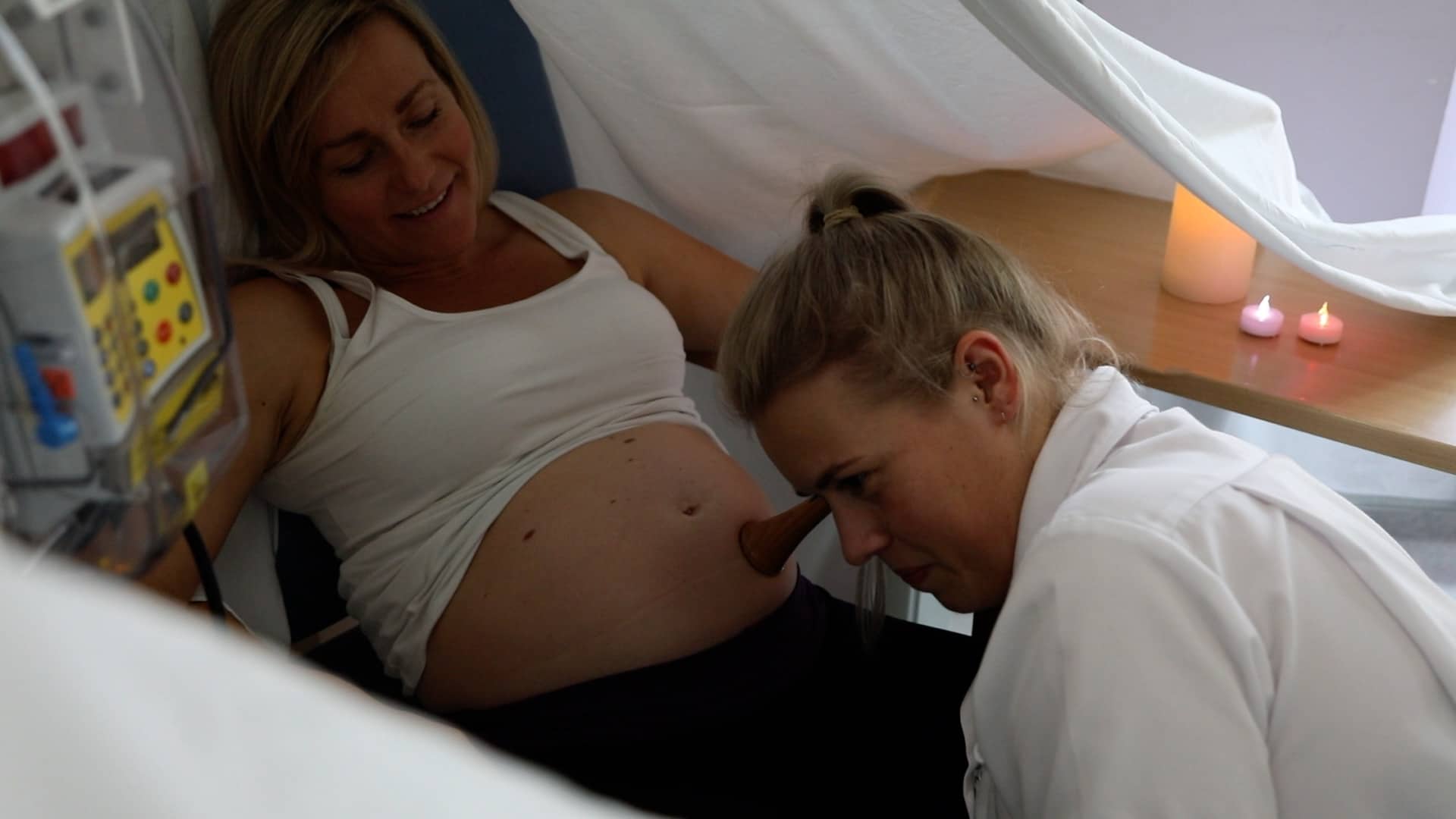
Challenging ‘Fresh Ears’ during labour and birth
Anna-Marie Madeley, Senior Midwifery Lecturer and Carolyn Rooth, Senior Midwifery Lecturer

Fresh ears: raising concerns
The Each Baby Counts 2015 Report introduced the Fresh ears concept and approach to IA whereby a second midwife confirms the fetal heart rate pattern every hour, with the expectation that interpretation errors will be minimised.2 This has resulted in adoption of the practice in some NHS organisations despite a paucity of evidence to support implementation. The lack of evidence base remains unchanged. The Royal College of Obstetricians and Gynaecologists (RCOG) ‘Each Baby Count’s progress report3 highlighted ongoing concerns with IA being a seemingly contributory factor to poor obstetric outcome. Midwives have a duty to practice in line with the best available evidence4 and uphold knowledge and skills to maintain safe and effective practice. However, when considering IA, a dilemma for midwives presents in that guidance on frequencies, timing, techniques, duration and principles is varied.5 With this knowledge in mind, it is nevertheless troubling that further roll out of the ‘Fresh Ears’ approach to IA is occurring across the UK even though evidence supporting its use remains lacking. Coupled with increasing medicalisation, scrutiny of maternity services and pressures faced by the midwifery workforce an impression of doubting credibility could be assumed. The introduction of other seemingly well intentioned defensive measures includes others rooted in other disciplines; for example, intentional rounding.6 Although the aim is to mitigate against the possibility of human error, issues of undermining of the midwifery profession raises concern.
We have, since 2015 and continue to be, disturbed by the implementation of an intervention which is unproven, lacks an evidence base and yet appears to increasingly implemented in maternity services. Questions are now being raised through social media about how this could happen. It is not as simple as a failure of the workforce to challenge implementation; midwives are working at a time where hospitals face increasing pressures to limit the possibility of the reoccurrence of adverse outcomes. It is therefore understandable that the introduction of practices such as Fresh Ears become part of our working lives. Lone voices can challenge the practice, but a collective response has been missing. If as a profession we are to effectively challenge the use of non-evidence based interventions and advocate for the autonomy of midwives, what is now required is a cohesive and collective raising of voices to question the use of this strategy.
Auditing practice
In previous roles, the authors undertook an audit of this practice.7 Whilst too small (13 respondents) to draw significant conclusions, the audit forms a possible reflection of the views of midwives using the intervention within their practice. Concerns were raised regarding the intrusive nature of Fresh Ears on women’s birthing experience, implementational challenges at home birth and the lack of consensus of how the practice should be implemented. Not all respondents were antagonists of the process, where preceptor midwives reported it provided reassurance, perhaps suggesting a lack of experience of IA. Above all, responses most viscerally reacted to the underlying motive in implementation of Fresh Ears, namely that midwifery skills in relation IA were being scrutinised and a lack of trust in the ability of midwives to perform IA safely.
Issues of competency
This appears to be supported by the text within the 2018 RCOG Each Baby Counts progress report3 where Fresh Ears is recommended. This highlights that despite the possibility of other contributory factors, in 21% of 674 reviewed cases, IA was identified as playing a critical contributory factor in cases which resulted in poor fetal outcome. Most notably these involved technique, equipment and timing (9%), errors of interpretation and detection of suspicious findings (8%), failure to escalate suspected deviations (7%), and other (6%). Whilst it may be difficult for midwives to acknowledge deficiencies in competency, this evidence suggests that auscultation skills amongst clinicians are variable. Exacerbating the problem has been a recognition of the lack of consensus of the standardised method for assessing and evaluating competency in the use of intermittent auscultation post registration and conflicting advice in how IA is conducted.1,8,9, 10
However, a Fresh Ears approach does not mitigate these issues of competency. Nor does it address inadequacies of assessment during an ongoing systematic assessment of risk. Rather than Fresh Ears, we advocate mechanisms to upskill and support midwives to perform IA effectively; to maintain a culture in which concerns can be escalated, either in relation to fetal well-being OR concerns around the practice of midwives in performing safe and intelligent IA. While educational packages on IA are becoming widely available, these have yet to be universally adopted and therefore there remains no universally accepted approach.12
In the absence of research, a transparent and balanced discussion across disciplines is needed to agree a consensus in terms of the perceived benefit or detriment unfavourable to all stakeholders, including service users.
Consensus requirements
What is clear is that there needs to be consensus in terms of standards for performing IA and the systematic approaches to periodic risk assessment. In an effort to address not only this gap, but also to understand why midwives are reluctant to translate existing evidence for IA into practice, for example Maud et al.,’s Intelligent Structured Intermittent Auscultation (ISIA) framework.5 The framework encompasses an admission risk assessment to assess suitability for IA and, importantly, an on-going assessment of risk which may indicate a need to revert to CEFM. Many organisations have adopted effective risk assessment tools to facilitate this which can also be used throughout labour to re-assess risk, confirming that IA as the method of fetal monitoring continues to be appropriate. We wholeheartedly support this type of approach as opposed to a universal use of Fresh Ears.
Conclusion
The overall response to the Each Baby Counts report has been implementation of the Saving Babies Lives Care bundle. This care bundle continues to be implemented in the second iteration, despite the AFFIRM trial13 showing no difference in stillbirth rates even though efforts to increase awareness of fetal movements and identify high risk fetuses and in some cases to expedite delivery. Conversely caesarean and induction rates have increased as has the duration of neonatal unit admission.13 This is a perplexing scenario and is therefore imperative that the Fresh Ears approach is not allowed to simply roll out across the UK and become further embedded into custom and practice without robust research into the effectiveness of the Fresh Ears intervention. This will inevitably take some time. In the absence of research, a transparent and balanced discussion across disciplines is needed to agree a consensus in terms of the perceived benefit or detriment unfavourable to all stakeholders, including service users. We would also propose that work continues to standardise approaches to both undertaking IA and the ongoing holistic risk assessment to ensure that IA remains the appropriate method of fetal monitoring for each woman.
Editorial note
The authors here have raised important issues regarding the introduction of the concept of ‘Fresh Ears‘. With opportune timing, the issue was recently flagged on social media and discussed with eminent midwifery academics. A letter of concern was written and escalated via the RCM who have kindly passed on our collective concerns. We have been informed that the issue will be investigated, with view to revising this component of the Saving Babies Lives bundle. However, we understand that official changes may now be delayed due to the Covid-19 pandemic, but we will follow up when appropriate.
REFERENCES
1.National Institute for Health and Care Excellence (2014) Intrapartum Care for healthy women and babies. Clinical Guideline. CG190. London. 2014 amended 2017.
2.Royal College of Obstetricians and Gynaecologists. Each Baby Counts: 2015 Full Report. London: RCOG; 2017 [www.rcog.org.uk/en/guidelines-research-services/audit-quality- improvement/each-baby-counts/ebc-2015-report/). 2015.
3.Royal College of Obstetricians and Gynaecologists. Each Baby Counts. Progress Report 2018. [online] 2018 Available at: https://www.rcog.org.uk/globalassets/documents/guidelines/research–audit/each-baby-counts/each-baby-counts-report-2018-11-12.pdf
4.Nursing and Midwifery Council. The Code: Professional standards of practice and behaviour for nurses, midwives and nursing associate. NMC. London. 2018.
5.Maud, R., Skinner, J., Foureur, M. Putting Intelligent structured intermittent auscultation (ISIA) into practice. Women and Birth. 2016. 29. 285-292.
6.Harrington, A; Bradley, S; Jeffers, L et al. The implementation of intentional rounding using participatory action research. International journal of nursing practice. 19(5);523-529. 2013
7.Madeley, A. and Rooth, C. Audit of Midwives Views and Experiences of Fresh Ears. Buckinghamshire: Unpublished. 2016.
8.Harding, C (2014). Intelligent auscultation – ‘listen’ for fetal wellbeing, NICE Shared Learning Database http://bit.ly/1ZmXulf. Accessed 21/11/2018
9.Intrapartum Fetal Monitoring. FIGO London Maternity Strategic Clinical Network. Fetal monitoring, competency and assessment: A best practice toolkit. 2015. http://www.londonscn.nhs.uk/wp- content/uploads/2015/06/Fetal-monitoring-competency-and-assessment-toolkit.pdf.
10.Winter C. PROMPT practical locally based training for obstetric emergencies: course manual. London. RCOG PRESS 2017.
11.Devane et al. Cochrane Review not included re: CTG. https://www.cochrane.org/CD005122/PREG_comparing-electronic-monitoring-babys-heartbeat-womans-admission-labour-using-cardiotocography-ctg 2017.
12.Portal.e-lfh.org.uk. (2020). e-LfH Hub. Intelligent Intermittent Auscultation [online] Available at: https://portal.e-lfh.org.uk/LearningContent/Launch/599637 2020
13. J Norman, A Heazell, A Rodriguez, C Weir, S Stock, C Calderwood, S Burley, J Frøen, M Geary, F Breathnach, A Hunter, F McAuliffe, M Higgins, E Murdoch, M Ross-Davie, J Scott, S Whyte. Awareness of Fetal Movements and Care Package to Reduce Fetal Mortality (AFFIRM) The Lancet.292. 10158.1629-1638. 2018.