








Culture, Language and Community in Midwifery
Enass Akkouch – Midwife, Auburn Hospital, New South Wales
Social @enassakkouch
Published in The Practising Midwife Australia Volume 02 Issue 04 April 2024, Pages 31-34
https://doi.org/10.55975/ECVD5360
Summary
I write to discuss my perspective of midwifery from the lens of multiculturalism and coming from a culturally and linguistically diverse background (CALD). Working in the field of midwifery regularly exposes me to a diverse community often with many of my personal cultural practices and my second language, Arabic, in the workplace whilst caring for women and their babies. This is my story of discovering my passion for midwifery through my upbringing, cultural environment and local community.
Growing up in Sydney
I was born at Auburn Hospital in Sydney. My mother and her siblings were also born at the same hospital. I am a second generation Lebanese Australian. Since my childhood I have always spoken a mixture of English and Arabic at home. I have also followed Islamic practices since I can remember. Growing up, I was surrounded by people from a variety of different backgrounds and ethnicities. Western Sydney is a large multicultural region filled with a diverse population. As a young teenager, I was surrounded by children and babies who were my cousins and part of my local community. Seeing pregnant women, newborns, toddlers and children was something I was accustomed to. This sparked my interest in the field of midwifery, involving the care of pregnant women and supporting women in the postpartum period with their newborn babies.
Growing up in Western Sydney, I was familiar with multicultural schools, large family gatherings, different cultural practices and a large array of languages and different dialects. In NSW alone, 26.6% of Australians speak a language other than English at home.1 There are 286 languages spoken in Australia other than English, with the top five languages spoken being Mandarin, Arabic, Cantonese, Vietnamese and Hindi. While growing up I met or spoke to at least one person who spoke these languages.
Living in a Lebanese household meant I was fluent in Arabic. When considering the career I wanted to pursue as I grew up, I always knew it would be midwifery. I considered it a career where I was able to assist and support women in the community and use my language to help women who did not understand English. I wanted to be able to represent my culture and background in the healthcare workforce which was something I struggled to see whilst growing up.
Working in midwifery
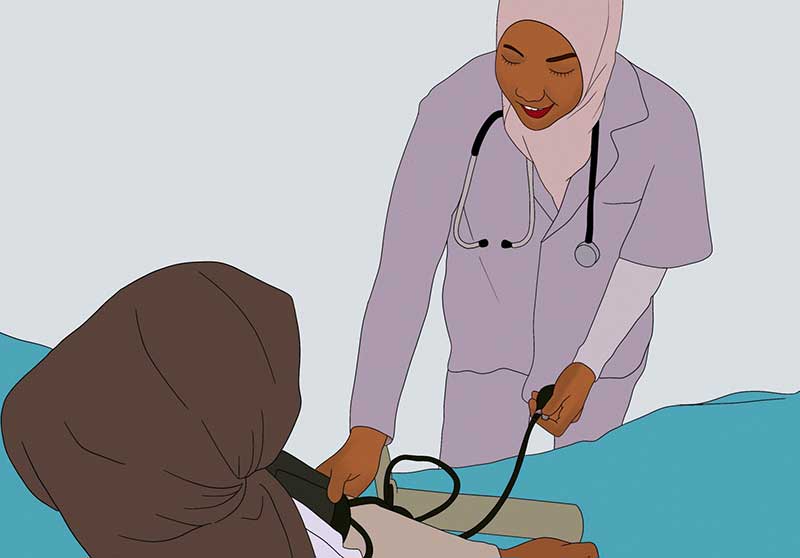
Coming from a CALD background has greatly influenced the way I provide care to women and their babies and my perspective on the importance of family, culture and language. This has opened my eyes to the significance of providing culturally-sensitive care to ensure that I am enabling a positive labour, birth and postpartum experience for the woman and her family.
Working in Western Sydney has been extremely insightful as it has exposed me to numerous cultures and backgrounds. As a Lebanese Muslim there are many cultural practices which I am very familiar with. These practices enable me to understand and recognise the importance of upholding these values and practices for women in my care. Whilst providing care for women who only speak Arabic, I can proficiently speak with women in Arabic without the need for an interpreter which can make a world of difference in the woman’s experience. I have been told by many women that they feel so relieved when the midwife looking after them speaks Arabic and can understand them, rather than having to struggle to communicate with their midwife.
Another advantage of coming from a CALD background is my personal experience with Islamic practices. Some Islamic traditions and practices include:
- Being covered and modest in our dress in front of males who are not family
- Recitation and listening to Quran and dua (supplication/prayers)
- Eating dates in labour
- Recitation of the Athan and Iqamah (Call to Prayer) into the newborn’s ears
- Male circumcision1
In the hospital I practice in, there are many women from different backgrounds who are also Muslim. They are always so relieved when they find that their midwife is familiar with and accepting of the religious practices they participate in and value. Understanding these practices is helpful as I can smoothly facilitate the practice and ensure a positive experience for the woman and her family. I am also able to explain this information to my colleagues who may not know these religious-cultural practices so that they can also facilitate a culturally-safe birth experience for the woman and her family.
Overall, coming from a CALD background has enabled me to think with an open mind to ensure that I can provide culturally- appropriate and safe care for all women in my care, no matter their background or culture.
“I always knew it would be Midwifery. I considered it a career where I was able to assist and support women in the community and use my language to help women who did not understand English. I wanted to be able to represent my culture and background in the healthcare workforce which was something I struggled to see whilst growing up.”
The challenges
However, knowing all these practices can place me in a difficult place sometimes, especially with uncommon practices. For example, in Islam it is compulsory for Muslims to fast during the holy month of Ramadan. However, pregnant women, amongst other people like the sick, elderly and the travelling, are exempt from fasting. Many women I care for like to participate in fasting during the holy month as they do not want to miss out on the religious rewards and the community worship. Whilst fasting may not impact a healthy woman with a low-risk pregnancy, fasting can negatively impact the health and wellbeing of women and their babies when their pregnancy has complications. This places me and other Muslim midwives in a difficult position as it can be quite difficult to advise women about the risks of fasting whilst pregnant. Especially when knowing the value of fasting in the month of Ramadan.2
Another challenging situation is when women request that no male doctors or midwives care for them or enter the room during labour and birth. This is difficult to facilitate to women in scenarios when there are only male health practitioners in an emergency. It is completely understandable to want to feel comfortable in your birth environment. However, in situations when there is only a male available, notifying the woman is difficult as it is not widely accepted in our culture and religion unless in an emergency. Some women may not even be comfortable in notifying their midwife that they would not like a male doctor. According to studies by Hassan, some women have stated they feel anxious to know if their request will be fulfilled whilst in hospital.2
Conclusion
Growing up in a CALD community has shaped the way I perceive culture and its importance in the labour and birth experience for women and their families. I can care for Arabic- speaking women in labour, birth and the postpartum period by speaking to them in Arabic so that they can understand and also feel safe to ask questions. This has been a blessing in my career as I can see the world of difference it makes to a woman’s experience when her cultural and religious practices are acknowledged. I hope that in the future we can have more culturally-safe and appropriate care provided to all women in the perinatal period. Birth is a very intimate yet family orientated event involving a variety of cultural influences, thus, all women deserve to have culturally-appropriate care. TPM
“I have been told by many women that they feel so relieved when the midwife looking after them speaks Arabic and can understand them, rather than having to struggle to communicate with their midwife.”
References
- NSW Demographic Fact Sheet 2022. NSW: Transcultural Mental Health Centre. https://www.dhi.health.nsw.gov.au/ ArticleDocuments/197/NSWDemographicFactSheet%202022.pdf.aspx. Updated August 24, 2022. Accessed January 30, 2024.
- Hassan SM. Religious practices of Muslim women in the UK during maternity: Evidence-based professional practice recommendations. BMC Pregnancy Childbirth, 2022;22(335):4-7. doi.org/10.1186/s12884-022-04664-5

