









Design Your Own Midwifery Unit – Making the Evidence Count
Wendy Jessiman, Senior Lecturer – University of the Highlands and Islands
Irene D. Murray, Lecturer (Midwifery) – University of the Highlands and Islands, Centre for Health Science, Inverness
Hazel I.R. Inglis, Lecturer (Midwifery) – University of the Highlands and Islands, Centre for Health Science, Inverness
Twitter: @wendy.jessiman
Summary
As part of the final theory module in a Shortened Midwifery Programme (PG Diploma) at the University of the Highlands and Islands, student midwives were invited to design their own ‘dream’ community midwife-led unit (MLU) based on Scotland’s The Best Start1 recommendations. Using the evidence to support their individual designs students demonstrated their understanding of the impact of the environment and the importance of continuity of care(r). Each MLU was thoughtfully designed and displayed the students’ firm grasp of the ‘ideal’, and the ‘dream’ midwife-led environment – supported by the evidence.
L to R – Irene, Hazel, Wendy
‘Being a midwife, Best Start and the Context of Care’ was the title given to the final module of the Shortened Midwifery Programme and the focus corresponded with recommendations within The Best Start1 review of maternity services in Scotland.
As one of several formative challenges the students were invited to design their own ‘dream’ community midwife-led unit based on those recommendations. They were also advised to incorporate art (as has been the practice throughout the programme). Using the evidence to support their ideas each group presented a PowerPoint presentation to the class to describe their unit designs, what each unit would offer to women and to demonstrate their understanding of the impact of the environment on women including the importance of continuity of care/carer.
Box 1. The evidence for CMUs
Studies into the benefits of continuity of care and provision of midwifery care in Community Midwifery-led units (CMUs) are abundant. For low risk, nulliparous women, giving birth in a CMU is as safe as hospital for place of birth.2 Others3,4 have identified that women who received midwife-led care were less likely to experience intervention and to have greater satisfaction with their care.
Three groups of students were formed with the challenge of producing a design for their own Midwife-led Unit (MLU), taking The Best Start1 into account. The designs were to be predicated on two key facts: that Covid-19 had been eradicated and that money would be no object…! They were invited to suggest a name for their unit, a philosophy including beliefs, values and goals, to design the birthing environment and rooms with diagrams of their plans, and to identify specific practices in their units that would ensure a non-clinical and friendly environment throughout the childbirth continuum.
Three designs for MLUs were presented under potential names (see boxes 2-4). The aim of this article is to demonstrate the students’ enthusiastic uptake of the evidence and provide a synthesis of their designs of midwife-led units which could potentially be a template for the future in the north of Scotland.
Box 2. Highland Oak Birth Unit
Presented by Caroline Macleod, Louise Wilson, Lindsay Ross and Roslyn Lohse
So named because the oak tree is the image with which midwives like to compare childbearing women – strong and empowered.
Box 3. Sonas Birth Unit
Presented by Lucy Halls, Caroline MacDonald, Klaudia Zbikowska, and Eilidh Ryan.
So named because Sonas in Gaelic means happiness, bliss, passion, success.
Box 4. Highland Serenity Birth Unit
Presented by Alison Henderson-Wright, Dawn Searles, Joanne McMaster and Dianne Goodlad
‘Serenity’ is defined as ‘a state of being calm, peaceful and untroubled leading to a calm, relaxed and friendly atmosphere. The aim of the Highland Serenity Birth Unit is for every woman and family who walks through the doors, to achieve this positive state of inner peace.

Designs
Sonas MLU Design of Labour Room
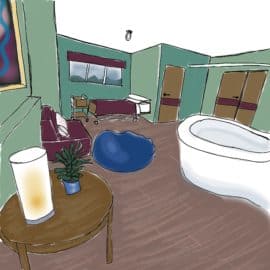
Sketch by Eilidh Ryan
Highland Oak MLU
- At Reception – a mural of an oak tree representing the name of the Unit where women/families would be invited to leave a memory tag after the birth of their baby.
There will be therapeutic outdoor spaces and gardens with views to seafront and woodland settings for couples and staff to enjoy.
Highland Serenity MLU
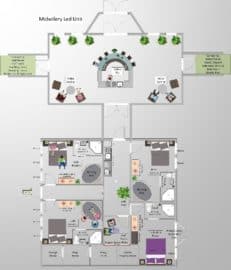
Graphic Design courtesy of John Ewart
Philosophy of each MLU (see Box 5)
MLU environment
Each unit wanted to create a comfortable, safe, nurturing ‘haven’ for low-risk women and their families throughout the childbearing continuum.5 It would be a friendly, welcoming, homely, supportive and multi-sensory environment to aid relaxation during low-risk pregnancy and labour. A quiet, calming environment in terms of light, temperature, music and privacy, as care with dignity can decrease the need for medical intervention in labour.6 It would include opportunity for enjoying nature, gardens and fresh air.7
Safe, effective evidence-based care
Emphasis was placed on the importance of the highest possible standards of safe, effective, evidence-based care and the provision of information according to best practice as supported by the UK’s Nursing and Midwifery The Code.8
Continuity of Carer
All women would have continuity of named midwife throughout their entire maternity journey in order to provide individualised and personalised care developing meaningful, trusting and therapeutic relationships.9,10
Informed choice and decision-making
Familiar with the experience of the Sandwell and West Birmingham NHS Trust,11 which found that when women are relaxed they are more able to make decisions and voice their choices about labour and birth, the design of all three MLUs by the students, included the promotion of women’s birth rights, and support, honour and respect of their informed choices.12 Decisions would be made together by the woman and her midwife and in more complex situations, the obstetrician would also be involved.
Multidisciplinary team working
While working in a multi-agency team culture, midwives would enjoy professional autonomy and accountability in an environment that meets the needs of the women they serve, with everyone’s contribution being equally valued.13 General Practitioners (GPs) would be involved as they provide long term support for women and their babies.
Family-centred care
All three MLUs would provide woman/family-centered care that would deliver a positive experience for women and their families, with a strong emphasis on collaborative and holistic birthing with love and compassion where everyone matters.
Active birth
Women would be encouraged to mobilise during labour to minimise intervention in the absence of complications, thus promoting active, natural childbirth.
Breastfeeding support
Breast feeding support workers, groups, and clinics for drop-in support would be provided. Serenity MLU aimed to ensure all members of the team were trained and regularly updated according to Baby Friendly Initiative (BFI) standards.14
Box 5. Shared themes in the philosophy of each MLU
- Comfortable, safe, nurturing
- Continuity of carer
- Informed choice and decision-making
- Multi-disciplinary team working
- Safe, effective, evidence-based care
- Personalised, individualised care
- Family-centred care
- Active birth
- Breastfeeding support
Additional specifics at the Highland Serenity MLU (HSMLU)
Place of birth
Women would be fully informed on the evidence around their choice of place of birth. A 24-hour home birth service would be available, based on the evidence that home birth is safe for low-risk women who begin labour with a plan to birth at home.15
Communications
HSMLU identified the importance of high quality, professional, caring, compassionate and consistent communications which are continuously monitored and improved upon through service user feedback, reflection, regular debriefing, and supervision using the Scottish Clinical Supervision model.13
Midwives’ Charter at HSMLU
Midwives will:
- Be highly skilled, safe, empathic, trustworthy and sensitive to women’s needs and emotions.
- Continually update their skills through ongoing education and training in child protection, domestic abuse, newborn examination, trauma-informed practice, perinatal mental health, neonatal resuscitation and intrapartum emergencies.
- Never be complacent and continually assess practice and care through monthly audits and service user feedback, with the goal of improving care provision and standards.
- Care for each other’s emotional and physical wellbeing, and continually assess satisfaction and working hours, in-order to avoid burnout.
- Have two preceptors for 12 months for newly qualified midwives.16
Themes found in all the MLU’s additional services
All midwives will be trained in complementary therapies including aromatherapy, massage, acupuncture, yoga, aquanatal and hypnobirthing as well as education on diet and physical activity. It is anticipated that the effects of a physical exercise programme including aerobic water exercise will reduce the need for analgesia during labour, reduce dystocia and increase maternal satisfaction.17
Additional services
- Focus on the importance of practising with cultural awareness, sensitivity and safety to ensure appropriate, individualised, culturally congruent care that is inclusive and accessible for all women including:
- Celebration and nurturing of diversity that would challenge discrimination and racism
- Engagement of all midwives in the three cultural competence modules18
- Preconception clinic
- Fertility clinic
- Early Pregnancy Support group
- Mindfulness classes to manage pain and reduce stress and anxiety19
- A tour (virtual and face-to-face) of the unit including all services
- A small, peaceful room will provide sleeping /resting space where staff living in rural areas may stay overnight when on call when the weather is bad.
- Midwives’ photographs on display on entrance to the unit, with information about who is on duty
- Parentcraft classes and postnatal support groups
- ‘Meet the Midwives’ monthly informal sessions with refreshments
- Post-dates clinic providing a choice of interventions to reduce the need for induction of labour.
- ‘Birthtime Story’ evenings to celebrate the birth of babies
- Newborn examination
- Newborn hearing screening
- Follow up clinics for smears and contraception
- Clinic for treating ‘tongue tie’
- Social media platforms used to gather women’s and families’ views
- Information and news would be shared via social media platforms
- A lending library for books or equipment
- Free WiFi
Common to all designs for the labour and birth environment
- Welcoming, quiet, calming and comfortable environment
- Tones of greens, deep purple and blue, all of which have been found to have a relaxing and calming effect
- A safe, private, sanctuary-like environment that allows for flexible, unhurried ‘watchful waiting’, will promote calm and healing for women who have suffered previous trauma20
- Spa design with wood-effect tiled floors and furniture to instil a sense of calm
- Plants and flowers and a focus on the natural environment
- Artwork on the walls to provide a focal point on which the woman can concentrate to distract her from the intensity of the contractions
- Music to facilitate a relaxed and multi-sensory ambiance
- Optimal room temperature to aid oxytocin production
- Subdued, soft, mood lighting, as harsh artificial lighting can provoke release of adrenaline which inhibits the natural physiology of labour
- Ensuite facilities in each room with walk-in shower
- The bed will either be in an unobstrusive point in the room, or it will be a ‘fold down’ double bed providing shared sleeping accommodation which is essential to promote oxytocin secretion during labour21,22
- The woman and her partner will be able to freely move around a spacious room and have frequent positional changes using ‘peanuts’, birthing ‘balls’ and slings or ropes
- A pool for labour and/or birth22-26 will be central to creating a sense of privacy, and safety reducing the fear of birth6
- A recliner chair or comfortable seating
- Each room would have hidden built-in storage containing drugs and concealing equipment, to optimise the birth environment and mitigate against anxiety and the medicalisation of childbirth27
- After the birth the couple will be able to remain together throughout the woman’s total stay20,21
- Café serving light snacks
- Kitchenette area for women, families and staff.
Staffing common to all MLUs
Each MLU developed a weekly staffing and on-call rota ensuring 24-hour cover and correct skill mix based on a complement of 11 whole time equivalent midwives and four maternity support workers for a caseload of 400 women (100 births) per year
Each unit considered:
- The daytime shift pattern
- Individual midwives’ hours depending on whether full time or part time
- Annual leave and study leave
- Frequency of being ‘on-call’
- Caseload holding
- Preceptorship of newly qualified midwives
- Clinics
- Home births
- Self-rostering.
Conclusion
As the educational midwifery team we were very impressed with the three excellent designs of midwife-led units created by our students. They were soundly based on the evidence, complemented by an obvious flair for artistic and aesthetic design and illustrated by graphics, images and personal art. It confirmed to us that the students were well prepared to lead the way in the north of Scotland in terms of the development of an appropriate birthing environment, based on the evidence and the recommendations by the Scottish Government,1 in order to provide the model of midwifery care that women want and which the students are eager to provide.

References
- Scottish Government. The Best Start: A five year forward plan for Maternity and neonatal care in Scotland, 2017. https://www.gov.scot/publications/best-start-five-year-forward-plan-maternity-neonatal-care-scotland/ Accessed March 1, 2021.
- Henshall C, Taylor B. A Systematic Review to examine the evidence regarding discussions by midwives, with women, around their options of where to give birth’. BMC Pregnancy and Childbirth 2016; 16 (1).
- Sandall J, Soltani H. Midwife-led continuity models versus other models of care for childbearing women.Cochrane Database of Syst Rev. 2016. https://pubmed.ncbi.nlm.nih.gov/27121907 Accessed March 8, 2021
- Hunter M, Smythe E. Confidence: Fundamental to midwives providing labour care in freestanding midwifery-led units’. Midwifery 2018; 66, 176-181
- Walsh D, Gutteridge K. Using the birth environment to increase women’s potential in labour’ MIDIRS 2011; 21(2), 143-147.
- Irvani M, Zarean E. Women’s needs and expectations during normal labour and birth. Journal of Education and Health Promotion 2015 4 (6).
- Alonso B. Creating a positive birth space environment’ all4birth 2021. Available https://www.all4birth.com/factsheet-creating-a-positive-birth-space-environment Accessed March 3, 2021.
- NMC The Code. Nursing Midwifery Council 2018. https://www.nmc.org.uk/standards/code/ Accessed March 8, 2021
- Karlström A, Nystedt A.The meaning of a very positive birth experience: focus groups discussions with women. BMC Pregnancy Childbirth. 2015; https://bmcpregnancychildbirth.biomedcentral.com/articles/10.1186/s12884-015-0683-0#citeas Accessed March 5, 2021
- Aune I, Hoston M. Nature Works best when allowed to run its course. The experience of midwives promoting normal births in the home setting’. Midwifery 2017; 50 (1), 21-26.
- Sandwell and West Birmingham NHS Trust The Serenity Birthing Suite-Virtual Tour 2012. https://www.youtube.com/watch?v=74WbsblPHGc Accessed March 2, 2021.
- Birthrights. Dignity in Childbirth 2021 https://www.birthrights.org.uk/campaigns-research/dignity-in-childbirth/ Accessed March 2, 2021.
- NHS Education for Scotland (NES). The cyclical model of supervision. Clinical supervision for midwives. Unit 2: Fundamentals of supervising others. 2019. Edinburgh: NHS Education for Scotland. https://learn.nes.nhs.scot/3654/clinical-supervision/clinical-supervision-unit-2-fundamentals-of-supervising-others Accessed March 2, 2021.
- UNICEF Guide to the UNICEF UK Baby Friendly Initiative Standards 2017. https://www.unicef.org.uk/babyfriendly/wp-content/uploads/sites/2/2014/02/Guide-to-the-Unicef-UK-Baby-Friendly-Initiative-Standards.pdfAccessed March 5, 2021.
- Reitsama A, Simioni J. Maternal outcomes and birth interventions among women who begin labour intending to give birth at home compared to women of low obstetrical risk who intend to give birth in hospital: A systematic review and meta-analyses’. The Lancet 2020;21: 1-10.
- Higginbottom GMA, Evans C. Experience of and access to maternity care in the UK by immigrant women: a narrative synthesis systematic review’. BMJ Open 2019; 9.
- Navas A, Artigues C, Leiva A, et al. Effectiveness and safety of moderate-intensity aerobic water exercise during pregnancy for reducing use of epidural analgesia during labor: protocol for a randomized clinical trial. BMC Pregnancy and Childbirth 2018; 18 (1): 94.
- e-Learning for Healthcare (e-LfH) and RCM. Cultural competence: an e-learning package to support health professionals in developing cultural competence 2016. https://www.e-lfh.org.uk/programmes/cultural-competence/Accessed March 2, 2021.
- Warriner S, Dymond M. Mindfulness in maternity. Br J Midwifery 2013; 21 (7): 520-522.
- Gutteridge K. Who’s afraid of the big bad birth? AIMS Journal 2013; 25 (3).
- Magon N, Kalra S. The orgasmic history of oxytocin: love, lust, and labor.’ Indian J of Endrocrinol Metab 2011; 15 (3): 156-161.
- Gaskin I M. Spiritual Midwifery. 4th edn Summertown, Tennessee, US: Book Publishing Company; 2002.
- Howard E. Optimizing the birth environment with evidence-based design. J Perinat & Neonatal Nurs 2017; 31(4): 290-293.
- Jenkinson B, Josey N. BirthSpace: An evidence-based guide to birth environment design. Queensland centre for mothers and babies 2014. http://activebirthpools.com/wp-content/uploads/2016/11/Birth-Space-1.pdf Accessed March 2, 2021.
- Maude R, Foureur M. It’s beyond water: Stories of women’s experience of using water for labour and birth. Women and Birth 2007; 20 (1): 17-24
- Cluett ER, Burns E. Immersion in water during labour and birth. Cochrane Database of Syst Rev. 2018:https://www.cochrane.org/CD000111/PREG_immersion-water-labour-and-birth Accessed March 8, 2021.
- Bowden C, Sheehan A. Birth Room Images: What they tell us about childbirth. A discourse analysis of birth rooms in developed countries’. Midwifery 2016; 35: 71-77

