









Doulas and Midwives: A Powerful Alliance
Maddie McMahon – Approved Doula Trainer and Mentor, and Registered Breastfeeding Counsellor and Tutor
Milly Morris – Midwife at Hinchingbrooke Hospital
Published in The Practising Midwife Volume 21 Issue 3 March 2018
Summary
This article explores the relationship between doulas and midwives. Misunderstandings of the doula role are common in midwifery circles. Despite this, doulas are more sought after than ever before and it is increasingly likely that midwives will encounter a doula in the birth room or in a mother’s home. The aim of this article is to address these issues, raise awareness of mutually beneficial areas of collaboration, and make suggestions for ways forward. At a time of flux for midwifery, I think effort is required by all to address gaps in mutual understanding and build robust systems of communication.
Maddie McMahon
In my 15 years as a doula I have met many midwives. I have been greeted with kindness, sometimes with open-hearted enthusiasm. Equally common, however, is a sense of puzzlement or suspicion. At a time when maternity services are under unprecedented pressure, I am convinced that the relationship between doulas and midwives has never been more crucial.
Doulas are well aware that some midwives believe we have a strange approach. Some think that doulas regard medical intervention as an evil, or they see doulas as an expensive luxury. There may be little awareness of the long-term relationship we build with our clients or the commitment we make to stay with them, however long the labour. A doula’s work is mother-work: wakeful nights, housework, long hours listening to the anxieties of new parents. It is pregnancy peer support, similar in nature to breastfeeding peer support. Yet in some conversations I have with midwives, I sense their fear of doulas overstepping the boundaries or encouraging parents to disengage from medical care. Sometimes, as I hold a woman in the throes of hard labour, stroke her hair, or provide much-needed sustenance, a midwife whispers that she wishes she could care for couples like that.
Milly Morris, a friend who moved from doula to midwifery, wrote her dissertation on the midwife-doula relationship, after feeling these tensions. Below, she comments on some of the research into the subject.
Both doulas and midwives acknowledged that midwives cannot always support women’s choices, as they are aligned to and bound by the system
Milly Morris
There is very little research into the midwife-doula relationship. Stevens et al’s (2011) study from Australia focuses on this relationship in a maternity system with significant similarities to the UK.
Three focus groups made up of six doulas and 11 midwives were used to provide information-rich qualitative data.
The midwives worked in a variety of settings and had all worked with doulas. Doulas had to have attended a doula education course and be currently practising.
The questions asked were:
- What is the role of the doula in pregnancy, birth and the postnatal period?
- What has been your experience of working as, or interacting with, doulas in the care of women?
- How do you think the presence of a doula affects the experience of a woman?
- What do you think are the limits of the role of the doula?
- What interactions stood out while you worked with/as a doula?
The research themes
 A consensus of themes was arrived at by the researchers:
- The broken maternity system
- Filling the gap
- Taking our role
The broken maternity system
Midwives felt unable to provide woman-focused care because the maternity system “is fragmented, overloaded and medically dominated” (Stevens et al 2011: 511). Both doulas and midwives acknowledged that midwives cannot always support women’s choices, as they are aligned to and bound by the system. This is a shame, especially now that the Code (Nursing and Midwifery Council [NMC] 2015) dictates that a woman’s wishes should be adhered to unconditionally. They also agreed that time – or lack of it – is a major factor, and that continuity of midwifery carer would improve the system (Stevens et al 2011).
Filling the gap
With reference to the theme of ‘filling the gap’ the sub-themes of continuity and time were also dominant. Doulas were focused on the woman’s needs, with no other demands on their time. The doulas supported the women and their partners to stay at home longer before going to hospital, one of the doulas admitting that “they can’t start the clock until you walk through the door” (Stevens et al 2011: 512). This links to the ‘taking our role’ theme, where midwives believed that doulas provided education that was ‘misinformed and inappropriate’ (Stevens et al 2011: 512).
Taking our role
Midwives were concerned that they were vulnerable as they were legally accountable for the wellbeing of the women and babies, and encouraging a woman to “stay at home until late in the labour or even to give birth at home with no-one in attendance” was “overstepping the boundaries” (Stevens et al 2011: 512). The midwives also felt “delegated to the obstetric nurse who is the meanie who just comes in and does VEs [vaginal examinations]”, and that the doula “acts like a buffer around the woman that actually increases the distance between the midwife and the woman” (Stevens et al 2011: 512). The midwives recognise that this buffering role is part of the appeal of having a doula when women don’t trust the medicalised system.
Representing parents
Maddie explains that the code of conduct in the organisation of which she is a member ensures that doulas aspire to enhancing the relationship between parents and medical staff, and that they never take decisions for parents. Rather, they are led by the parents and their desires completely, whether they agree with their decisions or not. This unconditional support is the foundation of doula care. They should never give advice or encourage disengagement from medical care. The doula organisation has a feedback and complaints system that health professionals can use if necessary.
Both wanting the best for women
Both midwives and doulas recognised that they are striving for the same outcome – the best for the woman and her infant – but that midwives are bound by a system they have no control over (Stevens et al 2011). Despite the conflict, doulas are supportive of midwives and understand that midwives sometimes do not feel free to provide the continuity and unconditional support they would wish to.

The place of regulation
In Stevens et al’s study (2011), the midwives thought that regulation of doulas would reduce conflict, a stance supported by Bainbridge in the British Journal of Midwifery (Bainbridge 2010). However Adela Stockton, midwife-turned-doula and writer, believes the subject is actually more nuanced and that women and families would not gain any benefit from ‘professionalised’ doulas (Stockton 2014). She explains that the lay status of doulas supports diversity, with doulas and families being free to choose the right match for them. Stevens et al agree, stating that the fact that doulas are accountable only to women and not a health service or regulatory body leaves them free to truly support women and their needs and wishes. Stockton believes that some sort of voluntary self-regulation of doulas, with systems that support families if there were difficulties, would be sufficient (Stockton 2014).
Good communication
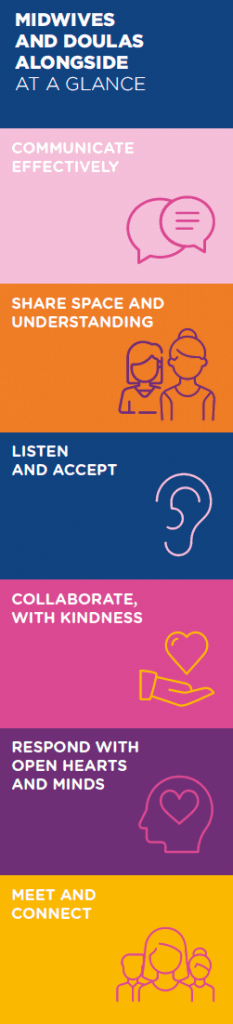
Midwives and doulas agreed that communicating more often and more effectively may help to build understanding, possibly through regular formal or informal meetings. This idea is supported by the experience of volunteer doulas in Spiby et al’s study (2016), which found that initial problems between doulas and midwives were resolved once the midwives became more familiar with the doulas and the purpose of their role.
 It is imperative that midwives and doulas increase their understanding of each other’s roles to improve their ability to work collaboratively. I feel it would be useful if Paeglis’ 2013 guideline Working with doulas (NHS England [archived]) could be used as a basis for producing local guidelines for staff working with women and their doulas; however, this is no longer publicly available and therefore not accessible to midwives in general. Were it possible to disseminate it, this would provide midwives and doulas with the information they require to recognise when boundaries may have been crossed, as well as a supportive framework for addressing concerns; however we cannot escape from the reality that it is not available. Collaborating with local doulas and women who have used doulas on the creation of such guidelines would help to make them more useful, by recognising that the woman’s perception of her needs is central to the way care is delivered (Buggins and Nolan 2000).
It is through collaboration and mutual understanding, agrees Maddie, that we prevent upset and communication breakdown. But midwives have to want to do this.
In frantically busy schedules, what benefits are there in the midwife-doula alliance?
Midwives and doulas working together
When doulas understand local guidelines, they can help their clients engage with the system in ways that are meaningful for all parties, thus contributing to safety and positive maternity experiences.
As midwives understand the uniquely intimate relationship between doulas and families, they can join the team, safe in the knowledge that everyone understands their role and their boundaries. Rather than feeling obliged to assert power and authority, a midwife can be part of the beautiful dance around the birthing person.
Doulas can be useful, representing women’s voices on Maternity Voices Partnerships and feeding back on how they see services being delivered. Doulas witness the care delivered by staff, and notice inconsistencies, or areas where savings or efficiencies could be achieved. They see service provision through the eyes of the end user and often take note of little things that staff may miss. Standing outside the system, doulas can also stand up against threats to midwifery, against bullying, poor care or human rights abuses, without fear of reprisal.
Doulas come from the communities midwives serve. We were that young mother, that woman with postnatal depression, that parent who lost a baby, that woman from all the cultural and racial groups in your area. We can be communication conduits, enhancing the relationship between families and midwives. Increasingly, we are working under the auspices of agencies like social services, who recognise that, because of our lay role, families often engage with us in a way they don’t with ‘people who wear badges’.
Midwives have no greater fans than doulas, who see them ‘up close and personal’; see when a midwife has concerns or is tired. They see how challenging the system can be and are in a position to support midwives, too.
There have always been doulas
Doulas in some guise have always been here and are becoming increasingly popular. A growing body of research is showing the beneficial effect we can have on the maternity experience. It’s not an either-or. A doula should complement the woman’s relationship with her midwife. A pregnant woman can’t receive too much love and care.
TPM
References
- Bainbridge J (2010). ‘Doulas: supportive, calm birth partners or obstructive to clinicians?’ British Journal of Midwifery, 18(1): 57.
- Buggins E and Nolan M (2000). ‘Involving consumers in research’. In: Proctor S and Renfrew M (eds). Linking research and practice in midwifery, Edinburgh: Bailliere Tindall.
- NHS England (archived). Working with doulas, London: NHS England.
- Spiby H, Mcleish J, Green J et al (2016). ‘The greatest feeling you get, knowing you have made a big difference: survey findings on the motivation and experiences of trained volunteer doulas in England’. BMC Pregnancy and Childbirth, 16(1): 289. http://bmcpregnancychildbirth.biomedcentral.com/articles/10.1186/s12884-016-1086-6
- Stevens J, Dahlen H, Peters K et al (2011). ‘Midwives’ and doulas’ perspectives of the role of the doula in Australia: a qualitative study’. Midwifery, 27: 509-516.
- Stockton A (2014). Gentle birth companions: a handbook for doulas and parents, 2nd edition. Edinburgh: Wysewomen publishing.
- NMC (2015). The Code. Professional standards of practice and behaviour for nurses and midwives, London: NMC. http://www.nmc.org.uk/standards/code/