









European Midwifery Units: A Systematic Review on Maternal Morbidity
Marta Valerio (she/her) – Maternity Site Coordinator, London North West Healthcare NHS Trust
Social linkedin.com/in/marta-valerio
Marina Daniele (she/they) – Midwifery Lecturer, City St George’s, University of London
Lucia Rocca-Ihenacho (she/her) – City St George’s, University of London
Social @luciagreenwich
Hope Jackson (she/her) – Research Assistant, City St George’s, University of London
Published in The Practising Midwife Volume 29 Issue 3 May 2026, Pages 26-32
https://doi.org/10.55975/BBVY6009
Summary
The International evidence on midwifery units suggests these birth settings are associated with positive clinical outcomes, improved service user experience and cost effectiveness compared with obstetric units, for women experiencing low-risk pregnancies. However, implementation across Europe has been slow and uneven. We conducted a systematic literature review of European studies reporting on maternal morbidity outcomes for planned MU births. Our findings provide reassurance regarding the consistency and effectiveness of MU care within the European context.

Background
International evidence consistently indicates that midwifery units (MUs) offer an optimal model of care and favourable maternal and perinatal outcomes for healthy women with uncomplicated pregnancies.1 Despite this evidence and the recent endorsement of midwife-led models of care by the World Health Organisation,2 access to midwife led birth settings remains limited across Europe. Policy guidance encouraging health systems transformation in this direction is largely absent. Attempts to introduce midwife-led care alongside established obstetric-led models have proven challenging in several countries.3 To support implementation efforts, a comprehensive picture of current evidence on clinical outcomes of MUs in Europe is needed to inform practice, policy making and future research.
Our group undertook a broad systematic review with the aim of evaluating maternal and neonatal outcomes for planned MU births across Europe. This paper presents a subset of our findings, focused on maternal morbidity outcomes. Maternal morbidity is largely avoidable and can have long-lasting adverse effects on the mother, the baby and the wider family. It should thus be considered a public health priority.4
In relation to this, we can summarise our objectives for this paper as follows:
- To identify maternal morbidity outcomes reported in the literature on planned MU births in Europe.
- To synthesise the evidence on similarities and differences between planned MU and Obstetric Unit (OU) births in relation to maternal morbidity outcomes.
- To identify gaps and opportunities for further research.
Methods
Inclusion and exclusion criteria
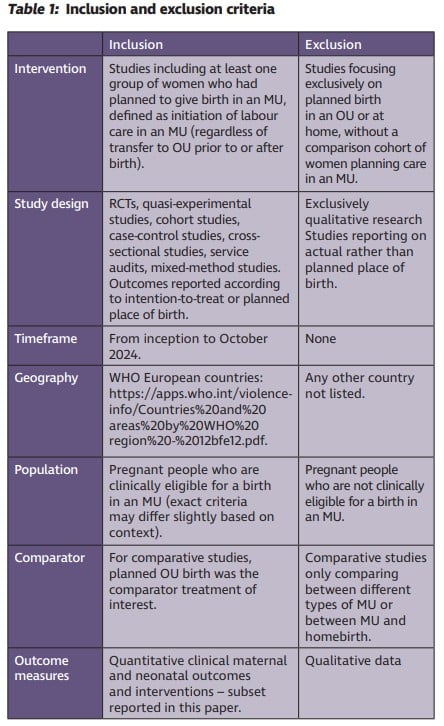
Studies were selected for inclusion based on the criteria presented in Table 1. Both comparative and non-comparative studies were included, provided they met the criteria and were of sufficient quality. Comparative studies needed to have both a planned MU and a planned OU arm and all studies needed to report on planned rather than actual birth for each setting. Studies were included if the full text was available in English or in other European languages spoken by the research team. No pre-set list of clinical outcomes was set, in line with Objective 1.
Search strategy
We searched the following databases: CINAHL, MEDLINE, EBM Cochrane Database of Systematic Reviews, Cochrane Methodology Register, MIDIRS, Embase, Emcare, and Social Policy and Practice.
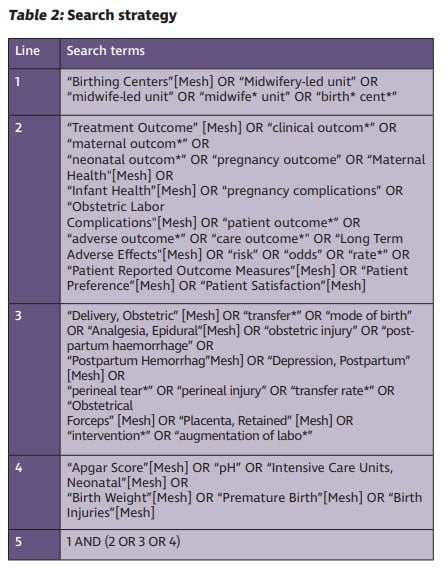
We ran the search on October 31, 2024 using keywords “Birthing Cent*”, “Maternal Health”, “Treatment outcome” and their MESH derivatives, combined as described in Table 2, using Boolean operators and synonyms, truncations and alternative spellings.
Using Covidence software5 two authors independently screened titles and abstracts and one reviewed full text articles to confirm eligibility.
Data extraction
We extracted information on study characteristics, including author, year of publication, country, study design, sample size, outcomes reported on and their definitions. For each study we documented whether it reported on alongside midwifery units (AMU), which are co-located with an OU, or freestanding midwifery units (FMU), which are on a separate site. We extracted the percentage experiencing the outcome among all planned MU births. Where suitable comparative data were available, we also collated information on the measure of effect, confidence interval and/or p-value (see Appendix 1 here).
Analysis
A list of maternal morbidity outcomes was developed. For each, we counted the number of reporting studies and compiled a frequency range for Midwifery Units (MUs), using the lowest and highest reported rates. For studies undertaking a comparison between planned MU and OU, we considered reported differences in baseline characteristics between the groups and assessed the approach the authors had taken to deal with confounding. Only measures of effect derived from a robust approach were included in a narrative summary of the comparative findings. Meta-analyses were not included as most studies were observational and there was considerable variety in the populations studied, sample sizes, intervention characteristics, outcome definitions and reported measures of effect (e.g. OR vs RR).
The review used published research data; thus no ethical approval was required. However, we ensured the included studies upheld ethical standards.
Critical appraisal
We assessed methodological quality using tools from the Critical Appraisal Skills Programme.6
Results
Included studies
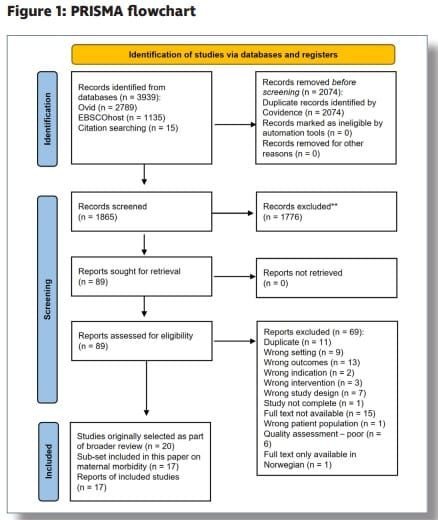
An initial 3,939 records were identified. Following de-duplication 1,865 titles and abstracts were screened. Of these, 89 full texts were reviewed. Twenty eligible studies were identified, of which 17 were retained for this paper as they reported on relevant outcomes. For further detail, see the flowchart in Figure 1.
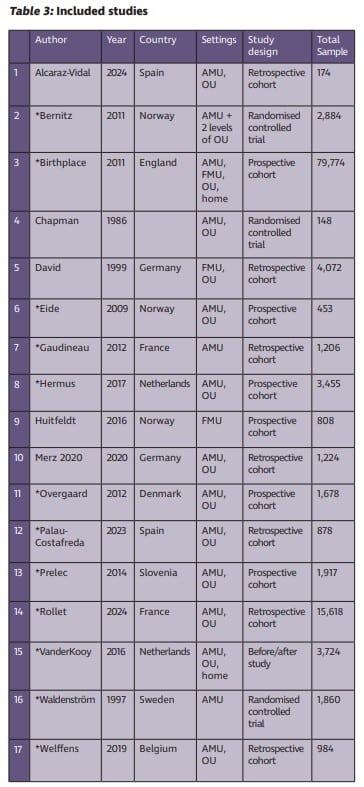
The characteristics of the 17 studies are outlined in Table 3 below. The studies were observational, with the exception of three trials, and were conducted in ten European countries. Three were published prior to the year 2000, but most were published after 2010. Twelve studies reported on AMUs, three on FMUs and two on both. Included studies were deemed to be of sufficient overall quality. More specifically, 12 studies were comparative and dealt adequately with confounding, thus providing usable data on the comparison between MU and OU. The latter are indicated by an asterisk (*) in Table 3.
Narrative synthesis of findings
The findings are presented below by reported outcome. Unless otherwise specified, the rates are reported for mixed parity cohorts. All reported confidence intervals (C.I.) were set at 95% confidence levels.
- Postpartum haemorrhage (PPH) >500ml: Four studies reported on this outcome, reporting rates between 1.3% and 5.5% of planned MU births.7,8,9,10 Out of three comparative studies, one retrospective matched cohort study from Denmark reported a lower rate for planned FMU births (RR 0.4, C.I. 0.3-0.7),7 while two other cohort studies found no difference.9,10
- PPH >1000ml: Six studies reported on this outcome. Rates for planned MU births varied between 1.3 and 5%,7,11,12,13 with a higher rate reported for nulliparae in a study that stratified by parity (6.6%).14 One trial in Norway,11 two prospective cohort studies from Norway and the Netherlands,14,15 one matched cohort study from Denmark,7 and one before/ after study from the Netherlands12 all found no significant difference between MU and OU. A nationwide cohort study from France used a composite outcome of severe PPH, defined as “1000 mL blood loss +/− red blood cell transfusion +/− secondary procedure”.13 Although rates were low in all settings, they were higher for planned AMU birth at 2.4% versus 1.1% in OU (AOR 2.37, 95% C.I. 1,29-4.36). The authors attributed this to variation in the practice of prophylactic uterotonic administration in the third stage, less commonly performed in MUs.
- Retained placenta or MROP: Three comparative studies reported on retained placenta or manual removal of retained products (MROP), which affected between 1.2% and 4.2% of planned MU births, with no difference between MUs and OUs.9,10,16
- Blood transfusion: This was reported as a distinct outcome in six studies, with rates for planned MU births ranging from 0.0% to 1.5%,8,9,14,17,18,19 the highest rate of 1.5% being reported for nulliparae in Hermus’s study, which stratified by parity. A trial in Sweden and a prospective cohort study in the Netherlands found no difference between MU and OU.14,19 The Birthplace in England cohort study found no difference in blood transfusion rates between AMUs and OUs, but they did find that the rate was significantly lower for FMUs compared with OUs (AOR 0.48, 95% C.I. 0.32-0.73).17
- Admission to a higher level of care/ICU: The Birthplace study also reported on maternal admission to a higher level of care, such as an ICU.17 For this rare outcome (0.5% for FMU and 0.9% for AMU), the study found no difference between AMU and OU, but the rate was lower for FMU compared with OU (AOR 0.32, 95% C.I. 0.13-0.84).17 A cohort study in France reported no ICU admissions for AMU but eight women (0.1%) were admitted from the OU group.13
- Episiotomy: Episiotomy rates for planned MU births varied widely across 12 reporting studies, with two single-centre retrospective cohort studies reporting the widest variation between 33.8% in Slovenia,9 to 4.720 While a prospective cohort study from the Netherlands and a trial from Norway found no difference between planned MU vs OU births,11,14 several other comparative studies found lower rates for planned MU. These include the Birthplace study (for AMU vs OU, AOR 0.62, 95% C.I. 0.50 – 0.77; for FMU vs OU, AOR 0.40, 95% C.I. 0.32 – 0.51),17 a prospective cohort study in Norway (with the OU as reference category, OR 1.6, 95% C.I. 1.0-2.4),15 a retrospective cohort study in France (AOR 0.33, C.I. 0.30-0.36),21 one in Spain (AOR 0.47, C.I. 0.28) and one in Belgium (AOR 0.31, C.I. 0.17-0.56). Prelec, et al., also reported lower rates in their study in Slovenia (p=0.001).9
- Third or fourth degree tears/obstetric anal sphincter injuries (OASI): Fifteen studies reported on OASI. In the majority, rates for planned MU birth varied between 0.6% 18 to 3.2% (rate for AMUs in the Birthplace study).17 An exception was a prospective cohort study in Norway which reported an exceptionally high rate at 14% (no significant difference between settings).15 The next highest rate of 4% was reported for nulliparae in a prospective cohort study in the Netherlands, and in this study the OU rate for nulliparae was significantly lower (p<0.01).14 On the other hand, six comparative studies reported no difference between MU and OU. 7,10,11,12,13,16,17
Discussion
The literature on planned birth in MUs reported primarily on PPH and on perineal outcomes.
Among healthy women experiencing physiological pregnancies, the overall risk of PPH was low across all settings. Despite using different definitions, Overgaard’s matched cohort study and the Birthplace in England cohort study both found more favourable PPH outcomes in planned FMU births compared with planned OU, with Birthplace also finding lower odds of ICU admission.17 Rollet’s cohort study,13 on the other hand, found a higher risk of severe PPH for women in the planned AMU group, without however affecting ICU admission rates. This unusual finding calls for further research to describe management practices for the third stage of labour in different settings. Fahy suggests that while the terms ‘expectant management’ and ‘physiological third-stage care’ are often used interchangeably, in reality they are not synonymous.22 A clearer understanding of the physiological implications of different forms of care during this delicate stage, including the influence of the environment on the risk of PPH, is essential to advance knowledge on both prevention and effective management when required. As Begley, et al., stated in their Cochrane Review, in a population at mixed risk for PPH, active management of the third stage offers certain advantages but is also associated with several disadvantages.23 Consequently, careful consideration of how to support physiological processes to minimise the risk of PPH is required. Ultimately, a balanced approach that places women and birthing people’s preferences and experiences at the centre of care remains paramount.
“Among healthy women experiencing physiological pregnancies, the overall risk of PPH was low across all settings.”
Reflecting on the perineal outcome findings, the evidence clearly points towards lower rates of episiotomy in planned MU births. A striking feature is, however, the variability between studies conducted in different countries. Hermus, et al., for example, reported similarly high episiotomy rates (approximately 40%) across homebirth, MU and OU settings in the Netherlands.14 These comparable rates may be explained based on the consistency of care provider, as community midwives in the Netherlands attend all women experiencing physiological labour, regardless of setting. However, the justification for such high overall rates remains unclear and may reflect differences in midwifery practice or service culture. For OASI, the majority of studies reported no significant differences between settings.
Methodologically, the included studies displayed substantial heterogeneity in study design, outcomes measure definitions and reporting, as well as providing limited description of clinical practices. This made interpretation of the results challenging. We note that in addition to presenting intention-to-treat analyses of planned place of birth, analyses of clinical interventions and outcomes by actual birth setting would also be important. For example, in Hermus, et al., only 31% of nulliparous women who intended to give birth in MU ultimately did so.14 Consequently, nearly 70% of the outcomes attributed to MU were in fact based on births occurring in the OU. This has important implications for the interpretation of outcomes and practices. Such more detailed analyses would allow, for example, for consideration of mode of delivery in relation to PPH. Additionally, consistency in the definition of MU is essential. Across the reviewed literature, definitions and organisational characteristics of MUs varied, potentially influencing the model of care provided and the resulting outcomes. Finally, we note the lack of evidence on other aspects of maternal health and wellbeing, such as mental health.
Conclusion
Despite some heterogeneity among the included studies, the overall findings indicate that the risk of experiencing PPH and severe perineal tears is low for women experiencing physiological labour, regardless of whether they plan birth in an MU or an OU. The likelihood of episiotomy varies across Europe but tends to be lower with planned MU birth. The FMU literature suggests that these settings are associated with the most favourable outcomes. Further research is warranted to explore how differences in organisational structure, clinical practice and professional culture may contribute to these findings. TPM
References
- Scarf VL, Rossiter C, Vedam S, et al. Maternal and perinatal outcomes by planned place of birth among women with low-risk pregnancies in high-income countries: a systematic review and meta-analysis. Midwifery. 2018;62:240-255. doi. org/10.1016/j.midw.2018.03.024.
- Transitioning to Midwifery Models of Care: Global Position Paper. WHO. https://iris.who.int/bitstream/handle/10665/379236/9789240098268-eng.pdf. Published 2024.
- Batinelli L, McCourt C, Bonciani M, Rocca-Ihenacho L. Implementing midwifery units in a European country: situational analysis of an Italian case study. Midwifery. 2023;116:103534. doi.org/10.1016/j.midw.2022.103534.
- The maternal care bundle. NHS England. https://www.england.nhs.uk/ long-read/the-maternal-care-bundle/. Updated March 06, 2026. Accessed March 10, 2026
- Covidence systematic review software. Covidence. https://www.covidence.org. Accessed March 10, 2026.
- Critical Appraisal Skills Programme. CASP checklists. https://casp-uk.net/casptools-checklists/. Published 2025. Accessed October 10, 2025.
- Overgaard C, Møller AM, Fenger-Grøn M, Knudsen LB, Sandall J. Freestanding midwifery unit versus obstetric unit: a matched cohort study of outcomes in lowrisk women. BMJ Open. 2011;1(2):e000262. doi.org/10.1136/bmjopen-2011-000262.
- Huitfeldt AS, Voldner N, Blix E. Outcomes of care at “Føderiket Midwifery Unit” 2007-2011, a freestanding midwifery-led unit in Oslo, Norway: a prospective cohort study. Nord J Nurs Res. 2016;36(1):38-43. doi.org/10.1177/0107408315602641.
- Prelec A, Verdenik I, Poat A. A comparison of frequency of medical interventions and birth outcomes between the midwife led unit and the obstetric unit in low-risk primiparous women. Obz Zdr Nega. 2014;48(3). doi.org/10.14528/ SNR.2014.48.3.16.
- Welffens K, Derisbourg S, Costa E, et al. The “Cocoon,” first alongside midwifery-led unit within a Belgian hospital: comparison of maternal and neonatal outcomes with the standard obstetric unit over 2 years. Birth. 2020;47(1):115-122. doi.org/10.1111/birt.12466.
- Bernitz S, Rolland R, Blix E, Jacobsen M, SjØborg K, Øian P. Is the operative delivery rate in low-risk women dependent on the level of birth care? A randomised controlled trial. BJOG. 2011;118(11):1357-1364. doi.org/10.1111/j.1471- 0528.2011.03043.x.
- van der Kooy J, de Graaf JP, Birnie DE, Denktas S, Steegers EAP, Bonsel GJ. Different settings of place of midwife-led birth: evaluation of a midwife-led birth centre. Springerplus. 2016;5(1). doi.org/10.1186/s40064-016-2306-2.
- Rollet C, Le Ray C, Vendittelli F, et al. Severe adverse maternal and neonatal outcomes according to the planned birth setting being midwife-led birth centers or obstetric-led units. Acta Obstet Gynecol Scand. 2024;103(12):2465-2474. doi. org/10.1111/aogs.14971.
- Hermus MAA, Hitzert M, Boesveld IC, et al. Differences in optimality index between planned place of birth in a birth centre and alternative planned places of birth: results of the Dutch Birth Centre Study. BMJ Open. 2017;7(11):e016958. doi.org/10.1136/bmjopen-2017-016958.
- Eide BI, Nilsen ABV, Rasmussen S. Births in two different delivery units in the same clinic: a prospective study of healthy primiparous women. BMC Pregnancy Childbirth. 2009;9:25. doi.org/10.1186/1471-2393-9-25.
- Palau-Costafreda R, García Gumiel S, Eles Velasco A, et al. The first alongside midwifery unit in Spain: a retrospective cohort study of maternal and neonatal outcomes. Birth. 2023;50(4):1057-1067. doi.org/10.1111/birt.12749.
- Brocklehurst P, Hardy P, Hollowell J, et al. Perinatal and maternal outcomes by planned place of birth for healthy women with low risk pregnancies: the Birthplace in England national prospective cohort study. BMJ. 2011;343:d7400. doi.org/10.1136/bmj.d7400.
- Alcaraz-Vidal L, Velasco I, Pascual M, Gómez RG, Escuriet R, Comas C. First alongside midwifery led unit in a high complexity public hospital in Spain: maternal and neonatal outcomes. Women Birth. 2024;37(3):101577. doi. org/10.1016/j.wombi.2024.01.003.
- Waldenström U, Nilsson CA, Winbladh B. The Stockholm birth centre trial: maternal and infant outcome. Br J Obstet Gynaecol. 1997;104(4):410-418. doi. org/10.1111/j.1471-0528.1997.tb11491.x.
- Merz WM, Tascon-Padron L, Puth MT, et al. Maternal and neonatal outcome of births planned in alongside midwifery units: a cohort study from a tertiary center in Germany. BMC Pregnancy Childbirth. 2020;20(1):267. doi.org/10.1186/ s12884-020-02962-4.
- Gaudineau A, Sauleau EA, Nisand I, Langer B. Obstetric and neonatal outcomes in a home-like birth centre: a case-control study. Arch Gynecol Obstet. 2013;287(2):211-216. doi.org/10.1007/s00404-012-2553-6.
- Fahy K, Hastie C, Bisits A, Marsh C, Smith L, Saxton A. Holistic physiological care compared with active management of the third stage of labour for women at low risk of postpartum haemorrhage: a cohort study. Women Birth. 2010;23(4):146-152. doi.org/10.1016/j.wombi.2010.02.003.
- Begley CM, Gyte GML, Devane D, McGuire W, Weeks A, Biesty LM. Active versus expectant management for women in the third stage of labour. Cochrane Database Syst Rev. 2019;2019(2):CD007412. doi.org/10.1002/14651858.CD007412. pub5.

