









Global Perspectives: Maternity Care and Practices in Ethiopia
Indie McDowell – Founder and Director, Atsede Clinic, Gurage Zone, Ethiopia Secretary, Board of Directors, Global Alliance of Independent Midwives
Published in The Practising Midwife Volume 24 Issue 1 January 2021 https://doi.org/10.55975/CBDX8165
Summary
There is an unspoken, unacknowledged routine practice haunting delivery rooms across the world. One that leaves women feeling like failures, ignored and abused. With obstetric violence under the spotlight, it is time now to bring it into the conversation. Fundal pressure, far from any demonstrable good, is doing harm, not only with the potential physical side effects, but with the long-lasting psychological impact of a painful and unnecessary intervention performed often without permission. In the first of a five-part series on Ethiopian maternity care, midwife Indie McDowell explores the practice of fundal pressure, both from a historical perspective, and as experienced today.
The unrecognised pain and trauma of fundal pressure
Colombia. Brazil. The US. India. Germany. Spain. Mexico. Russia. Bosnia. Iran. Kenya. Italy. France. Sweden. Uganda. The list of countries is seemingly endless. South Africa. The Philippines. Latvia. Indonesia. Tanzania. Ghana. Every few hours a new story of obstetric violence and trauma, all related to one, almost global, unnecessary childbirth intervention: fundal pressure. The anger and sadness from women who have experienced it is palpable, still affecting them many years after it happened. The extent of this has largely been unrecognised, with the exception of one paper by Zanconate and colleagues,1 but when Norwegian birth photographer Eva Rose travelled to document birth in Ethiopia, and posted on her Instagram two images of midwives performing fundal pressure, the messages started pouring in.
I am the midwife who hosted Eva, and took her to witness that moment. Many people, too, have asked why we didn’t step in. For Eva, that was not her responsibility. For me, the reasons were twofold. Now no longer the senior midwife at the hospital, a position I had held until two years ago, and instead a guest, I didn’t feel it was my position to intervene either. The matter of decolonialising of birth is significant one. But also, I wanted Eva to see this. I knew it was difficult and shocking, but it was also real. This is what happens here. Whether that was the right decision or not is still something I cannot decide. The midwives present knew, absolutely, that I would not be willing to perform fundal pressure, and they understood when I supported the student midwives witnessing it who also refused. I had explained, time and again, that such outdated and potentially dangerous practices are not part of my ethical code as a midwife.
But in considering whether or not to intervene, it also raises the question of who is responsible for policing ethical practice? Is it the responsibility of each midwife to hold themselves to account, or do we judge each other? Of course, the midwives knew the potential complications of using fundal pressure, from complicated lacerations to uterine rupture and shoulder dystocia.2 They were also aware of my feelings towards the practice. Never once, in a year and a half of working alongside them, had I wavered from my fierce stance against the practice. And yet still they chose to use it, even knowing the birth was being documented by Eva. So the question is, why? Where did the practice start? Why does it continue? To answer that we have to go further back.
Why is fundal pressure used as a childbirth intervention?
Like many folklore treatments in Ethiopia, fundal pressure is a practice that has travelled through the generations. Before birth moved into the hospitals (with all the unique benefits and challenges that came with that), women were cared for by other women, particularly those with experience of births. Fundal pressure was universally used. I travelled to the village of one of the last traditional birth attendant (TBAs) in the area to ask her about the tradition. Her response was not entirely what I, anticipating denial or guilt, expected.
‘The women here,’ Askalech started with a sad timbre to her voice, ‘were undernourished, underweight, and often under-developed. They are tired. Life is much more physical here than in your country. Women are working in the gardens with the animals and vegetables until the moment they start their contractions. Through their pregnancy they haven’t had good rest and good food. At the end of a long labour, they are even more tired. They haven’t got the reserves to draw on or the stamina to push. So we helped them.’ The belief that those there with the women as they deliver are only trying to help, now the midwives in the hospitals rather than the TBAs in the tukul huts, persists. Interestingly, the midwives at the hospital always ask consent. More than that, the phrases used before starting translate as ‘we will do this together, I will help you’. There is an absolute certainty that the midwives believe it is in the best interest of the women they are charged with getting safely through a birth. It is worth remembering, too, that other methods of expediting birth in cases of foetal or maternal compromise aren’t reliably available. So, perhaps in emergency cases at least, the midwives really were helping. Routine use, though, is another matter entirely. And with uncertainty existing in the evidence of physical harm, the psychological ramifications of painful interventions performed without consent are still a significant factor.
I was in shock to see this procedure being done without any reason at all. It looked so painful and watching the mum trying to force her to stop and the midwife just smacked her hands away like it was nothing made me want to scream.
I talked this through with Eva during her all too brief time with us. She had been deeply affected by what she saw, describing it as ‘absolutely heartbreaking’. But eventually understanding the context and intention doesn’t take away from the brutality of fundal pressure. And yet, in all trials considered by the World Health Organization (WHO) when writing the guidelines (nine trials involving 3,943 women), there is no high-quality evidence of harm.3 There seems to be a strange ambivalence in the literature: no documented benefit, but no reported harm (although low-quality evidence, with many other factors not accounted for, suggest increased risk of third-degree perineal and cervical tears). Hofmeyr and his colleagues, the authors of the WHO guidelines, note this themselves, commenting that there is simply not enough evidence in settings of maternal exhaustion to make a judgement on its efficacy.3 Cultural knowledge suggests it helps women. The midwives, who care deeply about the women, are adamant that it does.
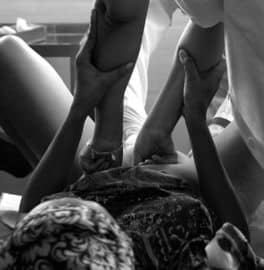 Eva’s images, although a very accurate depiction of that moment, don’t show necessarily what happened around it. Like a tracing of a cardiotocography (CTG), the photographs only reflect that particular time, not before and not after. They don’t show the midwives finding a pillow for the woman, making sure she has sips of drink, reassuring her she’s doing well. Without justifying the use of fundal pressure, it is worth noting that here, at least, it is not performed with the intention of violence, it is performed with the intention of compassion. Afterwards, when I went to check postnatally on Yordu, to make sure she and baby were OK before sending them home, I asked her, in a general sense, about the birth. She laughed softly, gently bouncing her new son, and said: ‘It was so much easier than my first! I am happy.’ I pressed a little more about the midwife ‘helping’. ‘I can’t really remember exactly,’ Yordu replied. ‘But it didn’t hurt more than contractions, and she [the midwife] had said she was helping. It did seem to go faster after she pushed with me, so it really wasn’t that bad.’
In considering whether or not to intervene, it also raises the question of who is responsible for policing ethical practice? Is it the responsibility of each midwife to hold themselves to account, or do we judge each other?
This is, it seems, a far cry from how the practice is perceived and received elsewhere. Women say they didn’t consent and didn’t understand. And under such circumstances, the impact of the practice cannot be understated. It becomes one of the many ways the distribution of power in the birth room is distorted, felt as an assault on birthing women, and yet another example of unchecked obstetric violence. And regardless of the intention, the fact remains that research has widely found the practice to have the potential for harm, with WHO expressively not recommending it4 and most national midwifery councils and colleges acknowledging the possible damaging consequences.2 Moving beyond the physical aftereffects, the traumatising nature of being forced into having fundal pressure is deeply felt. Many women responding to the images with their own stories report their feelings of failure, of not having given birth, of their objections being dismissed. It is this, as much as any lasting physical effects, that moves fundal pressure into the realm not only of poor care, but of active assault.
Fundal pressure found its way into the birth room not only via the traditional birth attendants, but also through western scientific practice. At one time, much like hitting the soles of a newborn’s feet or routine suction of meconium from the mouth and nose of a baby at the perineum or the lithotomy position, fundal pressure was a valid practice, even given a technical name: Kristeller’s manoeuvre. The very act of naming it lent weight to its legitimacy, as did designing an inflatable belt to be positioned in such a way as to provide it, and it came as part of the normalisation of interventions, the medicalisation of birth, and the marginalisation of natural processes in the delivery room. At the same time, the language around birth changed, the composition of those attending a birthing woman changed, and the expectations of what was acceptable changed. The balance of power shifted into the hands of the overwhelmingly male obstetric doctors, all in the name of making birth safer. And, granted, maternal and neonatal mortality rates dropped. So we, midwives and women alike, were blind to, or perhaps turned a blind eye to, the elements of this new model of care that made us uncomfortable, that didn’t seem entirely necessary, that went against our instinctive approach to this delicate and dangerous time in a woman’s life.
Finding the strength to establish change
So, we come back to the present day, and the movements around the world encouraging women to reclaim birth. As with all public health interventions, effective and real change can only come from within. In Mongolia, fundal pressure ceased after a concerted and public damning of the practice. Awareness was raised for women and health practitioners alike. With great success, demonstrating what has long been known: education is key. Fundal pressure in some places is a misguided attempt to help; in other places it is a tool of convenience in the minds of birth attendants. Under neither circumstance is it acceptable. But for the most part, midwives embrace the sanctity of their role, and only want what is best for the women and their babies. With high-quality education, backed up by high-quality evidence, midwives can learn how to achieve this. But that takes time. From the younger student midwives refusing to perform fundal pressure in Ethiopia to the outpouring of dismay across the world shows there is hope. With 2020 designated the WHO International Year of the Midwife, there has never been a better time to push, not on the fundus, but for change.
The gentle assisted pushing (GAP) trial, a multi-centre randomised controlled study, is currently under way, so we are still awaiting results on the effects of controlled, limited fundal pressure, and whether there is a place for it, like there is a place for episiotomy or forceps, both of which can seem just as barbaric as fundal pressure. In the meantime, it is even more crucial that healthcare and birth care professionals everywhere work to empower women. Manoeuvres cannot be performed on women who refuse to allow them. Finding the strength to stand up to disrespectful care, particularly to providers who are in positions of power, is difficult. But if women are given the time and space to question and learn freely, they will have an armour of confidence and knowledge to stand behind. Midwives are the guardians of birth knowledge, not the guards. It is our moral, ethical and professional duty to share that knowledge. To give birthing women the credit owed to them, to stop infantalising and cushioning, and to realise that explanations of physiology and pathology will not overwhelm or terrify, it will empower. It isn’t enough for midwives to just advocate for women, instead we have to encourage women to advocate for themselves. This includes having a birth partner who is unquestionably on their side, aware of their desires, and willing to stand firm in the face of pressure.
Perhaps that’s the answer to who should hold midwives and birth attendants to account: everyone. Midwives, hold yourself and your colleagues to the highest standards. Women and their birth partners, help us to do this by demanding the same. Fundal pressure is not necessary, not acceptable, not appropriate. It needs to stop. TPM
From the younger student midwives refusing to perform fundal pressure in Ethiopia to the outpouring of dismay across the world shows there is hope. With 2020 designated the WHO International Year of the Midwife, there has never been a better time to push, not on the fundus, but for change
References
- Zanconate G et al. Fundal pressure (Kristeller manoeuvre) during labour in current obstetric practice: assessment of prevalence and feto-maternal effects. Minerva Ginocology. 2014;66(2):239-241.
- Habek D et al. Possible fetomaternal clinical risk of Kristeller’s expression. Central European Journal of Medicine. 2008;3(2):183-186.
- Hofmeyr G et al. Fundal pressure during the second stage of labour. Cochrane database systematic review. 2017;7;3(3):CD006067.
- WHO. WHO recommendation on fundal pressure to facilitate childbirth. https://extranet.who.int/rhl/topics/preconception-pregnancy-childbirth-and-postpartum-care/care-during-childbirth/care-during-labour-2nd-stage/who-recommendation-fundal-pressure-facilitate-childbirth. Published February 17, 2018. Accessed February 19, 2020.

