








Home Birth: Can midwives and obstetricians work together to provide true choice and support?
Florence Wilcox – Consultant Obstetrician at Kingston Hospital NHS Foundation Trust
Jo Pitcher – Birth Centre Lead at East Surrey Hospital; previously Home birth team Lead at Kingston Hospital NHS Foundation Trust
Published in The Practising Midwife Volume 22 Issue 2 March 2019
Why working together counts
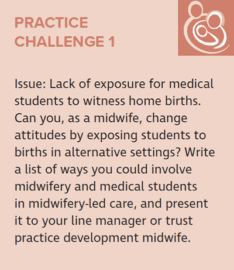
In the future provision of safe maternity care, home birth is likely to be a significant component, particularly with the targets to be achieved by Better births. Evidence (Birthplace in England Collaborative Group [BECG] 2011) demonstrates that healthy multiparous women planning a home birth, experience less intervention with no impact on perinatal outcome, yet nationally home-birth rates still remain low at 2.1 per cent (Office of National Statistics [ONS] 2015). Publication of Better births and the subsequent five-year Maternity Transformation Programme have an aspiration to change the care delivered, moving to local maternity systems with an increase in community-based care and personal maternity budgets, aimed at increasing individualised care and maternal choice (NHS England 2016). To achieve this transformation, not only is a general societal cultural shift required, but a change in the training and experience of health professionals providing care. Many qualified health professionals advising women have no experience of home birth, and medical and midwifery students currently train predominately in obstetric units. Many student midwives qualify without ever witnessing a home birth, so how do medical students ever stand a chance? The findings of the birthplace study (BECG 2011) specifically mention the requirement for supporting infrastructure of a wider team, including ambulance services, obstetricians and paediatricians, to facilitate home birth as a safe choice. If wider adoption of home birth becomes a reality, we need to ensure provision of a supportive extended team with suitable experience and training.
Home birth perspectives
From a midwife

As midwives, we provide a home-birth service that relies on the support of obstetric input only if women request care outside guidelines or if there is any deviation from normal. There is a general perception that home birth is the wild card: the choice for women willing to take a risk. In reality, most women opting for home birth do so for the convenience and the privacy; they are well informed and look for evidence and safety statistics before reaching their decision. But to reach the masses and change the way home birth is perceived, more is needed to change perceptions. The perceptions of midwives and doctors affect the choices women make: even when it is unintentional, the tone of voice or choice of wording can remain in a thought process and ultimately affect birth choices.
To explore how an obstetrician might gain experience of home birth we decided to work together for a limited period, thinking about how we might get the most benefit from the short period of time. Florence accompanied me to several antenatal appointments at home, witnessing the importance of developing a trusting relationship with women and their families. This relationship can only be built over time, a gradual process that allows for a deeper understanding of the woman’s wishes and fears.
From an obstetrician
As an experienced obstetrician, I advise women on the basis of evidence, but my personal understanding of the qualitative advantages or disadvantages of home birth was, at best, limited and, at worst, skewed by my experience of women transferred in during labour or newly postpartum, due to complications.
Building a home-birth service
A midwifery reflection
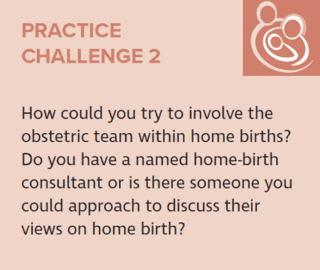
Our home-birth team provides antenatal care at home, with women being encouraged to meet a small number of midwives, providing continuity of carer, and then to attend additional sessions to meet other midwives, so that the chance of having a midwife they know during labour is increased. The most noticeable difference in comparison to hospital birth is the shift in power. We are being invited into women’s homes, with conversations being held in an environment in which those women are comfortable and confident and we are the visitors. This subtle shift in relationships results in a far more holistic approach to care. Listening to women and addressing their needs comes first, and the midwifery check is frequently last on the agenda, just before we depart. Care is more inclusive with a greater awareness of the needs of birth partners and extended family, as well as other children. We facilitate midwifery students to accompany us on visits and to births, with women’s consent; to expose them to low-risk midwifery care in an alternative setting. However, getting medical students interested in attending births in different areas is a challenge; as they are the future obstetricians, we became determined to involve our obstetric team in any way we could, to expose them to the world of home birth.
An obstetrician’s view
After joining the team for several antenatal and postnatal visits, I notice I am suggesting home birth more often to women in my clinic, and when I am referred a woman by the home-birth team, I have a much greater understanding of the care the woman is receiving, and understand that a visit to the hospital obstetrician – in contrast – could be a daunting experience. I am also aware that a clumsily worded question or comment could so easily undermine the relationship that will have developed with the team, and the confidence the woman has in the choices she is making. I know the detailed personalised discussions she will have had and this gives me a clearer context in which to discuss whether home birth remains a safe choice for her and her baby.
To appreciate these issues, in more detail, I wanted to work closely with the home-birth team and attend home births to help broaden my perspectives and enhance my practice.
Bridging the gap – a birth story
Obstetrician at a home birth? Whatever next?

For some time, witnessing a home birth eluded me, until one day in my antenatal clinic, I saw a woman having her third baby.
Tania* had been sent to me for obstetric ‘sign off’. (This happens when a woman’s plan falls outside our local maternity service home-birth guidelines. I have seen several women in this category achieve safe home births where a minor query could have unnecessarily resulted in a change in place of birth). Tania was planning a home birth, mainly from a purely practical perspective, because her second labour was rapid. She told me she was having regular tightenings and asked me to examine her, so that she could plan accordingly. She was 4cm dilated, with a very thin cervix, so I rang the home-birth team and encouraged her to head home. I was delighted when she agreed for me to come out with the midwives when she was in labour – and, sure enough, a couple of hours later, I received a call to say that she was in established labour and was 8cm dilated.
* Name changed for anonymity.
A journey reversed
The usual labour journey was reversed, the birthing woman being at home, and it was me – the anxious health professional – driving the short journey that seemed to be taking forever, with the worry of whether I was going the right way and whether I would arrive in time.
Luckily, I did and was welcomed by the two grandmothers opening the door and telling me to make my way up to the top of the house. In a light and airy bedroom, Tania was kneeling on a pillow by the side of her bed, her head resting on the mattress, breathing gas and air. Her partner was encouraging her and the two midwives were already present. I was struck by the aura of calm in the room and the fact that we were all intensely focused on the woman and supporting her. In contrast to the hospital, there were no distractions and no other women requiring our attention: our common purpose was her and her baby and family. This was total privacy with no interruption. Again we were guests at their home and their birth, so the permission and relationship between us and the couple felt subtly different, to me, from a hospital birth. Fairly soon her waters broke during a contraction; contrary to popular myth there was no mess, the deluge was swiftly dealt with by the midwives with efficiency and old towels, and the new bedroom carpet was protected by a tarpaulin, expertly laid by her partner (his first job on arrival home from work).
Welcoming new life

We listened in to the baby’s heartbeat; at times it slowed as the baby’s head descended, but there was no panic or intervention that might have occurred with a less experienced team. After a vaginal examination to confirm full dilatation, we encouraged her to go with her body. The midwives suggested she change position to stand, leaning on her partner. Soon we could see the baby’s head and, with support and encouragement, a baby boy made his way into the world. Tania was elated but exhausted, so the baby had immediate skin-to-skin with his father, while she sat on the side of the bed, looking slightly stunned. After the placenta was delivered, I was dispatched downstairs to the kitchen for a torch and batteries so that we could inspect Tania’s perineum. I told the waiting grandmothers the news; they had already heard the baby’s cries, and close behind me came the father, still with his son skin-to-skin, to introduce him proudly.
A sense of place
We helped Tania to the bath, as the improvised resuscitaire on the chest of drawers made way for the weighing scales. The midwives started to tidy equipment, while I helped Tania to dress – and then she settled into bed with the baby cradled in her arms, skin-to-skin, to start his first feed. Her son had arrived, firmly grounded in his family home; it felt unbelievably ‘right’: I felt a sense of place and belonging. From the beginning, he was surrounded by family in his home, rather than in an alien hospital room. The grandmothers brought cups of tea, biscuits and sandwiches, and we had an impromptu picnic, chatting and relaxing with the couple and their baby, reflecting on what we had all just experienced together. Both parents commented that this was a world apart from their previous births. The atmosphere was relaxed and, to some extent, we remained in a ‘bubble of birth’; we joked about timing (their older two boys were at nursery that day); we talked person-to-person about attitudes to home birth, about schools and all manner of things; while the baby fed.
Exploring equipment
One midwife packed the bags, noting what needed restocking; she showed me the equipment they carry for haemorrhage, cord prolapse, neonatal resuscitation and suturing. We discussed which drugs they can and cannot carry, and some of the more difficult home births she has been involved in. I also got to see the ambulance call cards that have been developed by the MAMA academy (2016) and London ambulance, to ensure midwives can organise a rapid transfer, should the need arise. In the past, she said, she had sometimes waited for an ambulance for hours. She left to return to the hospital to do the paperwork, while the remaining midwife and I stayed until the baby was two hours old, to complete final checks on both mother and son.
A special kind of something
As I was leaving, the grandmothers collected the older two boys from nursery and brought them home to meet their new baby brother. I felt I had experienced something very special. Although I have witnessed many midwifery-led births, this birth had an aura of calm and a different intimacy I had not experienced before.
It left me asking myself why you wouldn’t want this type of care provided in the familiar surroundings and comfort of your own home if it was your safest option. For those women for whom home birth isn’t a realistic safe option, it left me contemplating which elements of the experience could be brought into hospital birth. We spend time thinking about physical environment and décor but actually it was the shift in relationships and lack of interruption and distraction that really came home to me during the birth experience.
Women with complex pregnancies could definitely benefit from the detailed antenatal preparation and attention to detail I witnessed, as well as being offered the opportunity for an obstetric consultation at home. If we are truly going to transform maternity care to a woman-centred service, these are ideas that need further exploration for all women, regardless of place of birth. Better births focuses on the importance of providing continuity of carer, personalised safer care and multi-professional working. The obvious answer is to provide this to the low-risk woman requesting routine care. But the women who will benefit most from this service are the women with additional risk factors.
Enhancing care for all
During the time we spent together visiting women planning home births, we also had the chance to meet with one woman requesting care outside guidelines.
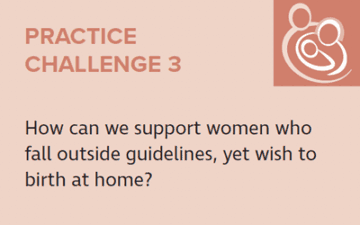
I am struck by the very detailed antenatal preparation provided for women and their birth partners. There is a focus on practical aspects, such as equipment or clear instructions to assist house identification in the middle of the night, as well as discussion of clinical issues including transfer rates, possible emergency situations and complications. Birth preferences including clear contingency plans are agreed, and midwifery management plans are developed with the support of the consultant midwife, obstetricians and professional midwifery advocates as well as the home-birth team, when women request care outside guidelines. One woman planning a home vaginal birth after caesarean (VBAC) has, with the assistance of the midwives, agreed three sets of preferences for home VBAC, hospital VBAC and caesarean section. The midwives tell me they build trust and understanding over a number of visits to help develop an appropriate plan by 36 weeks. This relationship is key, so that if transfer in labour is required, the woman has complete confidence in the midwife’s advice, as they know her as a person and what her priorities are.
The national drive to improve continuity of care for most women, as recommended in Better births, (the maternity transformation programme and NHS long-term plan), should help this sort of relationship-based care become the norm for all births. Bespoke plans made by midwives and obstetricians, together with women, can minimise risks for women ‘outside of guidelines’ by agreeing in advance what the relevant parameters for transfer are for her and ensuring that the woman feels in control of her care, so that she has a positive birth experience whatever unfolds during labour.

By combining our strengths as obstetricians and midwives, we can help shape the future of the NHS. Women and families deserve the very best of our care: when a woman requests a home birth, it is our responsibility to ensure we are adequately supporting them. Only by increasing the exposure of our midwifery and medical students as well as our qualified staff, can we ensure they have the understanding needed to provide truly informed evidence based care. TPM
References
BECG (2011). ‘Perinatal and maternal outcomes by planned place of birth for healthy women with low risk pregnancies: the birthplace in England national prospective cohort study’. British Medical Journal, 343: 1-13: d7400. https://doi.org/10.1136/bmj.d7400
MAMA Academy (2016). London ambulance call cards, Addlestone: MAMA Academy. https://www.mamaacademy.org.uk/about-us/london-ambulance-call-cards/
NHS England (2016). National maternity review. Better births. Improving the outcomes of maternity services in England. A five year forward view for maternity care, London: NHS England. www.england.nhs.uk/wp-content/uploads/2016/02/national-maternity-review-report.pdf
ONS (2015). Birth characteristics in England and Wales 2015, Newport: ONS. https://www.ons.gov.uk/peoplepopulationandcommunity/birthsdeathsandmarriages/livebirths/bulletins/birthcharacteristicsinenglandandwales/2015

