
How Can Midwives Provide Woman-Centred Care in the First Stage of Labour?
Maeve A O’Connell – Assistant Professor Midwifery, Fatima College of Health Sciences, Mafraq, Abu Dhabi, United Arab Emirates
Instagram @thelovelymaeve
Rachael McGrath – Volunteer, Birth Trauma Association and survivor of birth trauma
Introduction
 The first blog post is written in response to the article Time to rectify past mistakes and move towards a woman-centred approach to labour progress. At the end of the account is a reflection from a survivor of birth trauma.
What do you think of when you hear the words ‘birth trauma’ and ‘tokophobia’?
Birth trauma may be physical or psychological. A woman or birthing person could experience a life-threatening situation during the birth process, a third- or fourth-degree tear, or have severe pre-eclampsia warranting a category-one C-section for example.
For other women, birth trauma could be triggered by a dismissal of her symptoms or pain, not feeling heard, feeling ignored by those who should be caring for her at the formative time of labour and birth. Secondary tokophobia is a severe fear of childbirth which follows a negative or traumatic birth experience. This can be so severe the woman has flashbacks, nightmares and panic attacks and, at its most extreme, the woman will choose not to ever give birth again, despite her desire to have another child.
If you are reading this blog, you may be a midwife or a midwifery student, or you could be a doctor. I believe we are all very passionate about what we do and aim to provide respectful maternity care. So how do you feel when you hear that birth trauma and tokophobia are often caused or triggered by clinicians? The literature suggests there is a discord between how we perceive the care given, and how women experience the care.
The evidence reveals that this is not necessarily by WHAT we do, but often, by HOW we communicate with the woman during labour, and particularly by not offering choice and control, or explaining WHY things are done during the formative time of the first stage of labour.
The greatest gift that we can give women in labour is time. An awareness of the consequences of starting a cascade of interventions is crucial when considering the use of active management of labour. We need to seek to understand what is important for each individual and help them to make the best decision for them. Ideally, in a continuity-of-carer relationship, this will be realised during the pregnancy. However, the reality is most women experience care in fragmented maternity systems. Therefore, how can we give woman-centred care in the first stage of labour?
Presenting the options in a clear, neutral way and underpinned by the best available evidence, with good explanations. Women should never feel pushed into decisions, coerced or like they have no choice. In other words, we as professionals should be guided by the principles of informed consent (See Box 1).
Women should understand WHY interventions are suggested and receive good explanations throughout the labour process to reduce post-traumatic stress disorder (PTSD) and tokophobia after birth (secondary tokophobia). During procedures, women should feel they can say no and stop immediately if they do.
Principle 1. All individuals have the right to be involved in decisions about their treatment and care and be supported to make informed decisions if they are able.
Principle 2. Decision-making is an ongoing process focused on meaningful dialogue: the exchange of relevant information specific to the individual patient.
Principle 3. All individuals have the right to be listened to, and to be given the information they need to make a decision and the time and support they need to understand it.
Principle 4. Clinicians must try to find out what matters to patients so they can share relevant information about the benefits and harms of proposed options and reasonable alternatives, including the option to take no action.
Principle 5. Clinicians must start from the presumption that all adult patients have capacity to make decisions about their treatment and care. A person can only be judged to lack capacity to make a specific decision at a specific time, and only after assessment in line with legal requirements.
Principle 6. The choice of treatment or care for individuals who lack capacity must be of overall benefit to them, and decisions should be made in consultation with those who are close to them or advocating for them.
Principle 7. Individuals whose right to consent is affected by law should be supported to be involved in the decision-making process, and to exercise choice if possible.
The Principles of Informed Consent (GMC, 2020)
I suggest using the mnemonic BRAIN to help guide those in your care with the decision-making.
- What are the Benefits?
- What are the Risks?
- What are the Alternatives?
- What does the woman’s Intuition tell her about the situation?
- What if we do Nothing?
Nothing is an option often. Think about what will happen if we continue present care. As midwives, our role and scope of practice encompasses optimising normal biological birth processes and then recognising when pathological issues arise which warrant timely referral to our obstetric colleagues. The World Health Organization (WHO) recognised the unrealistic expectations of labour progress in the traditional partogram, updating it in 2018.
In this new guidance, the WHO stress the importance of a positive birth experience and overturning what was previously known about the labour progress in the first stage, by recognising there are physiological plateaus in labour.
So, if we know that there is not high-level evidence to support the traditional active management of labour as recommended in the fifties by Friedman, Philpott and Castle, Studd and O’Driscoll, then why is this still the reality for the majority of women in modern maternity systems?

Routine active management of labour using outdated partograms, championing the unrealistic rate of 1cm per hour dilation and requiring regular vaginal examinations to confirm this progress is dominant, even though we know that this does not reduce Caesarean sections. A key challenge in maternity care is re-education in this aspect of care which is now so engrained and normalised in many obstetric unit cultures.
The NHS England have strategised to implement a comprehensive plan for personalised care as part of the long-term plan (NHS England, 2021). This comprises all women having a Personalised Care and Support Plan (PCSP) (see Figure 1), working hand-in-hand with the healthcare team to complete this assessment. This document would be reviewed by the midwife/doctor and woman at each contact. Collaboration is key for safe care – recognising that women should remain in control of their birth.
The woman leads decision-making, with the midwife and obstetrician offering evidence-based information and having meaningful discussions to facilitate this (based on the recommendations from Montgomery and Lanarkshire landmark ruling). When decisions are made and interventions performed, the woman should understand why and have clear explanations as to why things happened. In this way, we are ‘with woman’ rather than ‘doing to’.
How we communicate with women is a priority. The tone of voice used, the language we use and balancing the power dynamic, viewing the woman as an equal in decision-making about their care. For example, the terms we use could be anxiety inducing, like ‘fetal distress’ could rephrased as ‘changes in the pattern of the baby’s heart rate’ or ‘amniotomy/rupture the membranes’ could be phrased ‘releasing the waters’.
The Royal College of Midwives in the UK have recently published a report Re-Birth to create a new, positive, shared language around childbirth.
It’s time for us to take ownership of this responsibility that we have and the past mistakes that we made. We have the power to protect a mother’s emotional and psychological well-being at this formative time. Let’s make a collective promise to make these changes and act now to provide woman-centred care in the first stage of labour.
Figure 1: Development of PCSP

Time to listen to women and collectively commit to prevent birth trauma: A reflection by Rachael McGrath
 Reading the article ‘Time to rectify past mistakes and take a woman-centered approach to labour’ written by Dr Maeve O’Connell, Prof Colin Martin and Prof Hannah G Dahlen, I am struck by how this is the absolute dream for all service users, not only across maternity – but all medical care.
I wish that this incredible vision was representative of my own experience, and that of so many others who have been left psychologically injured by the lack of basic kindness and humanity they experienced whilst giving birth.
As the Volunteer Manager at the Birth Trauma Association (BTA), this call to action to place the same value on informed consent and appropriate communication that is given to other medical interventions resonates fiercely with me.
If only the principles advocated in the article were utilised and embedded in all aspects of care, the BTA would not consistently have scores of people each week applying to join our Facebook Support Group, which currently has almost 14,500 members.
Birth trauma isn’t a drop in the ocean of maternity, this is a prolific issue with devastating consequences for those who unfortunately endure it.
The BTA is a small but mighty charity, almost entirely staffed by volunteers who’ve experienced their own traumatic births. As well as participating in research and campaigning for better outcomes for maternity service users, we offer an email and telephone peer support service to anyone impacted by trauma, or poor care during their birth which frequently leads to them developing symptoms of post-natal PTSD. We do our best to pick up the pieces and help them heal, signposting to professional help, and walking alongside people on their journey towards recovery.
If only the care women received was as Maeve and her colleagues set out in this article, we wouldn’t have so many coming to us feeling traumatised that procedures were carried out without their consent. ‘I just gave you a quick sweep whilst I was examining you,’ is something we hear repeatedly. This is usually the point where our member felt they lost all autonomy over their own body.
Women feel their pain wasn’t taken seriously, one of our members told us how a midwife asked her husband ‘is she always this much of a drama queen?’ as she laboured, writhing in agony. All these experiences create and embed lasting trauma.
Maeve and her colleagues are paving the way for a better future, where person-centered care is at the very heart of treatment. Their ethos recognises that as health care professionals you are such incredibly powerful people. Hospital admissions can be challenging for anyone, yet excellent care can be the difference between someone leaving a hospital feeling supported and nurtured, or violated and traumatised.
Please, strive to adhere to the principles in this article. You will then be that Practitioner whom the patient leaves with gratitude and relief that it was you who cared for them. They will always remember you, let it be for the very best reason.
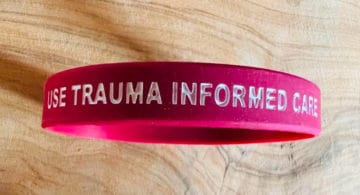
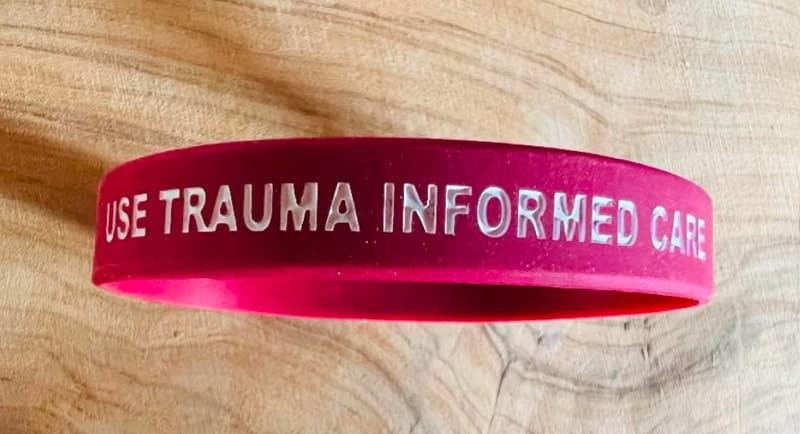
As a footnote, the BTA are raising awareness of our wristband which is a small piece of armour we can offer to empower our members. If you see someone wearing this, please know that they’ve previously experienced a traumatic birth, and take that little bit of extra time to help them feel safe in your care.