








‘In Order to Refresh Memories’: Hand washing re-visited
Nicky Leap – Adjunct Professor of Midwifery University of Technology, Sydney Australia
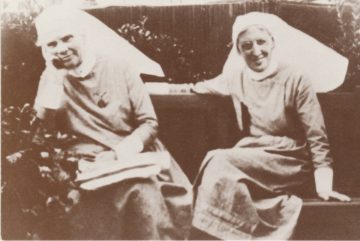
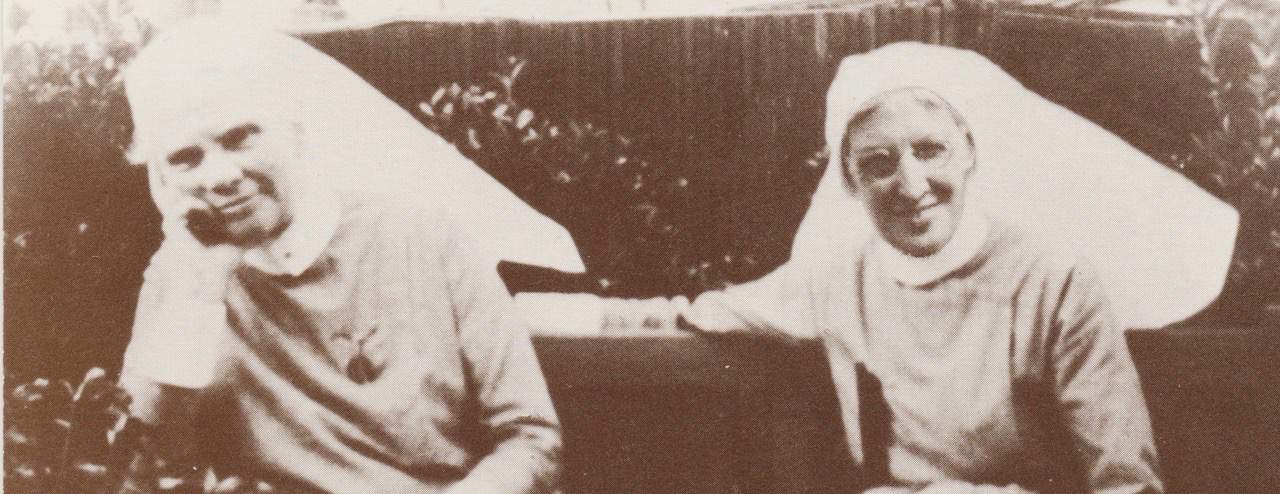
Alice Gregory and Maud Cashmere (1)
Hand washing and midwifery practice in the early 1900s
In the Preface to The Midwife: Her Book, Alice Gregory writes ‘[This is]… in no sense a text-book of midwifery… it is the outcome of the experience of three people who have spent many long years in the practice of district midwifery, and of preparing others to do the same… If [chapters] open any windows into the point of view of those who so often are putting up a good fight without any of our advantages, the book will have served its purpose.’1(p.6)
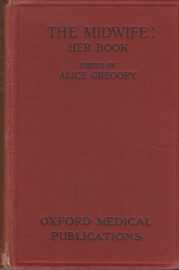
The Midwife: Her Book (2)
Indeed, the book is an eclectic mixture of fascinating stories from community midwifery practice.
The ‘good fight’ that Alice Gregory refers to reflects her conviction of the world being ‘… a great battlefield against the devil…sending out his emissaries, superstition, dirt, and germs that bring disease, taking advantage of the superficiality and carelessness of the nurse… every time we do our work in a perfunctory manner without real purpose and whole heartedness of endeavour.’1(p6)
The evolution of ‘germ theory’ and hand washing in maternity care
In order to understand the fervour of these words and the instructions to midwives in Boxes 1 and 2, it is worth bearing in mind that midwives like Alice Gregory were practising in an era only a couple of decades away from when the medical establishment had finally accepted ‘germ theory.’ Louis Pasteur’s publication in 1861 proved that bacteria caused diseases; this led to a re-appraisal of the earlier work of Hungarian obstetrician Ignaz Semmelweis. While working in the Vienna General Hospital’s first obstetric clinic, Semmelweis linked the high number of maternal deaths to doctors coming straight to the clinics from the mortuary, where they had practised dissection and vaginal examinations on cadavers. In 1847, he proposed the practice of washing hands with chlorinated lime solution to reduce puerperal sepsis. In spite of various publications showing that the shockingly high maternal mortality rates could be reduced to below 1% with hand washing, Semmelweis’ work was rejected by the medical community, some being offended by the suggestion that they should wash their hands.3
Hand washing procedures in early twentieth century midwifery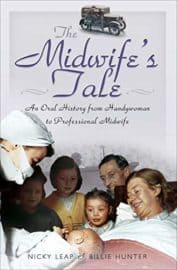
In the 1980s, Billie Hunter and I interviewed retired midwives who practised before the NHS came into being in 1948 as well as women who gave birth in that era. In the ensuing book2 we included two sections about hand washing from Alice Gregory’s (1923) book for midwives.1 These offer a vivid description of stringent hand washing efforts to prevent puerperal sepsis. When reading these vignettes in Box 1 and Box 2, it is worth noting that sterile gloves were not in use until after 1937.
Hand washing and vaginal examinations
In the first half of the twentieth century the practice of vaginal examinations in labour was rare, as these midwives explained:
We did them sometimes in labour if we felt it was required, but very, very seldom. We got into the habit of realising how the labour was progressing without a vaginal. It was quite easy really when you were watching the patient. I think it’s a pity to do unnecessary internals. They shouldn’t really be necessary in normal cases if you’re keeping an eye on the patient. I think people rely too much on that and too little on their own observations. It can’t be pleasant having internal aminations.2(p158). Somehow or other you know, as you became more experienced, you could just look at the patient’s face and say, ‘‘She’s about two or three fingers [dilated]’’, or, ‘‘She’s coming on’’. You could tell by the look on her face, not always by the number of pains she’s having. You never got two alike.2(p.158)
When we read the instructions for performing a vaginal examination in Alice Gregory’s book, we can understand why midwives might have thought twice about subjecting their hands to such punishing hand washing procedures.
Box 1. Hand washing and vaginal examinations
‘However necessary vaginal examinations may be, they must not be undertaken without plenty of time, and soap and water. A quarter of an hour is the least time that can be allotted for this purpose. For the preliminary bathing, three minutes’ scrub of your hands, and one minute’s scrub in perchloride of mercury, 1 in 1,000. After the bathing, change the water; and in a full basin of clean hot water, five minutes’ scrub; then a three-minute soak, and one is ready. If you have not enough time for these processes, so much the better – you have evidently not enough time to examine and the labour must be advancing rapidly’1 (p25) cited in Leap & Hunter.2(p.159)
Hand washing and the routine postnatal visit
In the first half of the twentieth century, all women were confined to bed for 10 days after giving birth and families were told that this was extremely important, as this woman explains:
They said if I didn’t, all my insides would drop out and I didn’t want that, did I. Still, it gave you a rest, but when the ten days were up you were expected to get up and do everything. His food had to be on the table, everything back to normal.2(175)
In pre-NHS days the midwife was paid to attend women daily during their ‘confinement’ – by the family, a local authority or a nursing association; this may explain some of the duties that are outlined in Box 2:
We went in to swab them and to make the beds. Occasionally the mother would make the bed, but it was very rare. ‘‘Nurse’’ was given 30 shillings to do this; she was getting paid! So yes, you swabbed them and then bathed the baby – that was for eight days – and on the tenth day you showed them how to bathe the baby and they could then do it themselves. But it was very hard work.2(175)
Box 2. ‘The proper ritual’ for a postnatal visit
‘In order to refresh memories, I add the proper ritual for an ordinary morning visit – with no complications:
- Ask at door for kettle and slop pail.
- Remove cloak and leave outside bedroom. Roll up sleeves to elbow.
- Open your bag, and the drawer holding napkins.
- Wash, domestically, in cold water.
- Give thermometer, open wool bag, mix lotions, per-chloride of mercury, 1–1,000-quart basin, Lysol in a second bowl, place these on a chair near bed.
- Take and record pulse, temperature, respirations, look at tongue, ask if bowels are open, and other questions.
- Remove binder, fold it up and place on pillow.
- Put patient on clean chamber, with pillow in small of back.
- Place paper receiver under bed.
- Scrub and disinfect (two minutes’ scrub, rinse, one minute soak, longer for lacerations, time by clock).
- Take wool from wool bag and close its mouth, put swabs in Lysol, one or two in perchloride of mercury solution and some in mouth of bag for breasts.
- Soak hands again, push back clothes with elbow, lather with soap and Lysol and stream down with that, then with perchloride of mercury. (The opening should be cleansed first and then covered with thin wet swab while the rest is lathered. Do not separate labia unless there are abrasions. These must be irrigated with either boracic or saline solution, or sterilized water, from sterilised bottle).
- Remove chamber with left hand, and tilt patient onto side with right elbow.
- Finish bathing from back, apply napkin, turn patient on back.
- Scrub hands again, empty and refill basin.
- Remove sheets and nightgown.
- Soak hands in perchloride of mercury.
- Wash and dry breasts with clean wool – cover with clean napkin.
- Wash in the ordinary way face, hands, arms, abdomen and back.
- Roll in binder, replace nightgown.
- Rub uterus for five minutes, measure, adjust binder. Do hair, cut nails if necessary.
- Make bed, transferring patient to other side if possible.
- Pin mother’s flannel and towel together.
- Scrub and soak hands one minute.
- Wash infant before fire, beginning with eyes and mouth. Powder must be warm (not hot) and dry.
- Empty basin, wash soap dish, leave nail brush in empty lotion bowl.
- Rinse out chamber with perchloride of mercury, using breast swabs.
- Empty pail, remove soiled linen, burn swabs.
- Give full instructions to last till next visit. (All linen should be folded neatly and placed together as soon as it is taken from bed of patient. Feet should be washed once a week, and toe nails cut. The visit should last about one hour to one hour and a quarter, unless breasts have to be relieved or a catheter passed, when it maybe longer,1(pp20-21) cited in Leap & Hunter.2(pp176-177
When following current NHS directives to wash our hands for at least 20 seconds with soap, let us spare a thought for the efforts of those early twentieth century midwives who worked so ardently to prevent infection.
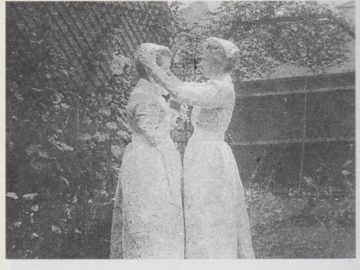
Alice Gregory and Lelia Parnell in the garden of the midwifery school they founded in 1905 (3)
References
- Gregory A (ed.) The Midwife: Her Book, London: Frowde & Hodder & Stoughton; 1923.
- Leap N, Hunter B. The Midwife’s Tale: an oral history from handywoman to professional midwife. Second Edition, Barnsley, South Yorkshire: Pen & Sword; 2013.
- Noakes TD, Borresen J, Hew-Butler T, Lambert MI, Jordaan E. (2008). Semmelweis and the aetiology of puerperal sepsis 160 years on: an historical review. Epidemiol. Infect. 2008; 136:1-9. doi:10.1017/S0950268807008746.
Images
- From the photographic exhibition: ’The British Hospital for Mothers and Babies Closed 1984’. The Independent Photography Project.
- A copy of the front cover of The Midwife: Her Book. Edited by Alice Gregory. Oxford Medical Publications. 1923.
-
Alice Gregory and Lelia Parnell in the garden of the midwifery school they founded in 1905. From the photographic exhibition: ’The British Hospital for Mothers and Babies Closed 1984’. The Independent Photography Project.[Note this (very old) photograph was lent to us by the Independent Photography project for publication in The Midwife’s Tale: An oral history from handywoman to professional midwife. It appears in both editions. The Independent Photography Project no longer exists but we were given permission to use it again by the person who used to work in the project and who curated the exhibition.]
Check out the Royal College of Midwives Heritage Blog for oral history interview excerpts and other highlights: www.rcmheritage.wordpress.com

