








Inclusive Language
Jacob Stokoe – Lived experience expert and LGBTQ+ trainer
Instagram: @jacobtheseahorse
Published in The Student Midwife Volume 5 Issue 02 April 2022, Pages 24-27 https://doi.org/10.55975/KVAY2768
Summary
There are simple but powerful changes anyone working in perinatal care can make to be more inclusive to trans and nonbinary people, while still centring women in their work. As a trans birthing parent, I have experienced how language can be a barrier to care. I have also seen how it only takes one person to make fundamental changes that benefit people of all genders who are accessing that service. In this article, I explore how changemakers, great and small, can make a difference.
The backlash
 Trans and nonbinary people are facing wave after wave of transphobia. There is backlash from people who would like to imagine that sex and gender are always binary, always easy to box. This transphobic rhetoric from a small but vocal group has only increased as trans people, particularly trans birthing people, have become more visible in recent years. The media is also pushing the agenda further, often twisting a narrative of trans pregnancy and birth to sell papers.
As a trans birthing parent I have been sensitive to this shift in narrative. It has changed so much in the three years between my two pregnancies. During my first pregnancy in 2018, the only talk of trans pregnancy was in the context of various people being labelled the “first pregnant man”. I spent that pregnancy terrified of photos of my masculine, bearded and pregnant self being splashed across tabloids. I gave birth to my second child in 2021 and, in that three-year gap, it was obvious the conversation around trans birth was wildly different. There are now conversations about how to make perinatal care more inclusive, and how the complex social factor of being trans and pregnant can mean that trans (including non-binary) people need particular forms of support during the pregnancy continuum.
Steps back and forth
With every step we take forward in trying to make perinatal care more inclusive to people of all genders, there is a huge pushback from the transphobic lobby. We saw this when the Brighton and Sussex University Hospitals Trust released their ground-breaking guidance on caring for trans people.1 The media presented it as a war between trans people and cisgender women, despite the fact that the guidance explicitly addressed this, and still centred women in their language.
So far it has been trans people leading these changes, and we have made incredible strides, but the relentless pushback means we need allies. Despite the backlash that feels like it is coming from all sides online, when talking to birth workers I have had an overwhelmingly positive response. This is both in the context of the people who provided care to me, and the birthworkers I have delivered training to on how best to support all birthing people. My hope is this quiet majority are willing to make small but meaningful changes in their everyday practice to improve the quality of care for birthing people.
Tangible change
During my recent pregnancy I met someone when I went for my pertussis vaccine who took it upon herself to make real, tangible change. She told me someone she loves had recently come out as trans. We spoke about how to be a good ally and she shared that, while she was proudly wearing her rainbow lanyard, it didn’t feel like enough. An easy way to not only be inclusive, but to actively mark yourself as an ally, is to wear a pronoun badge. Having your pronouns visible normalises it, making it easier for trans people to do the same, while showing you are a safe person. It is a functional symbol of your allyship. This extends electronically by adding your pronouns to your email signature.
Relentless and exhausting
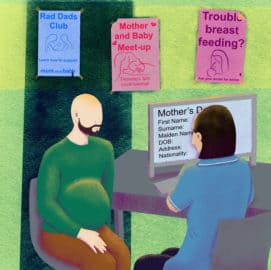
 We discussed how the hospital wasn’t hugely accessible to me as I’m continually misgendered by being in the space. I describe this assumption that everyone in a space is of one gender as ‘indirect misgendering’. The masculinising effects of testosterone means that people look at me and assume, correctly, I use he/him pronouns. This means that I am rarely directly misgendered. However, being in a space that equates pregnancy with womanhood means that I am facing a constant drip of indirect misgendering.
Every poster on the wall that talks about pregnant women either excludes me or misgenders me. The sign at the entrance dictating only pregnant women could come into the waiting room meant that I was misgendering myself by walking in and accessing care.
Every website you access to look up pregnancy symptoms, every blog, parent group, antenatal class, letter from the hospital – it all risks indirect misgendering. It is relentless and exhausting. In another experience, I asked a member of staff who didn’t know me directions to the toilet, to do a urine sample. I found my sore and pregnant self directed to toilets near the hospital entrance. The toilets inside the department were only for women. I had a choice to make and I chose to be indirectly misgendered (and risk harassment) by using the toilet that was marked to only be used by women.
I shared these experiences as she administered my jab and took my bloods. It was heartening to have the support of an ally in a space that didn’t feel hugely welcoming. I did not expect anything to come of it. But she took it upon herself to make change happen.
Changemakers great and small
By the time I came back for my growth scan a few months later, she had met with the LGBT rep and the Head of Department, and between them they had implemented several changes. The welcome sign at the front of the department now said “women and birthing people” and the toilets had been made gender neutral. Small changes in signage that didn’t exclude anyone else and still centred women, but welcomed me into the space. If every department, every trust, every team had someone like this member of staff – a cis ally willing to take on the effort to make change happen – then perinatal care would be so much more accessible for trans people.
Words of affirmation
 Language is incredibly important, especially for trans people, as many of us have had words weaponised against us. I spent years flinching upon hearing “she”, fearing it would be used to refer to me. Like a constant hail storm, those little words bruised me. Even now, years after the majority of people gender me correctly on sight, I still feel pain even at the possibility someone might use feminine language for me. It is an old wound, but it hits just as hard. This was worse when I was pregnant, vulnerable, and facing constant indirect misgendering. I can only imagine how much harder it would have been if I had accessed perinatal care before reaching a tipping point in my transition. The good news is that there are just a few small changes that can make your language more inclusive. It might take a little practise initially, especially when you work in a field where gendered language is currently the norm, and culturally expected.
Examples of non-conflating language
- Anyone with a cervix should make sure to have regular
smear tests - These toilets are for pregnant women and people
- Anyone in labour has the choice to decline interventions
Centring individualised care
Consider attaching pronoun stickers to physical copies of notes to prevent direct misgendering. Another possible addition to patient notes is a body map – an outline of a human body to write preferred language used around their body and pregnancy. This is useful for trans people, but is also valuable for trauma survivors. For example, it was important to me that only the word “chest” was used as any other language causes me intense dysphoria.

It is important to be mindful of who you are talking about. Not all people who give birth are mothers (surrogates or trans birthing people) and not all mothers give birth (step mothers, non-gestational mothers, those whose babies are born through surrogacy, adoptive parents, trans mothers etc). Conflating “mother” with “person who gives birth” is actively excluding the experiences of both trans and cis people. BSUH recommend “women and birthing people” when talking about the population of birthing people as a whole in their Gender Inclusive Language Guide.1 This still centres women while also including people of all genders.
 Another simple adjustment to make when creating written documents (eg. letters, leaflets, posters) is to use second- person pronouns. Using the second-person makes it not only more inclusive, but also more personal. For example, the letter sent out to all pregnant people could read “as you are pregnant, you will be invited to a scan at 12 weeks.” It is a simple, effective change, taking just a little consideration to implement.
It is important these examples are only for when talking about large groups of people or the population as a whole. When talking to individuals, the majority of whom do use mother for themselves, it is important their chosen language is respected. This is not about erasing language, but instead expanding it to make sure everyone is recognised.
With more people realising they are trans, and the community knowledge that taking testosterone does not seem to impact fertility, we are only going to see more trans people accessing perinatal services. Ultimately, services have a legal duty of care to be inclusive. TSM
Reference
- Green H, Riddington A. Gender Inclusive Language in Perinatal Services: Mission Statement and Rationale. England: Brighton and Sussex University Hospital Trust. https://www.bsuh.nhs.uk/ maternity/wp-content/uploads/sites/7/2021/01/Gender-inclusive-language-in-perinatal-services.pdf Published December 2020. Accessed December 2021.