







Meet the Team! – Syeda
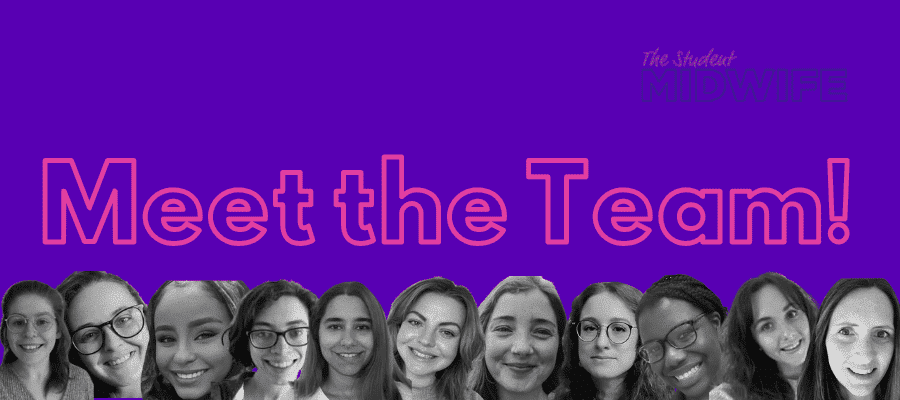
Did you know the Editorial Board for The Student Midwife (TSM) is made up entirely of student and newly-qualified midwives? We commission, write and edit all of the articles that fill our wonderful journal, so we know we’re bringing content that is of the most interest and use to you. Let’s dive in and meet one of the team!
This time we’re talking to Syeda Begum, she is a second-year student midwife at King’s College London.
What’s your role at TSM and how long have you been involved?
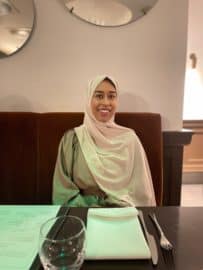
Syeda Begum
I am brand new to TSM, I started in January 2023 and I am the Digital Lead Co-Editor. My work includes editing blogs, curating social media posts and overseeing the new TSM podcast, as well as commissioning pieces for the TSM journal.
What’s your background?
My background is in International Relations, which I studied as my first degree. I’ve always been passionate about empowering marginalised groups and have worked first degree, I absolutely loved learning about the politics of global health and disease.
I knew my desk job at the Civil Service was not for me, so I made the career switch to midwifery and haven’t looked back since!
What are your main values that drive you?
Empathy – it is so important to have empathy in this line of work. You will meet people from all kinds of backgrounds and in that moment when they tell you their story, you need to be able to detach from any pre-conceived beliefs or notions you may have, to empathise with the individual you are caring for with sincerity and patience. As student midwives, we are also prone to burnout. It’s crucial to recognise when you are feeling depleted and need to replenish so that you can return to the clinical setting and give good care to service users.
What’s your proudest moment so far?
So many proud moments! But baby No.7 holds a very special place in my heart! It was a very busy, short-staffed night shift on Labour Ward, and I had already facilitated a birth just before midnight. During my break, I was suddenly called to attend to another birth. I didn’t know which midwife I was going to be working with and little did I know, I would find myself working with the Labour Ward Co–ordinator, who I was very nervous to work with! I wanted to impress her, but I didn’t want to disappoint her!
It was a completely physiological birth with no pain relief which I hadn’t seen during my time on Labour Ward. A woman came in fully dilated, in agony, from triage. During the two hours of continuous pushing, the Coordinator and I stood in back-breaking, uncomfortable positions as we supported the woman’s legs and arms with all our might!
Despite the back pain, it was an amazing experience, and I was excited to see a Labour Ward Coordinator be hands-on and support the pregnant woman so well.
During the birth, I too felt well-supported by the Co-ordinator and it was a real confidence boost for me as she trusted my abilities to work confidently, check the placenta and then take lead of the postnatal and neonatal care (under her supervision). During the labour, I was dreading doing something silly or getting something wrong but the Co-ordinator was really impressed with me and gave me wonderful feedback!
What’s your area of passion?
Equitable care! During my first degree, I volunteered as a Maternity Mate, supporting vulnerable women through their pregnancy. By providing emotional and practical support to women disproportionately affected by social, cultural and economic settings, I developed a greater insight into the complexities of healthcare delivery.
Whilst studying the Politics of Global Health, I reviewed contemporary global health crises such as Ebola and Zika outbreaks, which demonstrated the obstacles women face in claiming their right to health, reproductive rights and gender equality.
More recently, we can see how women’s reproductive and health rights were impinged upon during the COVID-19 pandemic.
Maternity reports have continually documented the disparities in outcomes for marginalised groups. My research interests focus on how commitments to improve population health can conflict with the politics of power and security. On a non-academic front however, the public health topic that I’m passionate about is pelvic-floor health! But more on that in a future blog!
Is there anything you dislike about midwifery?
The unsupportive, antagonistic culture in the clinical area. I’ve found that compared to other work settings, there is a higher threshold for treating student midwives unfairly and unprofessionally. Unprofessional behaviour which would immediately be challenged in other places of work is too often condoned within the NHS and excused.
This is widely remarked upon by student midwives and contributes to many students leaving the course. It is important to highlight unprofessional behaviour/ practice, if you feel able, to your Placement Facilitators or university tutors, so that it is documented and can be addressed accordingly.
What’s the most pressing issue facing the sector?
Staffing, definitely!
Labour Ward, Postnatal ward or Community?
Postnatal ward!
What’s your one tip for student midwives?
Attend Leah Hazard’s Student Survival Skills workshop! It was game-changing for me; she is a brilliant, captivating speaker who tells it like it is! I learnt so many important skills during her workshop, which gave me the confidence to recognise when something isn’t right and escalate accordingly.
What’s for dinner tonight?
Domino’s!