









Midwifery: A name to conjure with?
Dr Juliet Wood – Principal Academic in Midwifery, Bournemouth University
Social @jwoodmidwife
Summary
This article is a reflection on the question of what meaning is attached to the professional terms we use to describe ‘a midwife’ internationally and whether this matters. During the 33rd International Confederation of Midwives Triennial Congress in Bali last summer a wide range of midwives were asked what name is given to midwives in their country and this is an account of the conversations that followed.
One of the first things student midwives in the UK are generally taught is the meaning of the name ‘midwife’ – from the Middle English origins ‘mid’ meaning ‘with’ and ‘wyf’ meaning ‘woman’. This conjures up an image of the midwife being alongside a woman in her pregnancy or birth journey, intentionally, perhaps physically but also emotionally. It is sometimes contrasted or compared with the origins of the word obstetrics – from the Latin obstetricis ‘one who stands before/opposite’. Is this taught purely as a history lesson or is it in order to induct students into the discourse and philosophy of the profession? In the Shakespeare tragedy ‘Romeo and Juliet’ the relationship between names and identity is addressed by Juliet in Act II scene ii: ‘What’s in a name? That which we call a rose, by other name would smell as sweet’

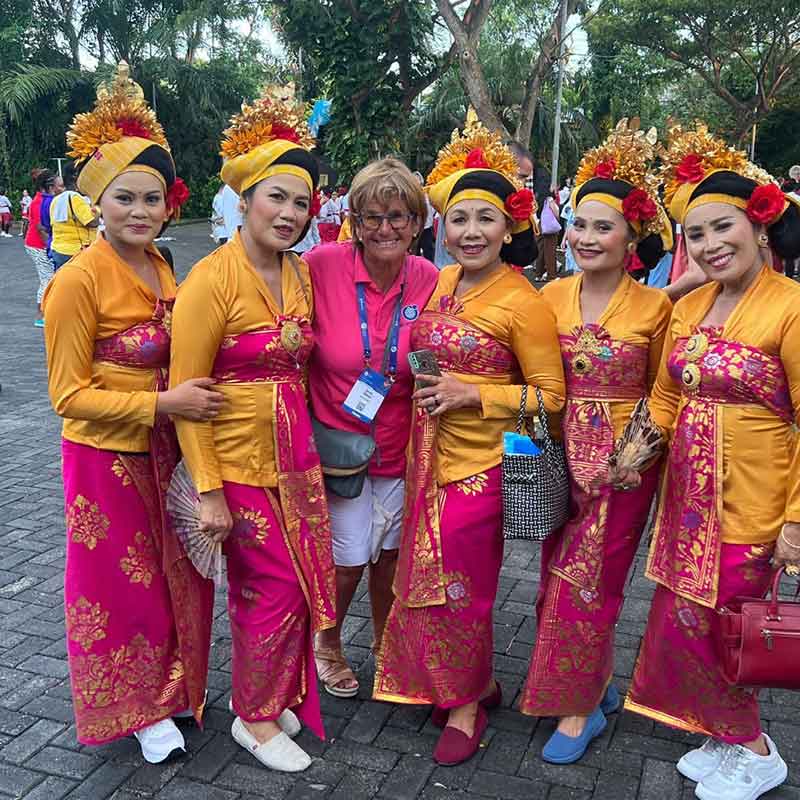
At the ICM conference last summer, which is a global gathering of midwives, I asked midwives from around the world what words are used to describe their profession and what those words mean. This was not a formal etymological exercise but rather to garner a sense of how terminology might be interpreted by midwives as representing midwifery, practically and/or philosophically, in their own countries. Some midwives described a clear linguistic derivation of the word whilst others did not and it is also recognised that the origins of terms are sometimes a function of history (including colonisation), sociolinguistics and geography.
Among some delegates there was no sense that the term used to describe someone practicing midwifery had any particular root in its meaning. Examples included South Sudan/Juba Arabic (Daya); Somalia (Umuliso); Eswatini/Siswati (Umbelekisi). However, many identified additional meaning in their derivation and these can be grouped according to the emphasis of the job title accorded to those who give maternity care.

The host country for the Congress was Indonesia where the term for a midwife is ‘Bidan’. This is derived from the Malay term which means ‘sage’ or ‘seer’. I met delegates from Western New Guinea, East and West Timor who use the same term. This title, which centres and reflects attributes of the practitioner and suggests that they have particular wisdom, foresight or insight is also mirrored in the word used in Fiji (Yalewa = woman, Vuku = wise), the Netherlands (Vroed = wise, vrouw = woman), France/Niger/Belgium (Sage = wise, femme = woman), Haiti (Saj = wise, Fanm = woman).

These titles also refer to the gender of the practitioner which is why in some French-speaking countries the title ‘maïeuticien’ has been introduced for male midwives.1 For further discussion on this issue of gender in the professional titles of midwives please see the article by Atchoumi, et al., (2022).
I spoke with a midwife from Afghanistan who explained that the Pashto title for a midwife (Qabela) carries with it a similar sense of intelligence and competence due to the history of midwives who, in the early twentieth century, were drawn from members of the Afghan royal family. The word is the same in Arabic ‘Qabela’. As a child’s name this means ‘one who receives’.
Other countries where the title for a midwife is derived from the assisting or helping role of the work include:
Rwanda/Kinyarwanda (Umubyaza)
Malawi/Chichewa (Mzamba)
Uganda/Luganda (Omuzalisa)
Japan (Josan-shi)
Czech Republic (Porodni Asistentka – female, Porodni Asistent – male)
Nepal (Prasutikarmi)
Hong Kong/Cantonese (Tsotansi)
Namibia/Oshindonga (Omuvalithi)
India/Hindi (Prasavika or Daee Dai)
In Hebrew the word ‘Meyaledet’ means ‘bring about a child’.

In some countries the term for midwife focuses more on the physical role or position of the practitioner. In Germany the title ‘Hebamme’ means ‘she who lifts’ and is also possibly associated with the Old High German ‘anna’ meaning ‘Grandma’ or ‘old woman’. In Poland there are various terms used – ‘Poloznictwo’ is very similar to the word for ‘Obstetrics’ (Poloznik) whereby midwives are more akin to obstetric nurses in their role. In addition the title ‘Akusherka’ refers to a traditional older woman or birth assistant with no formal training. This same term is used to denote midwife in Ukrainian and Russian (Akusherka). In Italian, the close link to obstetrics is evident in the title ‘Ostetrica’ derived from Latin ‘ob’ (in front) and ‘stare’ (to stand). This contrasts with the idea of the midwife being ‘she who lifts’ as it implies a different physical (and possibly power) position in relation to the woman giving birth. The same concept is apparent in the Norwegian term ‘Jordmor’ which was translated by the Norwegian midwife as ‘woman who helps mother deliver on the floor’. This is close to the Danish title ‘Jordemoder’ which was translated by the Danish midwife as ‘Earth Mother’. The translation to English demonstrates how concepts can be reimagined in the process of translation itself.
Another facet of practice reflected in the titles given to midwives globally relates to the social role or standing of the midwife. ‘Matrona’ in Spanish is derived from the Latin ‘mater’ (mother) and was originally a reference to someone who was a married woman. A Maori midwife explained that in Maori culture there are three words used to describe the midwife. The oldest (Tāpuhi) means ‘caregiver in health’. A more modern word (Kaiwhakawhānau) refers to both the process of giving birth and ‘person who brings families together’. The most modern title (Kahu Pókai) refers to the midwife as ‘a special and protective cloak that wraps around families’. This ‘protective’ function of the midwife may be part of what is captured in Finland where the term for midwives (Katilö) has its roots in the Finnish for ‘hands’.
The intriguing name for a midwife in Icelandic and Faorese does not appear to accord with any other type of name for the profession. It is ‘Ljósmódir’ which means ‘Mother of Lights’. It is, however, possible that this name links to the Roman goddess of childbirth, Lucina (from the Latin lux or lucis = light).
Conclusion

Juliet Wood
In chapter 5 of ‘Anne of Green Gables’ the American heroine, Anne Shirley, references Shakespeare’s ‘Romeo and Juliet’: ‘I read in a book once that a rose by any other name would smell as sweet, but I’ve never been able to believe it. I don’t believe a rose WOULD be as nice if it was called a thistle or a skunk cabbage.’2
My initial question about the word for ‘midwife’ in different languages lead to many fascinating conversations with midwives whose essential remit to support childbearing families is the same the world over. However, having thought about the terms used to describe the midwife globally it seems to me that Anne is more right than Juliet – the name does matter. So often it conveys something of intentions, perceptions or, less helpfully, power dynamics, all of which impact those we care for. And that consideration must always be central to maternity care.
I would like to thank all the midwives who discussed this subject with me with such great enthusiasm and interest.
References
- Atchoumi A, Vermeulen J, Tsou E, et al. French-speaking Africa and translation: From midwifery to maïeutique? Eur J Midwifery. 2022;6:1-11. doi:10.18332/ejm/146546.
- Montgomery L. Anne of Green Gables. Wordsworth Editions, 2018.

