


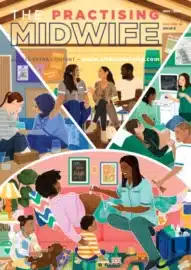






Midwives are revolting!
Laura Godfrey Issacs – artist, midwife, birth activist, feminist and mother
#RevoltingMidwife
We live in extreme times – Extinction Rebellion (2019), and many others have declared a climate emergency but is it time to declare a birth emergency too.
In the United Kingdom we have increasing medicalisation and intervention rates, black women/birthing people are five times more likely to die in childbirth than white women* (MBRRACE – UK, 2017), breastfeeding rates are low, birth trauma is estimated to affect 30,000 people a year (Birth Trauma Association, 2019) and suicide is the biggest killer of women* up to one year after birth. This is common in high income countries, whereas globally, in low income countries we often see ‘too little, too late’ (Miller et al, 2016), a situation where access to healthcare is limited, and a westernised obstetric medical model is imposed potentially triggering alienation and trauma.
Are midwives stepping up to this challenge?
- By challenging characterisations that see us as ‘revolting’, by a culture that values technocratic and medicalised procedures and diminishes us, as it does the people we look after?
- By becoming more political as the cultural landscape becomes increasingly hostile to the profession and women’s* reproductive autonomy?
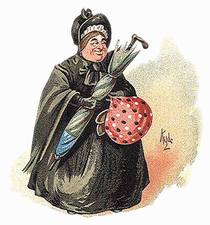
Illustration of Sarah Gamp
Historically, midwives have often been seen as a threat, particularly to male and medical authority. Their power and knowledge have been feared, ridiculed and banned and they themselves, at worse, have been burnt as well as imprisoned and side-lined. ‘Witches’ who were persecuted in the 16th& 17thcentury, were often midwives. In contemporary times some midwives operating outside the mainstream have been prosecuted and stopped from working such as Agnes Gereb from Hungary (Grace, 2018).
Furthermore, think of grotesque manifestations in art and literature, such as Sarah Gamp, the disreputable and drunken midwife from Dicken’s ‘Martin Chuzzlewit’ (Collin, 2012). Contemporary depictions can feel no better. Midwives are typically singled out for blame and demonised when ‘things go wrong’ in an overstretched health service (Borland, 2011).
And yet, midwives save lives…
There is so much evidence about how midwifery has the ability to saves mother’s lives around the world, and provide a safe and positive experience of childbirth for all, so why isn’t this message being heard? (Renfrew et al, 2019, Lancet, 2014).
Medical hegemony and the ‘risk’ agenda backed up by powerful media narratives which make a ‘drama’ out of birth persist. In this way birth is framed as an overwhelmingly dangerous process, which needs medical management, above any social or psychological strategies such as midwifery continuity of carer, which, for example, reduces preterm birth by 24% (Sandall et al, 2016).
Misogyny and patriarchy also play a huge part, by downplaying the role of midwifery and women’s* own power and abilities to birth, generating fear, anxiety and reliance on medical interventions, which we know are escalating and subsequently causing harm.
So, if you think it’s time to declare a birth emergency and become a ‘revolting’ midwife, read on.
Strike

Student midwives supporting the RCM strike, outside King’s College Hospital, 2014
Women* going on strike has a powerful history.
In Iceland the ‘Day Off’ in 1975 (James, 2018), saw 90% participation and marked the start of the United Nations Decade for Women.
Since then the ‘International Wages for Housework Campaign’ has gained momentum as a global movement. Women’s Strike UK (2019) is currently active organising actions on International Women’s Day (8thMarch) and has a mission that ‘rejects the decades of economic inequality, criminalization and policing, racial and sexual violence, and endless global war and terrorism.’
Recently, Greta Thunberg, the teenage climate activist has generated a mass school strike, which has involved up to 100,000 worldwide – starting with a solo protest outside her own school in Sweden.
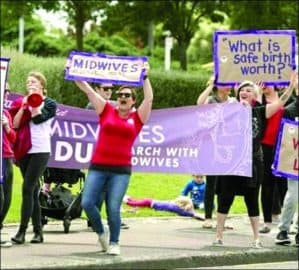
New Zealand Midwives on strike, 2018
In 2014, UK midwives went on strike for the first time in their history over the continued wage ‘restraint’ imposed by ‘austerity’ (Merrifeld et al, 2014). Championed by the Royal College of Midwives (RCM), midwives took industrial action working to rule and demonstrating outside hospitals. However, despite the unprecedented nature of the action, and the longer, protracted Junior doctor’s strike, little has improved in terms of pay or conditions.
Strikes continue globally with New Zealand midwives taking action in 2018 – with one of their slogans reading – ‘What is safe birth worth?’.
Strikes are not just about wages, but safe working conditions and workforce support for midwives which has a profound effect on women’s* birth experiences and safety.
Marching
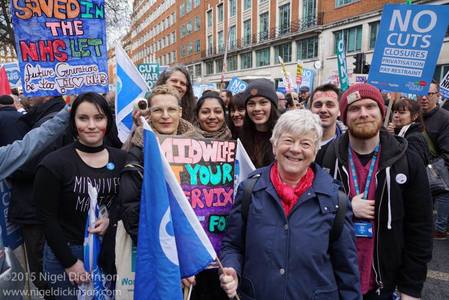
NHS March, London
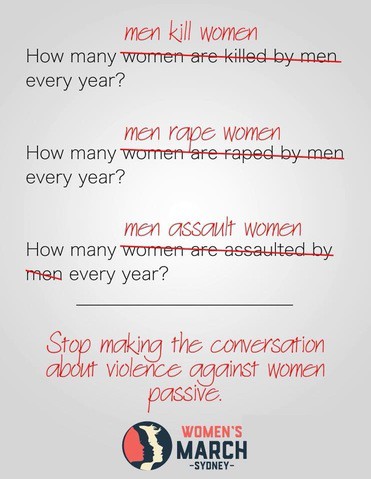
In January 2017, the ‘Women’s March’ movement (2019) was started in response to the misogyny of Donald Trump and particular threat this posed to women’s reproductive rights. These fears were justified with recent bans on abortion in southern states such as Alabama and the inevitable challenge many commentators expect to Roe v. Wade (1973) at the Supreme Court (the law that makes abortion legal in the first trimester in USA).
-

- RCM Pride March, London
-
- Women’s March
Lesley Page, President of the RCM at the time, and myself convened a midwives block and many came to take part in London. Midwives should be the guardians of reproductive health. Our own rights here in the UK and the world need protecting, so it felt right that there was a strong presence at the march.
Continuing from here, many midwives have taken part in NHS marches and rallies – protesting against cuts and privatisation and taking part in Pride events – making banners, chanting and making themselves heard.
In Ireland, particularly, many midwives and the Association of Irish Midwives have campaigned for the repeal of the 8thamendment and continue to lobby for full rights to abortion in Northern Ireland – and for the decriminalisation of abortion throughout the UK.
The Women’s March is now an international movement with its mission: ‘together, women have the power to create transformative social change.’
Organisational change
Our union, the RCM has traditionally taken a non-political stance, however in 2015 they joined the Trade Union Congress (TUC) – a decidedly political move, aligning us more closely with the Labour movement and increasing our influence over workers’ rights, despite the RCM still maintaining it takes a ‘non-party political position’.
Many midwives I know have also made the decision to join other unions, to strengthen their voices and representation – such as UNISON (The Public Service Union) and the Royal College of Nursing.
The Nursing and Midwifery Council (NMC) has also gone through a period of change. Many midwives and bodies such as Independent Midwifery UK (IMUK) have openly criticised the way the NMC operates and Helen Shallow, who was briefly employed by the NMC in an advisory role, made a very public resignation and published an open letter expressing her concerns about midwifery representation (Stephenson, 2018).
Alternative political parties and movements can be seen to address concerns about the future of the NHS and healthcare for women* better than the mainstream, including The Green Party and The Women’s Equality Party. As Co-Chair of The Women’s Equality Party’s Health Committee I worked on their Equal Health Policy – a rare chance to model what women-centred healthcare could really look like (Women’s Equality Party, 2019).
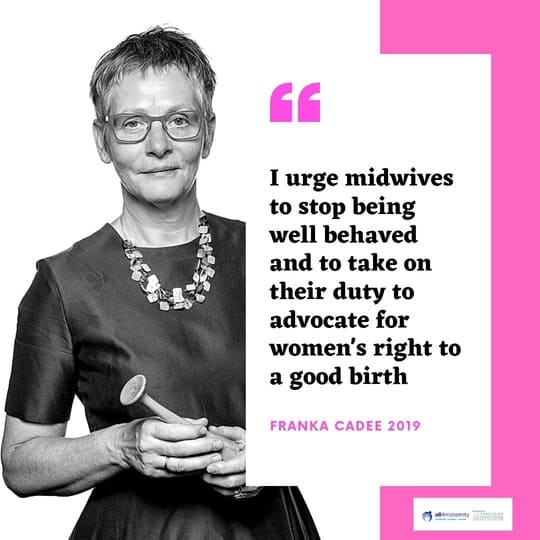
Recently, Franka Cadee, President of The ICM declared in her opening remarks at the ICM Africa Regional Conference 2019 that ‘the hand that rockes the cradle should also rock the boat’!
‘Women’s voices’

Birth is a Feminist Issue T-Shirt by The Positive Birth Movement
Increasingly midwives are joining with activists in the birth world to collaborate and lobby on a whole range of issues to do with reproductive justice and human rights in birth.
Incredible organisations that have sprung up over the last few years such as Birth Rites, Women’s Voices (conference), Pregnant then Screwed, Make Motherhood Diverse, The Positive Birth Movement, Best Beginnings, Make Birth Better as well as more established charities such as Maternity Action, Association for Improvements in Maternity Services (AIMS), and Association of Radical Midwives (ARM). As charities, third sector organisations, or led by women on their own, this represents an immense resource of advocacy, activism and information for birthing people and professionals.
Social media
Social media provides a platform like no other to disseminate ideas, views, campaigns and research. Engaging with others to promote midwifery knowledge, research and issues. Connecting across the globe with an international community is an incredible part of being active on social media.
Birth activism on social media can be very effective – many hashtags have gone viral such as #metoointhebirthroom and it has become a virtual forum where attitudes can be challenged. Active midwives in this forum however are not immune from trolls, and well-known advocates, such as Sheena Byrom have been subject to hideous bullying and attempts at silencing.
Useful rallying points are campaigns such as:
- World Maternal Mental Health Day (1 May) https://wmmhday.postpartum.net
- International Day of the Midwife (5 May) https://www.internationalmidwives.org/icm-events/idm-international-day-of-the-midwife.html
- Birth Trauma Awareness Week (7 – 14 July) https://birthtraumaassociation.org.uk/about-us/bta-awareness-week
- World Breastfeeding Week (1-7 August) http://worldbreastfeedingweek.org
- Black Breastfeeding Week (25 – 31 August) http://blackbreastfeedingweek.org
- World Prematurity Day (17 November) https://www.bliss.org.uk/support-bliss/world-prematurity-day
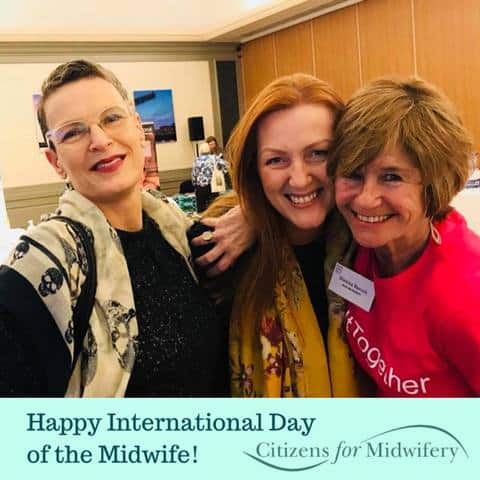
Sheena Byrom, Laura Godfrey-Isaacs and Nicolette Peel for International Day of the Midwife’
How to be a ‘revolting midwife’
Midwives are advocates, supporters, and protectors of women’s* rights in childbirth so let’s make our voices heard within and outside the birth space …
Top Tips:
- Be Brave and make change happen – in small and big ways – be an advocate for the women* you care for, your colleagues and the profession.
- Collaborate with others – in your workplace, on social media and at midwifery events.
- Get informed and connect with research – go to conferences & events, read some incredible books (see a suggested list below)
- Go on a protest and make you own banners (but keep it non-violent and within the law)
- Use social media wisely – connect and support people, blog, be opiniated but don’t retweet stuff that’s inflammatory & block people rather than get into an online argument.
- Have fun and find creative ways to be ‘revolting’!
Revolting Book List:
- ‘Birth and Breastfeeding: Rediscovering the needs of women during pregnancy and childbirth’ (2003) by Michel Odent
- ‘The Politics of Birth’ (2005) by Sheila Kitzinger
- ‘The Politics of Breastfeeding – when breasts are bad for business’ (2009) by Gabrielle Palmer
- ‘Roar Behind the Silence’ (2015) Edited by Sheena Byrom & Soo Downe
- ‘Breastfeeding Uncovered – who really decides how we feed our babies?’ (2016) by Amy Brown
- ‘Revolutionary Mothering – Love on the Front Lines’ (2016) edited by Gumbs, Martins & Williams
- ‘Why Motherhood Matters’ (2018) by Maddie McMahon
- ‘How to Give Birth Like a Feminist’ (2019) by Milli Hill
- ‘Squaring the Circle’ (2019) edited by Sheena Byrom & Soo Downe
- ‘Birthing Outside the System: the canary in the coalmine’ (2020) Edited by Hannah Dahlen, Bashi Hazard et al
- Untangling the Maternity Crisis edited by Edwards, Mander & Murphy-Lawless, Routledge 2018
Revolting Organisations:
Birth Rites https://www.birthrights.org.uk
Women’s Voices (conference) https://womensvoicesconference.wordpress.com
Pregnant then Screwed https://pregnantthenscrewed.com
Make Birth Better https://www.makebirthbetter.org
Make Motherhood Diversehttps://www.makemotherhooddiverse.com
The Positive Birth Movement https://www.positivebirthmovement.org
Best Beginnings https://www.positivebirthmovement.org
Maternity Action https://maternityaction.org.uk
ARM – Association of Radical Midwives https://www.midwifery.org.uk
References
Birth Trauma Association (2019) https://birthtraumaassociation.org.uk
Borland S (2014) If you Don’t hurry up, I’ll cut you: What one mother was told by a midwife at NHS Trust where five died during labour https://www.dailymail.co.uk/health/article-2054171/amp/NHS-maternity-care-Midwife-tells-mother-dont-hurry-Ill-cut-you.html
Cochrane Review (2014) Midwife-Led Continuity Models of Care Compared with other models of care for women during Pregnancy, Birth and Early Parenting.https://www.cochrane.org/CD004667/PREG_midwife-led-continuity-models-care-compared-other-models-care-women-during-pregnancy-birth-and-early
Collin R (2012) Sarah Gamp, my favourite Charles Dickens character https://www.telegraph.co.uk/culture/charles-dickens/9044813/Sarah-Gamp-My-favourite-Charles-Dickens-character.html
Extinction Rebellion (2019) https://rebellion.earth
Grace N (2018) Agnes Gereb sentenced to two years in prison for attending home births https://www.midwifery.org.uk/news/agnes-gereb-sentenced-to-two-years-in-prison-for-attending-home-births/
James S (2018) Decades after Iceland’s ‘Day Off’ our women’s strike is stronger than ever https://www.theguardian.com/commentisfree/2018/mar/08/iceland-global-womens-strike-protest
Lancet Series on Midwifery (2014) https://www.thelancet.com/series/midwifery
MBRRACE – UK (2017) Confidential Enquiry into Maternal Deaths https://www.npeu.ox.ac.uk/mbrrace-uk/reports/confidential-enquiry-into-maternal-deaths
Merrifield et al (2014)https://www.nursingtimes.net/roles/midwives-and-neonatal-nurses/historic-day-for-midwives-as-maternity-staff-strike-over-pay/5075748.article
Miller et al (2016) Beyond Too little too late and too much too soon: a pathway towards evidence-based, respectful maternity care worldwide https://www.thelancet.com/journals/lancet/article/PIIS0140-6736(16)31472-6/fulltext
Renfrew et al, (2019) Midwifery is a Vital Solution – What is holding back Global progress? https://onlinelibrary.wiley.com/doi/10.1111/birt.12442
Roe v. Wade (1973) https://www.thoughtco.com/roe-v-wade-overview-3528244
Sandall et al (2016) Midwife-led Continuity models of care compared with other models of care for women during pregnancy, birth and early parenting. https://doi.org/10.1002/14651858.CD004667.pub4
Stephenson J (2018) Expert midwife attacks regulator in explosive resignation letter from advisory role https://www.nursingtimes.net/news/professional-regulation/exclusive-expert-midwife-attacks-nmc-in-explosive-resignation-letter/7024875.article
Tice E (2018) Midwives go on Strike in New Zealand https://www.socialistparty.org.uk/issue/1021/28381/05-12-2018/midwives-go-on-strike-in-new-zealand
Women’s Equality Party (2019) Equal Health Policy https://www.womensequality.org.uk/equal_health
Women’s March (2019) https://womensmarch.com
Women’s Strike UK (2019) https://womenstrike.org.uk/about/