









Recognising White Privilege: Moving Towards Anti-Racism as a Student Midwife
Laila Saifeldeen – Third-year Student Midwife, Kingston & St George’s University
Published in The Student Midwife Volume 3 Issue 4 October 2020
Summary
This article explores the complex issue of racism within midwifery practice and highlights the need for students and midwives to work towards anti-racism. Laila Saifeldeen reflects upon her experience as a white-presenting, mixed-race student midwife and the privileges she is afforded because of her racial identity. In particular, she examines the impact of racial prejudice upon an interaction between a midwife and a client and explores how her presence affected their rapport.
The power of reflection
We must be anti-racist by actively opposing racism and challenging discriminatory public attitudes and systems of power
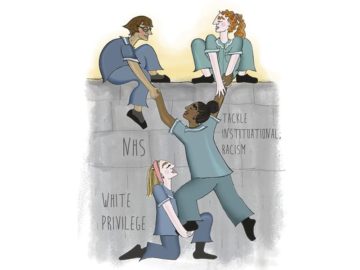
The Black Lives Matter movement has pushed racism to the forefront of collective discourse. For many, it comes with greater recognition that ‘not being a racist’ is not enough. We must be anti-racist by actively opposing racism and challenging discriminatory public attitudes and systems of power.1 However, we cannot disassociate ourselves from our contribution to systemic oppression. For this reason, it is essential to reflect upon the positions we occupy within these systems, which can be difficult and uncomfortable for those unaccustomed to acknowledging that they benefit from privilege.
 I am white, or at least, I appear to be. I am mixed-race – more specifically, I am half Arab and half British, but that might not be apparent at first glance. People I meet are frequently taken aback when they see the ‘foreignness’ of my surname, leading to inevitable discussion about my upbringing. It is hard for some to reconcile my appearance with my background because, as they remind me, I look ‘different’ and ‘not like one of them’. Although this is offensive, I understand their dilemma – I am difficult to categorise: schemas refer to an individual’s pre-existing mental frameworks for organising unfamiliar information, put simply, people develop categories and identify similarities to help them understand new things.2
Schemas can be grounded in stereotypes.3 As a mixed-race individual, I represent new information that conflicts with the prejudices people may hold. Meeting me could be an opportunity for people to challenge these biases and develop non-stereotypical frames of reference, however this infrequently occurs. Instead, most people separate my background from my appearance, because it is easier to ignore new information than it is to challenge prejudice.3
By compartmentalising and ignoring my racial identity, they exempt me from bigotry. I am viewed as interesting but not intimidating, exotic but not foreign. I am not subject to negativity because I am not viewed as ‘other’. In a way, I benefit from their prejudice.
Changing dynamics
A few months ago, I was working with a Black midwife. We were providing intrapartum care to a South Asian woman. We introduced ourselves and our roles. I was the whitest person in the room, though at the time I thought nothing of it. I noticed that the client seemed to like me, that she paid attention when I offered advice and encouragement. I felt like I was doing a good job. What I did not realise, until my mentor pointed it out, was that she was not being given the same level of attention.
The woman and her husband would direct their questions to me rather than the midwife. Likewise, if the midwife asked them a question, they would not always respond. Eventually, my mentor asked me to communicate on her behalf. I suddenly realised that the fact that I was a student did not matter – my skin colour had changed the dynamic.
In spite of being faced with daily interactions demonstrating the presence of racial prejudice, I sometimes forget that my history is not written on my face. I forget that when someone looks at me, they cannot tell that I am ‘other’. I forget that the first thing anyone notices is the whiteness of my skin and that my skin colour precedes any introduction. In this case, I forgot that being a student was secondary to the colour of my skin, and it is easy to forget these things because I am white.

White privilege
When you are white, racism can be viewed as something you are divorced from; something only identified in the overtly racist actions of others – and we often fail to reflect upon our own complicity. White privilege encompasses the benefits afforded to individuals born into societies where whiteness is viewed as the norm. White people are constantly validated from a political, social and cultural perspective,4 and there are innumerable examples of this in everyday life. I refer readers to McIntosh’s list of the ‘daily effects of white privilege’ as a point of reference,5 and argue that the existence of such a resource is testament to the ultimate privilege that white people have: the ability to ignore race.4 For most of the world, the notion of whiteness is inescapable. White privilege is not an exclusively ‘Western’ problem: prejudicial mentalities, arguably cemented by a history of white European colonialism, persist across much of the globe.6
Racism exists because whiteness is idealised and failure to recognise this power makes challenging racism next to impossible.
 Pushed to the extreme, a lack of this self-awareness on the part of white student midwives can be dangerous. Our words hold power, which is afforded by the undeserved authority that comes with the colour of our skin. In an emergency, when doctors, midwives and students might wear the same coloured hospital scrubs, no one will focus on our nametags. In that moment, instincts determine whether clients trust the people providing their care or not. As seen in the scenario above, these instincts may not always relate to qualifications or seniority.
Arguably, however, it is the daily interactions outside emergency settings that are of greater concern: racial bias continues to permeate the relationships we build with colleagues and clients. From the outset, Black and other ethnically diverse healthcare professionals may have to fight for the respect and authority their white co-workers are automatically granted. A report regarding Nursing and Midwifery Council (NMC) disciplinary proceedings found that Black midwives are more likely to be reported by clients and colleagues than their white counterparts. Further still, the rate of complaints is higher against midwives who train in Asia and Africa.7 In previous discussions, another Black midwife disclosed that she often has clients look at her with mistrust. That mistrust, however, often resolves when they hear her English accent. She, like me, is seen as less threatening because she sounds familiar.
We need to talk about race and anti-racism
 Black, Asian and ethnically diverse professionals are chronically under-represented in high-level management and leadership positions within the NHS.8 When this is examined alongside the increasing rates of maternal mortality among Black women9 and the disproportionate COVID-19 fatalities among healthcare workers of colour,10 one thing becomes clear: racism is undeniably present within the NHS. I do not claim to know how to solve these systemic problems, nor do I wish to oversimplify them or present them as insurmountable on account of their complexity. But what I will say is that becoming an anti-racist organisation requires reflection from those within it. White and white-presenting healthcare workers have a responsibility to recognise the privilege that they hold. We must acknowledge the impact that implicit bias has upon our relationships with colleagues and clients.
We cannot pretend to be ‘colour-blind’ and ignore the impact of whiteness and white privilege. To do so ignores the struggles of people fighting to be heard and contributes to the silencing of their voices. TSM
References
- Hoffower H. What it really means to be anti-racist, and why it’s not the same as being an ally. Business Insider. https://www.businessinsider.com/what-is-anti-racism-how-to-be-anti-racist-2020-6?r=US&IR=T. Updated June 8, 2020. Accessed July 23, 2020.
- Busselle R. Schema Theory and Mental Models. In: Rossler P, Hoffner C, Zoonen L, eds. The International Encyclopaedia of Media Effects. Wiley Online Library. https://onlinelibrary.wiley.com/doi/abs/10.1002/9781118783764.wbieme0079. Published March 8, 2017. Accessed 12 August, 2020.
- Fallin Hunzaker M. Cultural sentiments and schema-consistency bias in information transmission. American Sociological Review. 2016;81(6):1223-1250.
- Lindner A. Defining Whiteness: Perspectives on Privilege. GNOVIS Journal. 2018;18(2):43-58.
- McIntosh P. White privilege: and male privilege: A personal account of coming to see correspondences through work in Women’s Studies. https://www.wcwonline.org/images/pdf/White_Privilege_and_Male_Privilege_Personal_Account-Peggy_McIntosh.pdf. Revised 2010. Accessed August 7, 2020.
- Adamu N. Colonialism and the origins of skin bleaching. Wellcome Collection. https://wellcomecollection.org/articles/XIfdHRAAAKbQ_FWB. Published March 21, 2019. Accessed August 7, 2020.
- West E, Nayar S, Taskila T, Al-Haboubi M. The Progress and Outcomes of Black and Minority Ethnic (BME) Nurses and Midwives through the Nursing and Midwifery Council’s Fitness to Practise Process. https://www.nmc.org.uk/globalassets/sitedocuments/other-publications/bme-nurses–midwives-ftp-research-report.pdf. Published January 2017. Accessed August 7, 2020.
- The WRES Implementation Team. NHS workforce race equality standard – 2019 data analysis report for NHS trusts. https://www.england.nhs.uk/wp-content/uploads/2020/01/wres-2019-data-report.pdf. Published February 2020. Accessed July 23, 2020.
- MBRRACE-UK. Saving lives, improving mother’s care – Lessons learned to inform maternity care from the UK and Ireland confidential enquiries into maternal deaths and morbidity 2015-2017. https://www.npeu.ox.ac.uk/assets/downloads/mbrrace-uk/reports/MBRRACE-UK%20Maternal%20Report%202018%20-%20Web%20Version.pdf. Published November 2019. Accessed August 11, 2020.
- Public Health England. Beyond the data: Understanding the impact of COVID-19 on BAME groups. https://assets.publishing.service.gov.uk/government/uploads/system/
uploads/attachment_data/file/892376/COVID_stakeholder_engagement_synthesis_beyond_the_data.pdf.
Published June 2020. Accessed August 11, 2020.


