









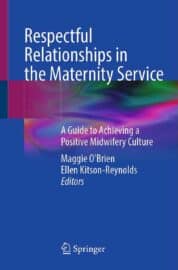
Respectful Relationships in the Maternity Service
 Maggie O’Brien (she/her)
Consultant Respectful Relations in Maternity
Tall Poppy Maternity Consultancy
Summary
Maternity units with a positive, strong midwifery culture that respects each member of staff are more likely to provide kind, high-quality care to women and birthing people together with good clinical outcomes. My book Respectful Relationships in the Maternity Service gives examples of how leaders have achieved cultural change, with the final chapter focused on finding resolution. The intention of this blog is to give hope to midwives and student midwives currently providing kind, high-quality care but practicing within toxic cultures, that cultural change is possible. The intention of the book is to provide guidance on how to do this.
Respectful Relationships
The driver for writing the book began when working as a regional officer for the Royal College Midwives; representing midwives who required support for employment and/or professional issues. Inspirational and motivated midwives who were being bullied, either by managers or colleagues quickly lost confidence, often becoming physically and/or mentally unwell. Sadly, this often resulted in them leaving the profession, and in student midwives not registering as midwives. It was particularly difficult when midwives were referred to the regulatory body and/or subjected to disciplinary processes for poor decision making and mistakes, made purely because they were practicing in psychologically-unsafe environments. Constant criticism and being subject to micromanagement led them to lose confidence in their practice; becoming afraid to make decisions, ask advice and escalate concerns when necessary. I used to ask myself, why do we treat each other in this way? I knew most midwives cared about others and certainly did not want to be the one that colleagues changed their shifts to avoid working with.
Some of us will be fortunate to work in innovative workplaces, where evidence-based practice is encouraged and zero tolerance of disrespectful behaviours exists
The book begins by explaining that both positive and negative cultures usually originate from the behaviour of one or two people. Unfortunately, in every profession, there will always be a few individuals who enjoy the power gained from belittling and manipulating others. The person at the centre can be of any rank or role; if you think about it, you will probably be able to identify these people in your workplace. They often ‘target’ people who ‘shine’ and want to make a difference, because they feel threatened by them. Even the most passionate practitioners eventually change their behaviour and practice to ‘fit in’. It is difficult to stay outside of an intimidating culture, eventually even the strongest of people either change their behaviour or leave, hence high turnover rates are common in areas where toxic cultures exist. Some of us will be fortunate to work in innovative workplaces, where evidence-based practice is encouraged and zero tolerance of disrespectful behaviours exists. For those working in toxic cultures the ripples continue to expand until the culture becomes deeply embedded and a culture of fear develops.

To counter this, it is important to challenge disrespectful behaviour as soon as it occurs; either as an individual being targeted, an active bystander, or as a manager responsible for the area. Once someone becomes afraid it is more difficult to stand up and challenge disrespectful behaviour. Whether you are being treated badly and need advice and support or want to change the culture of a maternity unit, ward or clinic, the book gives guidance on how to create and maintain an environment where zero tolerance of poor behaviour exists and where everyone is respected.
Turning Recommendations to Reality
Maternity services have been under scrutiny for at least two decades with many investigations and reviews, resulting in 748 recommendations since 2025, with little or no improvements evident. The most recent reports, the Independent National Maternity and Neonatal Investigation: Final Report and Recommendations¹ led by Baroness Amos and the Independent Review of Maternity Services at Nottingham University Hospitals University Trust,² led by Donna Ockenden both detailed experiences of many families suffering profound consequences because care, culture, leadership and kindness failed, with bullying and racism rife for women and birthing people and maternity staff. It will not be possible to implement the complex changes required to improve clinical outcomes and to listen to women and birthing people until the culture within maternity units is kind, led by leaders who are courageous, respected and respectful. The book identified seven ‘Golden Threads of Change’ the authors believe essential to turn recommendations into reality, these are:
- Psychological safety (including safe staffing)
- Respectful relationships
- Values-based education
- Midwifery model of care
- Inclusion
- Developing a coaching mindset
- Compassionate leadership
The final chapter ‘Finding Resolution’ takes each of the golden threads of change, detailing and giving examples of how they can be implemented.
Model of Midwifery Care
Leaders who contributed to the book, emphasised the importance of midwives practicing within a model of midwifery care they are philosophically aligned to. They believed that for a midwife to provide high-quality care and to be fundamentally aligned to the model of care they provide is essential for their well-being, often determining whether they stay in midwifery. To emphasise the importance of this, the midwifery model of care was identified as one of the golden threads of change. It is not the actual model of care but the opportunity for each midwife to practice in a way they are aligned to and find joy that is important. This may be, for example, providing continuity of care, providing expertise as a high-risk specialist, or supporting women and families through loss as a bereavement midwife. My experience is when midwives find joy and satisfaction in their roles there is less conflict within the service. To give midwives and midwifery leaders direction in implementing evidence-based models of midwifery care, the book gives guidance and provides an example on how to co-design and implement models that each midwife can align to and in doing so, improve the culture of their workplace.
My experience is when midwives find joy and satisfaction in their roles there is less conflict within the service.
A theme running through the book is the importance of midwives standing together to challenge disrespectful behaviour and unsafe practice. To many midwives it may seem impossible to stand together when national policy is confusing and inconsistent. An example of this originated with one finding of the Report of the Morecambe Bay Investigation. Bill Kirkup found “a small group of midwives pursued natural childbirth ‘at any cost’ resulting in unsafe care”.³ This finding was rightly highlighted, unsafe and had to be addressed. However, there was a strong reaction across England, causing distress to many midwives and educators who had been following national policy to reduce caesarean section rates.
Until 2022, all NHS maternity units were required to report their caesarean section rates to the Care Quality Commission, with penalties for those with high rates. In 2022, the Independent Maternity Report⁴ reported the same normal birth ideology persisted. As a result, NHS England ordered all maternity units to discontinue meeting the targets intended to lower caesarean section rates. This created conflict and distress, resulting in midwives and educators feeling unable to discuss physiological birth for fear of retribution, with far reaching consequences for women and birthing people, midwifery practice and midwives morale.
In 2015, caesarean section rates across the UK were 25%, the most recent figures, published for 2024-25 are 45.1%, for the first time overtaking unassisted vaginal birth rates, which are 43.8%. One finding of the National Maternity and Neonatal Investigation¹ led by Baroness Amos was the evidence available to the investigators did not find that ‘normal birth ideology’ was currently widespread in the maternity services they visited in England. However, this finding is currently being challenged nationally, doing little to improve the morale of midwives and the confidence of women and birthing people in maternity services. In these confusing circumstances it is important that midwifery leaders, organisations and each maternity unit gives clear direction and support to its maternity staff, with an acceptance we all aligned to different ways of working, all of which are equally important.
Conclusion
Many midwives will have asked themselves when will criticism and scrutiny of midwives stop and the incredible work that midwives undertake every day be recognised, valued and respected? The answer may be: when we all stand together, valuing and respecting each other. It is possible to make cultural change and for all midwives to practice in a way that is fulfilling and joyful. To achieve this, we must be seen as a united profession that values and respects each other, no matter what our different roles or opinions are.
References
- Amos V. Independent National Maternity and Neonatal Investigation: Final Report and Recommendations. Independent National Maternity and Neonatal Investigation. Final Reports and Recommendations. Published June 30, 2026. Accessed July 06, 2026.
- Ockenden D. Findings, conclusions and essential actions from the independent review of maternity services at Nottingham University Hospitals NHS Trust. Department of Health and Social Care. https://assets.publishing.service.gov.uk/media/6a3bb59c4c7605ab567238ec/ockenden-report-review-of-maternity-services-nottingham-university-hospitals-nhs-trust-e-lay.pdf. Published June 24, 2026. Accessed June 29, 2026.
- Kirkup B. The Report of the Morecambe Bay Investigation. Morecambe Bay Investigation. https://assets.publishing.service.gov.uk/media/5a7f3d7240f0b62305b85efb/47487_
MBI_Accessible_v0.1.pdf. Published March 03, 2015. - Ockenden D. Ockenden Report – Final. Findings, Conclusion and Essential Actions from the Independent Review of Maternity Services at the Shrewsbury and Telford Hospital NHS Trust. https://www.ockendenmaternityreview.org.uk/wp-content/uploads/2022/03/FINAL_INDEPENDENT_MATERNITY_REVIEW_OF_
MATERNITY_SERVICES_REPORT.pdf. Published March 30, 2022. Accessed June 29, 2026.

