









Revisiting Resilience
Billie Hunter – Professor of Midwifery and Director, WHO Collaborating Centre for Midwifery Development, School of Healthcare Sciences, Cardiff University, Cardiff, Wales
Lucie Warren – Professional Head: Midwifery, School of Healthcare Sciences, Cardiff University, Cardiff, Wales
Twitter @CUHealthSci
Published in The Practising Midwife Volume 25 Issue 05 May 2022, Pages 08-13
Summary
In this article we revisit the concept of resilience and what it means for midwifery. We are aware that the idea of ‘resilience’ is receiving increasingly negative coverage within the midwifery community. However, how resilience is defined and understood seems to have shifted significantly from its original meaning. We consider why that shift might have happened and explore what resilience is and what it isn’t. We argue that the original meaning of the concept still has a great deal to offer the profession as we navigate these challenging times.
Introduction

In 2014 we published our study of resilience in UK midwifery.1,2 At the time, ‘resilience’ was something of a buzzword. In the news you would often hear individuals, communities and organisations being described as resilient, and this was always interpreted as a positive characteristic.
However, we have become aware that this no longer seems to be the case. In professional debates and on social media, the concept of resilience has been criticised and even vilified.
In this article we argue that how resilience is defined and understood seems to have shifted significantly from its original meaning. Whilst this type of semantic slippage is common when words become popular and loosely used, it can also be problematic as the original meaning becomes more and more obscure.
But in rejecting the concept of resilience and its potential benefits for both individuals and organisations, could we be in danger of losing valuable insights and strategies that can support us as we respond to the current challenges facing midwives in the UK and globally?
We begin by exploring what resilience is – and what it isn’t. We hope to debunk some of the myths about resilience and change the narrative. We challenge those who interpret resilience as meaning ‘toughening up’ and ‘becoming hard’ to go back to the original meaning of the word and reconsider.
Definition of resilience
We start by exploring definitions of resilience and its application to midwifery. Resilience is a term that has been used in physical sciences to describe the ability and capacity of a given material to withstand and absorb energy and return to its original shape.3 This suggests that, under pressure, a resilient material can simply ‘bounce back’ to its original form. Indeed ‘bouncing back’ is often used when describing resilience and indicates that there is no lasting change.
However, when applied to an individual’s response to pressure, we would argue that this does not really take into account our propensity as humans to learn and adapt to experience. We use a definition of resilience that addresses this: ‘a positive adaptation to adversity […] without residual significant psychological or physiological disruption’.1
Midwife participants in our qualitative descriptive study1 indicated three key approaches that, in their experience, enabled the development of resilience. Firstly, self-awareness or ‘knowing yourself’ was seen as important. Pivotal to this approach was having a strong sense of professional identity and purpose; recognising the value of midwifery practice and the ability to make a difference. Secondly, individuals described how they adopted reactive strategies to help cope with and manage day-to-day challenges.
These strategies helped them to change their mood and gain perspective on adversities; a key strategy was social support from friends and trusted colleagues. Lastly, more longer-term proactive strategies were recognised as important in building and sustaining resilience in oneself and others. These included learning techniques for self-protection, identifying potential triggers, building self-awareness, and supporting and empowering others.
Importantly, we found that there were particular occasions when adversity would be more keenly felt such as when newly qualified or after a difficult clinical experience. At these times the support of colleagues would be most valuable. Our study findings provide an insight into how midwives describe and develop their personal resilience to adversity.
A critique of resilience
Critics of resilience claim that the concept is problematic as it places responsibility on the individual to toughen up and cope with whatever work throws at them, arguing that it has become something of a ‘badge of honour’ in the midwifery and nursing professions.4,5

There are two points here which we would challenge: firstly, that resilience is a matter for individual action only, and secondly that resilience is about toughening up and becoming hardened to adversity. From our perspective, these critiques indicate a misunderstanding of resilience and its evidence base, which acknowledge the importance of self-care, support seeking and the wider social context.
One particular danger with this line of thinking is that those who become anxious and depressed at work are then seen as weak and inadequate, with the associated risk of ‘resilience shaming’.6 An example can be found in a Maternity and Midwifery website discussion of the March with Midwives, where resilience was positioned as being in opposition to respect!7
‘Far from being broken, we remain strong, are forced into acting out of resilience rather than respect and point the finger back to the broken power systems and our government for not valuing our efforts, despite our continuous demands for improvement.’ Surely it is a sorry state of affairs when we cannot be respectful and resilient!
So why has this change in meaning occurred? We suggest that it may be because the term ‘resilience’ has been misappropriated by organisational imperatives. In a chronically under-resourced and struggling NHS, a focus on resilience that misunderstands its essence could be used to shift responsibility for workplace adversity and emotional wellbeing back to the individual.
Thus the onus is on the individual midwife to cope with excessive workloads, unsustainable working conditions and the undermining behaviours of some colleagues, rather than tackling the root cause of these problems.
As an example: following the publication of our 2014 study, we were approached by many NHS maternity and perinatal services and Health Boards with requests to run resilience training workshops. We quickly realised that what some managers wanted was a quick fix; they would be seen to be doing something in response to staff concerns, but with little attention to the more fundamental systemic problems where the attention was really needed.
Increasingly, we turned down these requests, uncomfortable with the notion that we might be seen to be putting the emphasis on managing adverse working conditions onto the individual and thus negating the need for strategic direction to improve conditions. As we have argued in a later paper, reliance on individual resilient responses to adversity in the absence of addressing systemic issues is not sustainable.8
What resilience is – and isn’t
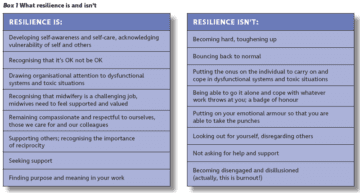
So – if resilience isn’t about the individual midwife toughening up and coping with whatever work throws at them, what is it? Box 1 provides a simple checklist.
Box 1 What resilience is and isn’t
Resilience and Covid-19
The impact of the COVID-19 pandemic on the psychological wellbeing of the healthcare workforce is now well known, with dramatic rises in staff anxiety, depression and post-traumatic stress disorder identified.9

Exhaustion, managing uncertainty, worries about one’s own health and that of one’s family, and lack of access to usual social support mechanisms are all critical factors, as is the sense of moral injury and guilt that staff may experience when they cannot give the care that they know is best.10
Understanding how resilience can be nurtured and the role of leadership in supporting this may offer some ways to navigate the greatest challenge that the NHS workforce has ever experienced. But if an incorrect interpretation of resilience is applied, then the risks are profound.
Rather than going it alone and toughening up, experts in trauma prevention9 advocate resilient strategies which facilitate reflection and sharing of experiences.
They emphasise the importance of frank discussion, self-care and mutual support within small teams, and also the vital role that organisational leadership plays in enabling and encouraging this approach to psychological wellbeing.
As Greenberg and colleagues argue, ‘healthcare managers in supervisory positions must now acknowledge the challenge staff face and minimise the psychological risk inherent in dealing with difficult dilemmas, and those in charge of resources must provide them with the opportunity to do so’.9
Conclusion
Resilience is a misunderstood concept. Its meaning has become distorted because of how it has been embraced (and misused) by organisations in ways that obscure systemic problems within the workplace and place the responsibility for coping with unreasonable workplace demands and environments on the individual.
Understanding what resilience is and what it isn’t is crucial to supporting and nurturing the emotional wellbeing of the midwifery workforce – and the need for this support has never been greater. TPM
References
- Hunter B, Warren L. Midwives’ experiences of workplace resilience. Midwifery. 2014;30(8):926-934. doi:10.1016/j. midw.2014.03.010.
- Hunter B, Warren L. Caring for ourselves: the key to resilience. In: Byrom S, Downe S, eds. The Roar Behind the Silence: Why kindness, compassion and respect matter in maternity care. London: Pinter & Martin; 2015:111-115.
- Conti AA, Conti A. Frailty and resilience from physics to medicine. Med Hypotheses. 2010;74(6):1090. doi:10.1016/j. mehy.2010.01.030.
- Chinn T. Please don’t call me resilient. Nursing in Practice. https://www.nursinginpractice.com/professional/ please-dont-call-me-resilient/. Published March 15, 2018. Accessed April 8, 2022.
- Jarral F. Resilience. Keywords for our Time. BBC Radio 4 broadcast. https://www.bbc.co.uk/sounds/play/ b09wg6gp. Broadcast March 21, 2018. Accessed April 8, 2022.
- Chinn T. The problem with resilience. Teresa Chinn [personal blog]. http://teresachinn.co.uk/the-problem-with-resilience. Published July 3, 2017.
- King K. March With Midwives – National Vigil on November 21 2021. Maternity and Midwifery. https:// www.maternityandmidwifery.co.uk/march-with-midwives. Published November 2021. Accessed January 17, 2022.
- Crowther S, Hunter B, McAra-Couper J, et al. Sustainability and resilience in midwifery: A discussion paper. Midwifery. 2016;40:40-48. doi:10.1016/j. midw.2016.06.005.
- Greenberg N, Docherty M, Gnanapragasam S, Wessely S. Managing mental health challenges faced by healthcare workers during covid-19 pandemic. BMJ. 2020;368:m1211. doi:10.1136/bmj.m1211.
- Hunter B, Renfrew M J, Downe S. Supporting the emotional wellbeing of midwives in a pandemic: Guidance for RCM. https://www.rcm.org.uk/media/4095/rcm-supporting-the-emotional-wellbeing-of-midwives-during-a-pandemic-v1-submitted-to-rcm_mrd.pdf. Published May 19, 2020.