









Warm compresses for perineal care during birth study sheet
Study sheet aim and key information:
Many women suffer from perineal tearing during childbirth, statistics suggest between 53-79%! While severe tearing, third and fourth-degree tears are quite low, the impact to women can be life-changing; ongoing pain, incontinence, painful sex has detrimental effects on women’s mental, emotional and physical wellbeing. There are several ways perineal tearing can be reduced, however, the focus of this study sheet is the benefit of warm compresses during the second stage of labour.
 Learning objectives:
- To understand why perineal trauma occurs.
- To explore the historical context of the HOOP trial.
- To understand the evidence of the benefits of warm compresses during birth.
- To understand the evidence of warm compresses during
Duration: 30 mins
Keywords: birth, childbirth, compress, second stage, perineum, tear, laceration


Improving Perineal Care in the Second Stage of Labour: Reducing postnatal perineal pain
Annette Ballard – Labour Ward Sister at Rosie Hospital Cambridge
Background
 Delivering a baby is a privilege and it is the role of the midwife to optimise health and wellbeing, this includes care of the perineum, especially during the second stage of labour. A vaginal birth is frequently accompanied by some degree of perineal trauma which can lead to serious morbidity issues for women, impacting on their immediate and long-term physical and psychological health (Priddis et al 2014). At least 70 per cent of women sustain perineal trauma during the birth of a baby (Bick et al 2012). Care of the perineum in the second stage of labour is a key skill for all midwives in clinical practice and particularly for those who are mentors teaching the midwives of the future. This skill which can be learnt from theory, clinical practice and tacitly from mentors, which can be invaluable. The beneficiaries from performing this skill proficiently are: the women, as it reduces the likelihood of short- or long-term morbidity (incontinence, pain, infection, prolapse); your trust/the NHS, as it will time for the repair, antibiotics, follow-up, potential gynaecological problems and surgery in the future; and finally the midwife, for job satisfaction, a sense of achievement and knowing that you have provided a professional service and made a difference to the women in your care. However, if a woman in your care sustains a third/fourth degree tear, it can cause a period of personal angst and a time of reflection, as it could make the midwife feel that she has failed the woman, particularly if she is deemed as a ‘proficient’ practitioner (Dreyfus 2004). not incur additional costs of theatre
What happens in practice
Care of the perineum during the second stage of labour can be defined by various perineal techniques and interventions to slow down the birth, and to allow the perineum to stretch and thin slowly, to prevent perineal injury (Aasheim et al 2012). Trauma can be either spontaneous, or surgical as the result of an episiotomy. Yet, sometimes despite one’s best efforts to protect the perineum, tearing can be out of the control of the midwife or obstetrician. There are well-known risk factors which increase a woman’s risk of tearing, for example: first baby, large baby, instrumental birth, maternal age, prolonged second stage, ethnicity, maternal position for birth, inactivity prior to pregnancy, previous third/fourth degree tear and midwife’s choice of hands on or off the perineum at birth (Klein et al 1997; Dahlen et al 2007; Pirhonen et al 1998).
In practice, decisions often need to be made rapidly to prevent or reduce the amount of trauma being sustained. Clinical decision-making is a multi-dimensional, complex process that involves gathering information, analysing and evaluating it, with decisions sometimes needed quickly (Standing 2005). It is important to explain clearly to the women in your care that you will do everything you can to prevent perineal trauma, but to also inform them that despite a controlled birth or an episiotomy (where applicable), extensive trauma cannot always be prevented. This can be due to fetal position (compound presentation), tissue integrity, loss of maternal control or shoulder dystocia.
It must be remembered that each labour, perineum, size of baby, medical conditions, mode of birth will differ for each woman. Clinical decision-making in some cases can be planned and managed but, in other cases, spur-of-the-moment techniques need to be utilised with consent from the woman. Decision making for care of the perineum is generally all done mentally as a cascade of decisions (Benston and Jatoi 2009), or as a mental flow chart from previous experiences.
This mental thought process helps the midwife to analyse the task to be carried out, minimise trauma, and take the best course of action. Nevertheless, one should never be complacent (particularly in midwifery) because any variation or incident of any type can occur. A compound presentation is defined as presentation of a fetal extremity (i.e. hand) alongside the presenting part (Cormier 2015); sometimes this can be managed by manipulation of the compound part, but it can be missed on vaginal examination or perhaps because labour has progressed rapidly. The compounding part is generally a hand; it causes increased risk of perineal or vaginal trauma as it is out of the control of the midwife.
The Past
Perineal care techniques during the second stage of labour have been studied thoroughly over the last decade, with various techniques being identified and promoted from the ‘HOOP’ trial in 1998 (McCandlish et al): the midwife either has her hands on or off the perineum, with or without flexion on the baby’s head as it is born; perineal massage; or the use of warm packs on the perineum during the active second stage of labour (Dahlen et al 2007). However, to some extent, the HOOP trial findings were misinterpreted, and many midwives changed their practice from guarding the perineum and controlling the speed of the baby’s head, to practising hands off the perineum, because it reduced episiotomy rates and postnatal perineal pain, but did not reduce perineal trauma.
McCarthy (2009) stated in an article 10 years after the trial: of the women who were allocated the ‘hands on’ technique, 22.5 per cent had fewer third- and fourth-degree tears, an important finding that also needs to be considered. The findings of the HOOP trial has led to wide variations in practice skills and rates of third- and fourth-degree tears across the UK; which is evident from the results of the National Maternity and Perinatal Audit (NMPA) (NMPA Project Team 2017).
Clinically, many junior midwives are unsure when and how to do an episiotomy; this could be because their mentors qualified post-HOOP trial and so they revert to what they were taught as students; this could be one answer for the increasing rates of third- and fourth-degree tears. Alongside that, there have been vast changes in women’s demographics and co-morbidities have increased in mothers today. A slow and controlled birth is thought to be important to prevent perineal trauma, and midwives use varying techniques to achieve this. For some, it is thought that spontaneous rather than directed pushing will reduce trauma, but there is no evidence to support this theory (Lemos et al 2015).
The Present
More recently, the Cochrane Database of Systematic Reviews published the findings of Aasheim et al (2017) who looked at perineal practice methods in the second stage of labour in relation to perineal trauma. Aasheim et al reviewed published and unpublished randomised and quasi-randomised controlled trials appraising the various techniques used. They found 22 eligible trials, but unfortunately many were open to a high level of bias. They looked at ‘Hands off or poised’ compared to ‘hands on’. The findings were: there was no difference in the number of women with an intact perineum; and the episiotomy rate was higher in the hands on group. But unfortunately most of the evidence was of low quality and not reliable enough to change practice either way.
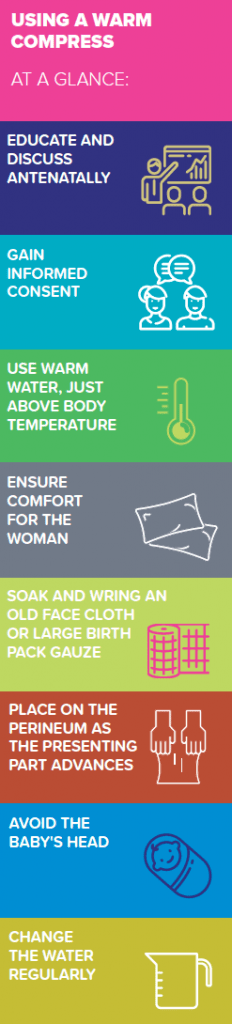
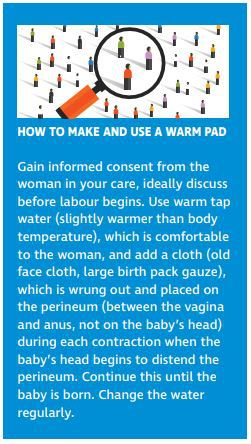 Research by Dahlen et al (2009) recommends the use of warm pads on the perineum. They carried out a randomised control trial (RCT) with 717 nulliparous women who had warm pads on the perineum during the second stage of labour, with the aim of assessing perineal pain and tearing. She found that there was no difference in the number of women who required suturing following the trial. Yet, she found that warm pads seemed to reduce third- and fourth-degree tears by more than half. Another finding from the RCT was that at 12 weeks postpartum, women who had had warm pads were notably less likely to experience urinary incontinence compared with women who did not have warm pads applied in the second stage of labour. Another finding was that warm pads significantly reduced the pain women felt when giving birth and on the first and second days postnatally.
The mechanism of a warm pad is that it dilates the blood vessels in the area, influencing the sensation of pain felt by the woman, and increases collagen extensibility, which facilitates greater stretching of the skin (Fritz 1995). This simple prophylactic non-invasive technique could save thousands of pounds for the NHS and, more importantly, prevent many women from a life of gynaecological morbidity. The development of knowledge networks in the future may help disseminate information nationally. This reflects with the philosophy and recommendations of the recent publication of the NMPA (NMPA Project Team 2017), where good practice initiatives are to be shared locally and nationally to improve and standardise care across the country for all women. Following a qualitative and quantitative study of 405 midwives, Bick et al (2012) found that there are extensive gaps in the implementation of evidence by midwives in practice with regard to perineal trauma.
This is such a simple and cost-effective intervention that could be implemented straight away into one’s practice.
The Future
If this technique is not normally part of your practice, give it a go; audit the results, and findings from your local maternity dashboard will feed into the NMPA over the next year. Let’s start sharing the good practice techniques. TPM
References
Aasheim V, Nilsen ABV, Lukasse M et al (2012). ‘Perineal techniques during the second stage of labour for reducing perineal trauma (Review)’. The Cochrane Collaboration, New Jersey: Wiley and Sons Ltd.
Aasheim V, Nilsen ABV, Reinar LM et al (2017). ‘Perineal techniques during the second stage of labour for reducing perineal trauma (Review)’. Cochrane Database of Systematic Reviews, 3: CD006672. DOI: 10.1002/14651858.CD006672. http://onlinelibrary.wiley.com/doi/10.1002/14651858.CD006672/full
Benston J and Jatoi I (2009). Management options in breast cancer: case histories, best practice and clinical decision making, New York: Informa Healthcare.
Bick DE, Ismail KM, Macdonald S et al (2012). ‘How good are we at implementing evidence to support the management of birth related perineal trauma? A UK wide survey of Midwifery practice’. BioMed Central Pregnancy and Childbirth, 12: 57. www.biomedcentral.com/content/pdf/1471-2393-12-57.pdf
Cormier CD (2015). Management of the fetus with a compound presentation, Netherlands: Wolters Kluwer. http://www.uptodate.com/contents/management-of-the-fetus-with-compound-presentation
Dahlen H, Ryana M, Homer C et al (2007). ‘An Australian prospective cohort study of risk factors for severe perineal trauma during childbirth’. Midwifery, 23(2): 196-203.
Dahlen H, Homer C, Cooke M et al (2009). ‘Soothing the ring of fire: Australian women’s and midwives’ experiences of using perineal warm packs in the second stage of labour’. Midwifery, 25(2): e39-e48.
Dreyfus SE (2004). ‘The five-stage model of adult skill acquisition’. Bulletin of Science, Technology and Society, 24(3): 177-181. http://bst.sagepub.com/content/24/3/177
Fritz S (1995). Mosby’s fundamentals of therapeutic massage, 5th edition. Missouri: Elsevier Mosby.
Klein MC, Janssen PA, MacWilliam L et al (1997). ‘Determinants of vaginal-perineal integrity and pelvic floor functioning in childbirth’. American Journal of Obstetrics and Gynecology, 176(2): 403-410.
Lemos A, Amorim MM, deDornelas Andrade A et al (2015). ‘Pushing/bearing down methods for the second stage of labour’. Cochrane Database Systematic Review, 10.1002/14651858.CD009124.pub2
McCandlish R, Bowler U, Asten H et al (1998). ‘A randomised controlled trial of care of the perineum during second stage of normal labour’. BJOG: An International Journal of Obstetrics and Gynaecology, 105(12): 1262-1272.
McCarthy R (2009). ‘Protecting the perineum: have we been duped by HOOP?’ British Journal of Midwifery, 13(12): 779-781.
NMPA Project Team (2017). National maternity and perinatal audit: clinical report, London: Royal College of Obstetricians and Gynaecologists.
Pirhonen JP, Grenman SE, Haadam K et al (1998). ‘Frequency of anal sphincter rupture at delivery in Sweden and Finland – result of difference in manual help to the baby’s head’. Acta Obstetricia et Gynecologica Scandinavica, 77: 974-977.
Priddis H, Schmied V and Dahlen H (2014). ‘Women’s experiences following severe perineal trauma’. Bio Medical Centre Women’s Health, 14(32). https://doi.org/10.1186/1472-6874-14-32
Standing M (2005). Perceptions of clinical decision-making skills on a developmental journey from student to staff nurse. PhD thesis, Canterbury: University of Kent. Cited in: Barber K (2012): ‘The complexity of decision making in midwifery: a case study’.British Journal of Midwifery, 20(4): 289-294.
FURTHER READING, VIDEOS AND LINKS
Watch a Professor Hannah Dahlen show you how to use warm compresses during birth
E-learning For further learning, head over to our all4maternity e-module

The download button below enables you to be able to print off and complete the study sheet, alternatively you might want to annotate the PDF and save to your computer, ready for adding to your student portfolio or for midwifery revalidation
-
Extend your learning by looking through the further reading, videos and links above and completing the practise challenges within the article
- Identify and write down key risk factors for perineal tearing.
- What did the Cochrane review findings reveal?
- Reflect on your current practice, what do you usually do when facilitating a woman’s birth? Having read the article, can you identify any areas you could improve? If not, identify what and why it works well.
- How would you discuss this during the antenatal period? Write a little script of the key points you would want to share with women, people and their partners.
- Watch the video link of how to use warm compresses during birth, making notes of what barriers or facilitators you have in your local clinical area to using warm compresses.
