









The Choreography of Birth and Care
Laura Godfrey-Isaacs – Midwife and artist, Guy’s and St Thomas’ NHS Foundation Trust
Instagram/Twitter @godfrey_isaacs
Originally published as Article of the Month in The Practising Midwife Volume 25 Issue 02 February 2022
Summary
Being a midwife, this experience – stewarding the passage into life of a new person, and the birth of a family – is no ordinary job. It requires training, expertise, and exceptional concentration and stamina. It also requires incomparable sensitivity and awareness of your body, your presence, your movement, and your interactions in the space, particularly in relation to the woman or birthing person.
To compare this to a dance or a choreographic sequence can seem reductive, but the parallels are there. The story unfolds through the bodily processes and interactions that happen repeatedly over time. Both the birthing person and the midwife are pushed to extremes and go through rites. This is a special place, an arena where extraordinary things occur and we are in an altered state.
Introduction
The idea of the choreography of care first came into my vocabulary after attending a symposium organised by dancer Rosemary Lee titled ‘On Taking Care’ in 2012, run by arts organisation Artsadmin in London. It was introduced by Professor of Nursing Policy and former President of the Royal College of Nursing, Anne Marie Rafferty, who used it in relation to the care she was providing for her elderly mother. It resonated with me so strongly that it is often the first thing I think about at the beginning of a shift. The dynamic of the space and my place in it is a vital consideration, and the notion helps me to bring a level of attention to my actions that I would not otherwise bring.
Birth story
It’s 7.45am and I walk purposely into a birth room – a midwife at the start of a shift in a busy London hospital.
Inside the room there is a birthing person, who is naked apart from an open hospital gown, labouring on the bed and moving freely. Another person, male presenting who appears to be her partner, is sitting next to her, and an older person (her mother, I think) is agitated, holding her body tightly.
There is a hospital bed in the middle of the room. A curtain, half hanging off its fixture, is partly drawn diagonally across the space, and the white blinds on the windows are closed – some are broken. The harsh fluorescent lights are on full.
I take all this in, in a minute, scanning for anything significant, such as a missing bit of equipment, something unfamiliar or alarming. I watch the labouring person move in time with the flow of contractions.
In this way, I assess the scene before really entering or engaging. I quickly say good morning to everyone and excuse myself, and go into a huddle with the midwife to get a handover.

The labouring person, who identifies as cis female, only arrived an hour or so ago. She’s in established labour so I listen with one ear, while paying attention to the midwife with the other.
How I interact, how I move around the space, the tone of voice I use, the noises generated by my actions and the actions of the machines I use, can profoundly affect the woman, her labour and ultimately the birth itself. So, I am careful how I insert myself into the space – what I say and how I say it – how I position myself in relation to the woman and her supporters, and how I move my body in the space.
After handover I rearrange things in order to establish a safer, more nourishing atmosphere that respects her privacy. I quickly rehang and close the curtains at the front of the room so no one can walk straight in, and close the door properly so sounds from the corridor are muffled. I move bits of equipment around so there is space, order and I don’t trip on them. I sort out the blinds so that the room is dark and feels more cloistered, and switch off the main lights. I move the tray from the bed and get rid of a deflated birth ball.
I move quietly and smoothly, making sure I don’t knock into anything or make unnecessary noise. I have become an expert at putting on a blood pressure cuff, silently, but the machine makes its familiar mechanical sound as it revs up, and then removing it – the tear of the Velcro – is grating. I speak softly but assertively – maintaining a balance in order to reassure her, not dominating, and seeking consent for everything I do.

The woman is constantly moving, reacting to the wave of contractions and I don’t want to disturb this, but in order to check the baby’s heart rate, I need to position myself and the monitor in the right spot. This involves a negotiation – again I speak, touch her arm and seek consent. We move together, me circling the bed as she moves, finding an accommodation together.
All clinical recordings are logged on the partogram – like a musical score. Each contraction brings pain which she rides, arching her back, breathing deliberately and heavily, bringing oxygen in and expelling carbon dioxide.
Sensing the birth is imminent, I stop and observe the dynamic in the room; how she is moving, the noises she’s making, even the smells.
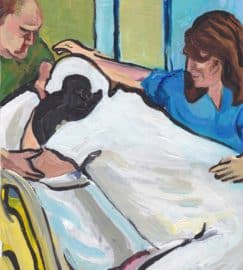
Illustration by Laura Godfrey-Isaacs
The woman is now making the kind of sounds I recognise as a signal that birth is imminent – low, guttural and sustained, and I see a slither of the baby’s head poking out between her legs. A dark, wet and glistening spectre.
The baby’s head appears, coming forward with each contraction as she pushes, and then moving away as it subsides. I speak in an upbeat way – each midwife has her own script, developed over time – key words, intonations and phrases that encourage and reassure.
The woman doubts herself – ‘I can’t do it’ she says, with desperation, arching her back and burying her head into a pillow – we all chorus back ‘you can!’.
More pushes, and now a change in position.
In left lateral, we all realign ourselves – midwife, partner, mother. The woman lifts one leg, which we support, bracing ourselves to take the weight and acting like scaffolding around her, as she pushes hard – the baby’s head emerges further. A tantalising effigy, emerging bit by bit, like the pointed end of a hat.
This scenario continues for an hour – we operate like props around her body as she moves into different positions, sometimes using the handles on the bed as buttresses to push against, sometimes her partner’s body or mine. We shift as she travels across the bed, responding to her actions and movements.
Protocols dictate that if the baby is not born after one hour of pushing, we need to call in the doctors for a review.
Two doctors enter the space.
It’s decided to try an instrumental delivery. The baby has to navigate through the woman’s pelvis, making exquisite twists and turns to find a way through the narrow spaces, flexing its head to wriggle through the narrow opening.
Suddenly the intimate, close relationship between everyone is broken – disrupted by the presence of a different energy and intent of the doctors. We all step back and make space for them. They enter with an air of authority and power and take control of the space, which was previously shared between us.
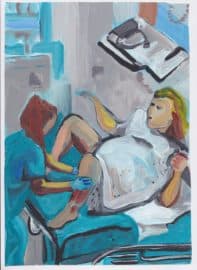
Illustration by Laura Godfrey-Isaacs
We shift the woman now, guiding her into the lithotomy position. We flatten the bed, bring her down towards the end and raise her legs into stirrups. This is the most undignified and vulnerable posture in the birth room – I bring sheets and cover her as best I can to protect her in this stark situation. The suction cap is attached to the baby’s head. Then in tandem, the doctor pulls with each contraction and the woman pushes.
After three pushes the baby is born – and delivered straight onto the woman’s chest. Slick, slippery and writhing, covered in a thick layer of creamy white vernix. Everyone clusters close and there is an immediate shift in the room – a pause and silence that seems to last forever as we wait for the baby to cry – it comes, and everyone exclaims, congratulates the woman and tears flow.
I come close to quickly assess the baby – she seems fine – breathing, crying, moving. Her colour slowly changes from blue and black to a lighter shade, and her eyes are blinking. The woman clutches the baby to her, and the partner embraces them both – there is an ambience of relief, joy and celebration in the space.
Meanwhile the doctor administers an injection and pulls the placenta out. She then assesses the damage to the woman’s perineum and prepares to stitch it up – sitting on a stool and whizzing back and forth to the trolley to get equipment. When finished we meticulously count the swabs and needles, and document that everything is correct. The doctor then leaves, her bleeper going off as she is called into another room.
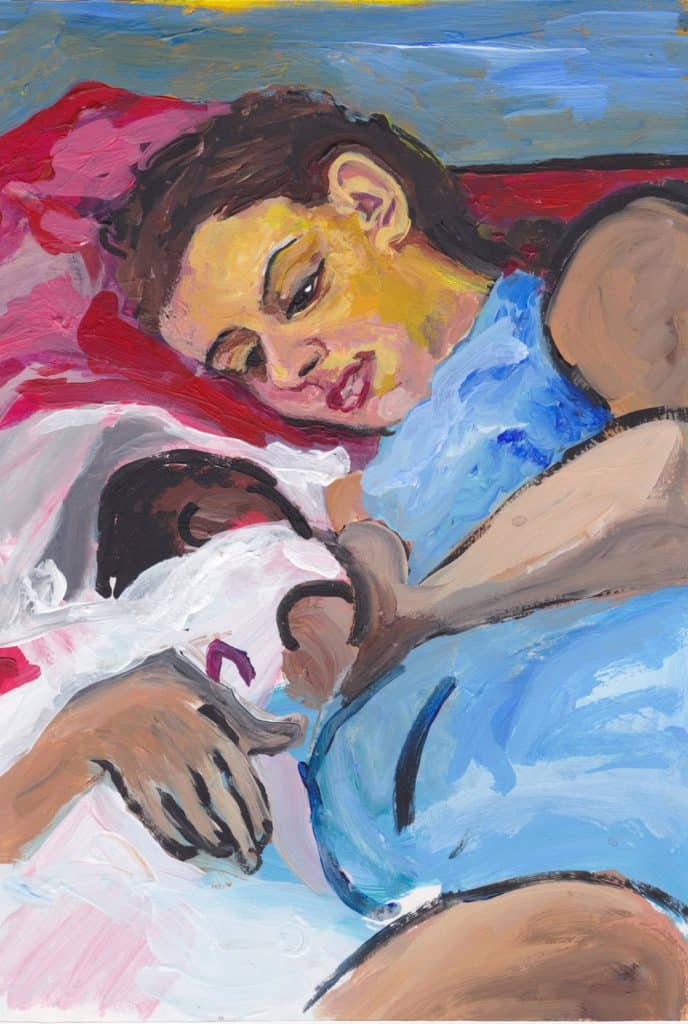
Illustration by Laura Godfrey-Isaacs
I help the woman latch the baby onto her breast, bending over, twisting to get good sight of the baby’s mouth attaching to the breast, and she immediately starts sucking.
After a while I gently and deliberately clean the woman’s body – tenderly washing off the blood and other bodily fluids using hot water and cloths. I change the bed sheets and arrange pillows and blankets so she is clean, comfortable and cosy. I offer a clean hospital robe. I also scour the room, on my hands and knees, mopping blood off the floor and collecting all used pads, gloves and other bits of debris, which have been discarded, putting it in the array of different bins, depending on its status.
After a while I take the baby over to the resuscitaire and check her over. She’s wrapped in a blood-streaked towel, feet poking out, warm against my stomach. I ask if they want to dress the baby and the partner comes over to do this.
Next, I help the woman get up and out of bed. We walk unhurriedly across the room together and into the bathroom with deliberate and slow steps, one at a time, with a pad held between her legs. I support her physically and she leans on me. She uses the toilet and then has a shower.
Then with everything done and the family safely back together, I withdraw and exit the space. This time is precious – a new family has been born, and they need time to be together, quietly, intimately, without me constantly interacting and interfering.
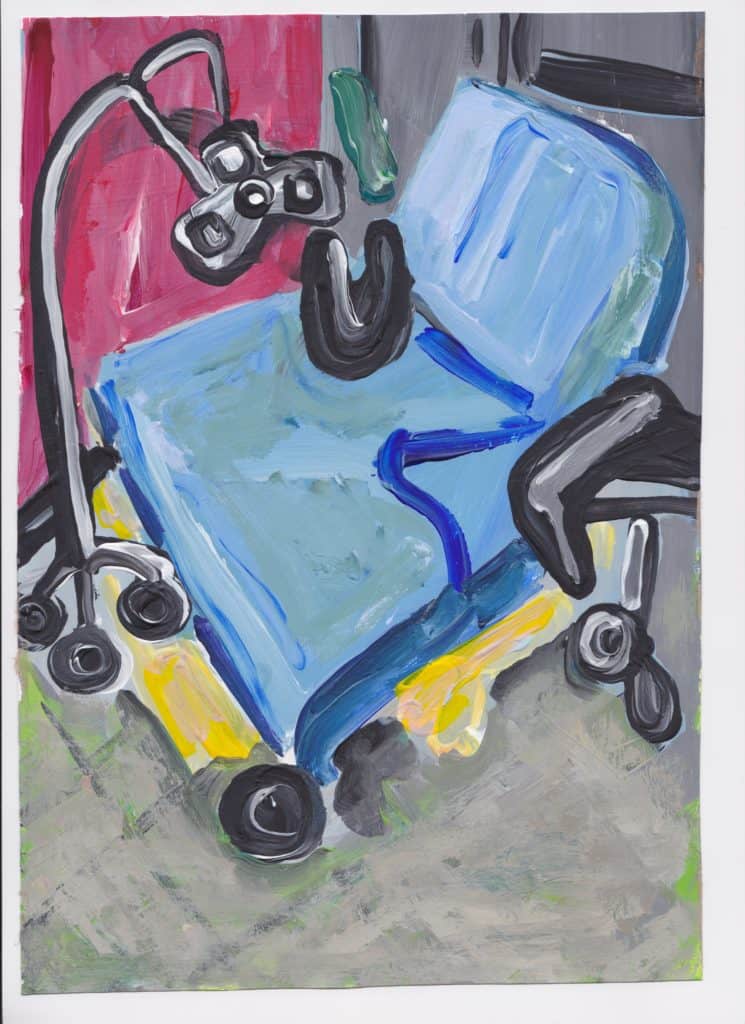
Illustration by Laura Godfrey-Isaacs
I feel exhausted but exhilarated – at the end of a seemingly endless list of tasks and negotiations. I sit down in the safety of the staff area and decompress. My body is tired and aching after the constant moving, bending, washing, cleaning and tidying.
I’m also emotionally tired, after the constant mediation between actions and words – and assessment of risk.
Now I need to finish my documentation, and arrange the transfer of the mother and child to the postnatal ward. I book a bed for her downstairs and call for a porter.
We transfer the woman into a wheelchair and hand her the baby wrapped in blankets.
As we exit the labour ward, everyone waves and wishes the family well.
We travel down together in the lift, the partner encumbered by bags and suitcases, the woman in the wheelchair holding the newborn. The porter chatting and asking about potential names.
As we arrive on the postnatal ward, the last vestiges of my care are completed. I help the new mother into a clean bed in a four-bedded bay, bring a water jug and cups and say my goodbyes. The intimacy we shared and the intensity of the experience are acknowledged as we embrace, and I wish them luck.
I go into the office space and hand over, as the midwife did to me around 10 hours previously. I tell her the story of the birth and I feel like I also outline the ‘performance’ of the dance – a series of choreographic sequences; a duo (me and the woman), a trio (with her partner) and sometimes more complicated multiple improvised sections (with other healthcare workers). How well these were structured, performed and completed influence the outcome of the birth and the dynamic created in the space.
Today, the dance went well – we were mostly in sync with each other and rode the unpredictability of the process to a beautiful outcome, and like with all great art, we leave feeling emotionally and culturally uplifted. TPM

