








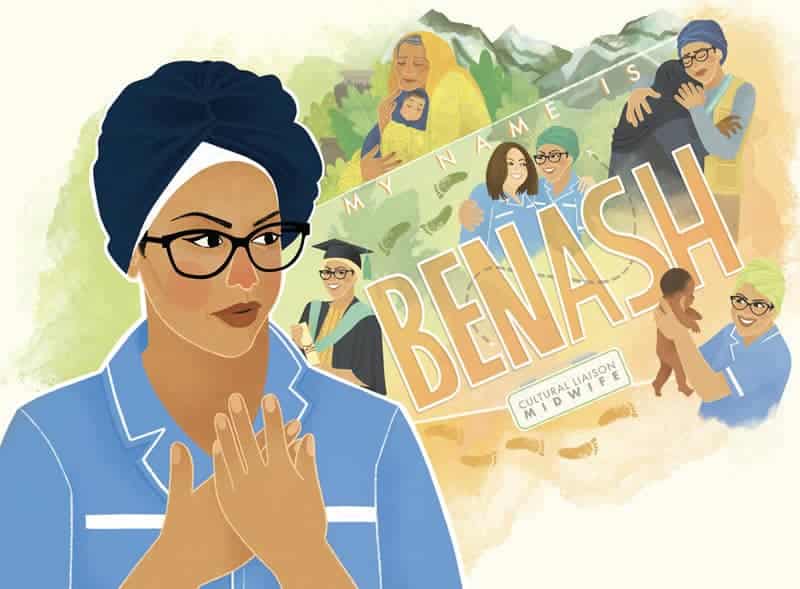
The Race of Life… and the Lessons We Learn – an open letter
Benash Nazmeen – Specialist Cultural Liaison Midwife, Bolton NHS Foundation Trust
Published in The Practising Midwife Volume 23 Issue 8 September 2020 https://doi.org/10.55975/LPGH6034
Dear respected colleagues and friends,
How do I put into words things that I have failed to address for years?
Let me set the background. I’m a first-generation immigrant. English is not my first language. I struggle differentiating ‘v and ‘w’ sounds, and I slow down what I’m saying to ensure I get this process and get it right – you see, only one of these sounds exists in my mother tongue. Often I am left lost with colloquialisms. Once I asked a doctor ‘if I could scratch his brain’ rather than ‘pick’ it. I laugh when it’s mentioned but internally I’m mortified – too embarrassed to converse with him after this incident. I told another midwife and she then said she has done this a lot and that ‘it’s no biggie’, not realising the cultural insecurities and vulnerabilities this incident triggered for me when she simply laughed it off.
Culturally speaking, I grew up in an extremely sheltered family, speaking my native language at home and growing up in an abstract environment to that at school. The dual expectation of family and society caused a long-lasting identity crisis, making it difficult to find my authentic self within this restricted parallel universe.
At home I was taught not to question authority, and respect those in authority unreservedly as any disrespect would influence how ‘they’ treated us, our requests or applications as we are considered ‘other’. I was young – I argued often, saying that ‘we’ are all the same, unaware of the insults and labels used to describe us.
A modern day example of this is the categorisation of BAME (Black, Asian and Minority Ethnic) – I didn’t realise that this was the official term to describe us. I’m considered the ‘A’ in this acronym but, like when men made decisions for women, others penned this label for us. I don’t identify with this terminology and cringe when I use it. I changed my job title from ‘BAME Lead midwife’ for this very reason.
But use it I do: to have a voice, to be heard. I learnt long ago that if I wanted to be included in a conversation, I would first have to learn a literal new language – English – and lose the accent. This led me to learn the skills to communicate, but soon after this I learnt that just because I could speak the language wouldn’t mean I would be invited to the table. So I learnt the buzz words and the vocabulary. My next lesson was: now I’m at the table doesn’t mean I will be heard. I was often passed over or ignored for the ‘tall poppies’, who sometimes simply repeated my ideas and got the credit. I had learnt to use English and the vocabulary to fall in line with the majority, but all I did was become washed out, diluted.
In reality I thought this was how everyone was treated – it’s not.
But I had learnt from my parents not to argue, or draw attention to myself – to pick my battles, as what we are called or if we are heard is the least of our worries. We should present a face of acceptance. To do otherwise would be to risk rejection, exclusion and isolation.
This I learnt later was a lesson from my ancestors, enslaved to the British colony of what later became Kashmir, the Pakistani side. After over a century of this, we were so thankful the British left that being thankful became a way of life that still exists today. We smile and nod, thanking for the minimum, because we have learnt to expect nothing.
This may explain the smile-and-nod mechanism that most non-English-speaking Asians revert to – it’s a defence that makes us agreeable for fear that anything else may cause offence.

As I grew up I learnt that this was a way of life, I was taught to adapt and accept. These are traits my immigrant parents developed to overcome their troubles and taught us children. The common understanding was that you have to work harder, longer and never complain. These traits are my default; know this about me. If I’m voicing concerns, advocating or going against the consensus then I am not only opposing the external force, but also opposing my natural protective instincts – it means I care and I won’t let the subject drop. But, boy, is this hard.
 I educated myself by learning about the BAME education gap, the higher percentage of BAME prisoners in jail and even the health inequalities faced by these communities.
I have worried that being vocal would draw attention, and somewhere my parents training of ‘smile and nod’ in acceptance is intrinsic, making me conscious about causing conflict.
I am passionate about midwifery and will openly stand by my views, and I can be persistent to the point of annoyance if I have a goal to achieve. I am an educated, independent Asian woman and yet I have publicly failed to address this issue.
I, like many, have been a target – I refuse to take the label of victim – of systemic and institutional racism and I didn’t even realise it. From the minute I arrived in the UK, the starting line of my race was drawn. The difference here is that line starts at an altogether different spot for the majority, and I was already far behind.
This letter is not about ‘woe is me’. I have reached my goal despite the challenges. It is to highlight that in midwifery there is a lack of understanding and representation for the communities we care for. This is the system perpetuating the cycle of institutional and systemic racism.
Look at your workforce and nurture those who are at the back of the room because they won’t step forward, and the ‘tall poppies’ will continue to grow. Let’s recalibrate the scales…
Shukria (thanks) for reading.
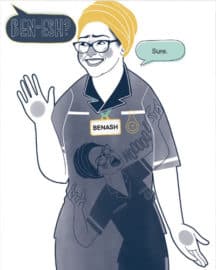
Benash Nazmeen (Bee-n-sh N-aa-z-meen) TPM

