









Transforming Fetal Monitoring in Labour: The Story Behind the Listen2Baby Toolkit
Megan Douthwaite – Listen2Baby researcher, University of Oxford
She/her
Social: @npeu_oxford
Dr Jennifer MacLellan – Listen2Baby researcher, University of Oxford
on behalf of the Listen2Baby team
Introduction
The Listen2Baby Toolkit emerged from a four-year NIHR-funded research programme running from 2022 to 2026. To understand the realities of IA practice, the research team conducted one of the most comprehensive investigations of intermittent auscultation undertaken in UK maternity care. The project used experience-based co-design (EBCD), to developing practical, frontline solutions: The Listen2baby Toolkit.
For women experiencing uncomplicated labour, intermittent auscultation (IA) remains the recommended method of fetal monitoring.1 Evidence consistently shows that, compared with cardiotocography (CTG), IA in uncomplicated labour is associated with lower rates of intervention without any difference in neonatal outcomes.2
Yet despite clear national guidance, concerns about IA practice have persisted across UK maternity services for years.3,4
National enquiries have repeatedly identified problems including:
- IA not being performed at the right time, for long enough, or often enough
- Inadequate documentation of the fetal heart
- Gaps in training, confidence, and audit systems
These challenges are not simply procedural issues. They have contributed to avoidable harm, including severe injury and deaths of babies.5Against this backdrop, the Listen2Baby Toolkit was created – a comprehensive, evidence-based intervention designed to strengthen IA practice across maternity services and support safer, more consistent care during labour.
A National Research Programme Grounded in Real Experience
The Listen2Baby Toolkit emerged from a four-year NIHR-funded research programme running from 2022 to 2026. The project used experience-based co-design (EBCD), an approach that brings together those delivering care and those receiving it to shape meaningful, practical improvement.6
The programme involved collaboration between:
- Midwives and obstetricians
- Maternity service users
- A research team from the Universities of Oxford, Birmingham, Cardiff, and Imperial College Healthcare NHS Trust
- Clinical and policy stakeholders
- Co-design specialists from the Point of Care Foundation
Rather than relying solely on guidelines or theoretical models, the team set out to understand how IA is practiced in real clinical environments.
Building a Detailed Picture of IA Practice Across the UK
To understand the realities of IA practice, the research team conducted one of the most comprehensive investigations of intermittent auscultation undertaken in UK maternity care.
The work included:
- A national survey of NHS maternity services with an 85% response rate7
- Observations, interviews and case note audits across seven NHS organisations8
- Interviews with women about their experiences of IA during labour9
A short film capturing women’s experiences was also developed as part of the project, ensuring that communication, consent, reassurance, and women’s priorities remained central to the Toolkit design. What emerged was a clear picture of the gap between guidance and day-to-day practice.
Researchers identified multiple barriers affecting IA implementation, including:
- Limited visibility and value placed on IA skills
- Variable confidence and capability among midwives and the wider multi-disciplinary team.
- Inconsistent offer of IA to women
- Reduced opportunities for staff to maintain IA skills
- Environmental pressures affecting practice and documentation
- Inconsistent access to equipment and suitable room layouts
The findings highlighted that improving IA is not simply a matter of teaching technique. It requires system-wide change.
Co-Designing Practical Solutions
Using experience-based co-design, the project moved beyond identifying problems to developing practical, frontline solutions.
This process included:
- Three online feedback and prioritisation events involving clinicians, service users, researchers, and policy stakeholders
- A face-to-face shared prioritisation event bringing all groups together
- Eight iterative, solution-focused online working groups
The Toolkit was continuously tested and refined with midwives and obstetricians, maternity service users, policy and practice stakeholders. Draft Toolkit components were developed directly from research evidence and co-design outputs before undergoing feasibility and acceptability testing in seven NHS organisations.
Importantly, the Toolkit was refined iteratively based on frontline feedback and designed to integrate into existing clinical workflows to support sustainable implementation.

What Makes the Listen2Baby Toolkit Different?
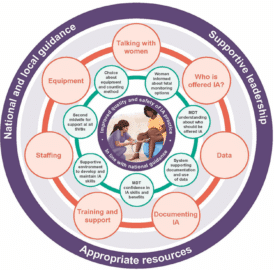
The Listen2Baby Toolkit (Figure 1) is not a standalone training package or a collection of disconnected resources. It is a complete, integrated, web-based intervention designed to improve the quality, safety, and consistency of IA practice during uncomplicated labour.
The Toolkit has been designed as a coherent package of interlinked components that work together across multiple levels of the maternity system — from individual skills and confidence to organisational audit, implementation, and service improvement.
What Does the Toolkit Include?
- Fitness Check: Assess and Prioritise
At the centre of the Toolkit is an interactive web-based Fitness Check designed to help organisations evaluate their current IA practice.
The Fitness Check:
- Reviews existing support for IA practice within an organisation
- Generates a personalised report with suggested improvement priorities
- Provides evidence-based feedback during completion
- Supports ongoing review and progress tracking
This enables maternity services to identify where improvement is needed and focus efforts strategically.
- Implementation Plan: Organising Change
Improving IA practice requires structured implementation support. The Toolkit therefore includes a step-by-step implementation plan offering:
- Guidance for planning and delivering change
- Resources for tracking actions and progress
- Support for team-based implementation
The emphasis is on achievable, sustainable change embedded within everyday maternity practice.
- Audit Tools and Proformas: Understanding Practice
The Toolkit also provides practical audit resources to help organisations understand how IA is currently being used. These tools support audits of:
- IA eligibility
- Use of IA during labour
The resulting local data can then inform targeted quality improvement work and monitor progress over time.
- Evidence-Based Resources: Enabling Change
A suite of evidence-based resources has been developed from examples of best practice identified during the research programme. These materials are designed to strengthen:
- IA knowledge, skills, and confidence
- Communication with women
- Consistency of care
Together, these resources aim to support both clinical excellence and positive experiences for women during labour.
Supporting Safer, More Consistent Care
The Listen2Baby Toolkit represents more than a training initiative. It is a system-level intervention grounded in national research, frontline realities, and women’s experiences.
By combining evidence, co-design, implementation support, and practical tools, the programme aims to close the gap between guidance and practice — helping maternity services strengthen IA, reduce avoidable harm, and support safer, more consistent care during uncomplicated labour.
The Listen2Baby Toolkit is free to use and can be accessed at: https://listen2babytoolkit.npeu.ox.ac.uk/register .
Figure 1: Components of the Listen2Baby Toolkit
References
- Fetal Monitoring in Labour. NICE guideline (NG229). NICE. https://www.nice.org.uk/guidance/ng229. Updated March 25, 2026.
- Alfirevic Z, Devane D, Gyte GML, Cuthbert A. Continuous cardiotocography (CTG) as a form of electronic fetal monitoring (EFM) for fetal assessment during labour. Cochrane Database Syst Rev. 2017;(2):CD006066. org/10.1002/14651858.CD006066.pub3.
- Saving Babies’ Lives Version Three: A Care Bundle for Reducing Perinatal Mortality. NHS England. https://www.england.nhs.uk/long-read/saving-babies-lives-version-3-2/. Updated April 24, 2025.
- Sholapurkar S. Scope for improved intermittent auscultation (IA) regime mitigating serious systemic risks, for wider acceptance in American, British and international practice. Int J Obstet Gynaecol. 2025;7(1):3-11. org/10.33545/26648334.2025.v7.i1a.35.
- Factors affecting the delivery of safe care in midwifery. National Learning Report. MNSI. https://www.mnsi.org.uk/documents/16/20240508-MNSI-Delivering-safe-care-in-midwifery-units.pdf. Published May 08, 2024.
- Point of Care: Experience-Based Co-Design (EBCD) Toolkit Picker Institute. https://www.picker.org/learning-development/experiences-care-toolkits/ebcd-experience-based-co-design-toolkit. Accessed May 5, 2026.
- Douthwaite M, Morelli A, Kenyon S, Sanders J, Rowe R. Intermittent auscultation fetal monitoring practice in different UK birth settings: a cross-sectional survey. BMC Pregnancy Childbirth. 2025;25:446. org/10.1186/s12884-025-07514-2.
- MacLellan J, Ade M, Douthwaite M, et al. Facilitators and barriers to the practice of intermittent auscultation fetal monitoring in UK maternity services: a qualitative study using the Consolidated Framework for Implementation Research (CFIR). BMJ Open. 2026;16:e115855. doi:https://doi.org/10.1136/bmjopen-2025-115855
- MacLellan J, Ade M, Fitzsimons B, et al. Women’s experiences of intermittent auscultation fetal monitoring in labour: a qualitative study. Women Birth. 2024;37(6):101805. org/10.1016/j.wombi.2024.101805.

