









Trauma-informed Care: A Journey to Healing
Kate*
Maternity Service User
Amy*
Consultant Midwife
*Note, pseudonyms have been used and identifiable information removed to maintain confidentiality
Published in The Practising Midwife Volume 28 Issue 6 November 2025 Pages 8-12
https://doi.org/10.55975/OXMN3385
Summary
The Birth Trauma Report calls for any woman or birthing person who discloses a history of trauma, including a previous traumatic birth, to be offered trauma-informed care during their pregnancy, labour and postnatal experience. Kate, a service user, and Amy, a midwife, share their experience of their trauma-informed care journey to demonstrate the healing effect it can have.
Introduction
Trauma is an experience unique to the individual which may be caused by a single or series of events which they experienced as harmful or felt as life threatening.1Such experiences can have a long-lasting impact on the individual’s physical, social, emotional or spiritual wellbeing, and may affect sense of safety when accessing maternity care. Understanding this and asking, ‘what does this person need?’ as opposed to ‘what is wrong with this person?’ is key to trauma-informed care. Trauma-informed care may be described as care that seeks to make the individual feel safe, able to develop a trusting relationship with healthcare professionals, and supported in making informed decisions about their health and wellbeing.1
Women and birthing people may come to maternity services having experienced some form of trauma in their life unrelated to pregnancy. Others may come to maternity services having had a previous traumatic birth experience, and some may have experienced trauma in life that has been reactivated by a pregnancy or birth experience. The recent Birth Trauma report2 which details trauma experienced by women and their families in the UK during the pregnancy, birth and postnatal continuum, is a harrowing read. It calls for any woman who discloses a traumatic history (including a traumatic birth) to be offered trauma-informed care. There are six principles of trauma-informed care: safety, trustworthiness, choice, collaboration, empowerment and cultural consideration.1 These principles are intertwined and are the foundation of quality care.
This article explores how these principles impacted on Kate, who had experienced trauma prior to pregnancy that was then reactivated during her first pregnancy, childbirth and postnatal experience. Together Kate writes with Amy, midwife for her second pregnancy, about their experience and how the principles of trauma-informed care help to make sense of how this second pregnancy and birth became a reparative experience.
We present the experience of both Kate and Amy during the three stages of the peripartum – before, during and after – to demonstrate how the journey of continuity of carer and of birth itself can be a vehicle for healing after trauma. We also attempt to capture the evolution the midwife-woman relationship, from the initial impressions at the first encounter until the present day. The text is presented as a dialogue between Kate and Amy.
PRACTICE POINT 1
Can you reflect on a time when a woman or birthing person in your care required trauma-informed care? Is this something you were able to provide?
Before
Service user Kate: I first met Amy before my second daughter was conceived. I had just received a formal complaint response from the maternity service regarding my first birth, an experience which had left me with PTSD and feeling completely disillusioned with maternity care. I called up the Birth Choices clinic number and a lady answered and introduced herself as the new consultant midwife, Amy. When she said the word ‘midwife’, my heart sank. My initial feelings were misplaced, though, as Amy actively listened to what I wanted to say. I met Amy in person several months later during a complaints resolution meeting where she told me that in a future pregnancy, she could be my midwife. Her presence was warm, humble, trustworthy and safe, and despite being let down by every previous clinician, I believed her.
Amy came to my house for antenatal appointments and got to know my family. In my previous pregnancy, COVID-19 restrictions meant I had attended antenatal appointments and scans alone and saw a different midwife every time. Continuity of carer throughout a whole pregnancy meant that the midwife-woman relationship deepened and presented an abundance of opportunities for informed decision making.
No pregnancy nor woman is the same, and as each person brings their hopes and dreams to a pregnancy so too do they bring their past traumas that risk being reopened. My ‘high risk’ status was not being used to end conversations or present threats and ultimatums, as it previously had been, but as a catalyst for productive dialogue. Amy acted as a conduit between me and doctors, advocating for what mattered to me and putting together a truly individualised birth plan, with safety and collaboration as central elements. If I hadn’t met Amy, I doubt I would have ever considered having another child. I also found it reassuring to have support from a perinatal mental health psychologist. Whilst supporting me, they liaised with Amy and the maternity psychologist to provide support and training for the wider team involved in my care.
I am a firm believer that informed consent does not exist unless ‘No’ is a valid answer, something I feel is rarely acknowledged in maternity policy, so having a midwife who lived and breathed compassionate, respectful care allowed me to slowly begin to heal and regain my sense of self. I’d planned a home water birth but knew that even if this didn’t work out, my second birth would not be like my first because of the inner healing I’d been supported to do.
Midwife Amy: I clearly remember the first time I spoke to Kate, a chance phone call. She told me her story and I could sense her frustration and ongoing distress. The next time we met was in the complaint resolution meeting where I offered to be Kate’s midwife if she chose to have another baby. Kate had my contact details and we emailed and spoke on the phone several times before she was pregnant. We discussed her fears and her hopes and explored all options for care, including opting to have her care elsewhere. I explained that my role was to advocate for Kate and support her to make informed decisions about her care.
When Kate contacted me and told me she was pregnant, I was nervous and anxious. I knew what Kate had been through and I felt a weight of responsibility to ensure this experience was different. Reflecting now, the antenatal period provided the time and space we needed to develop a midwife-woman relationship. All the aspects of trauma-informed care, safety, trustworthiness, choice, collaboration, empowerment and cultural consideration were able to be realised as I was able to offer continuity of care. Seeing Kate for all of her appointments in her home allowed us to get to know each other. Kate was able to address any query she had with me, and I grew to know her and pick up on changes in her tone of voice and body language. I had a sense of when to discuss certain things and when to wait. Offering home-based antenatal appointments also provided the space and time for Kate’s husband, Adam, and I to get to know each other and for us all to devise Kate’s individualised plan for labour and birth. As well as antenatal appointments, Kate and I spoke regularly and I think this helped Kate to feel psychologically safe in my care.
I had good multidisciplinary support whilst providing care for Kate, liaising with the various teams involved in Kate’s care and sharing their recommendations with her. Occasionally however, I struggled with the straddling between midwifery and other disciplines involved in Kate’s care. To help with this, I received supervision from the maternity psychologist during Kate’s pregnancy. This supported me in navigating these difficulties and was key to ensuring I had the tools I needed to support Kate.
Creating an individualised plan with Kate was a significant part of her care. However, I knew that making a plan and having that plan realised were two very different things. I created an on-call rota of midwives to be available to attend Kate’s birth with me and introduced Kate to these midwives during the antenatal period. These midwives were also supported by the maternity psychologist with training on trauma-informed care. The midwife who attended the birth, Camilla, had been at Kate’s 36-week appointment.
PRACTICE POINT 2
Do you feel confident in implementing the principles of trauma-informed care?
During
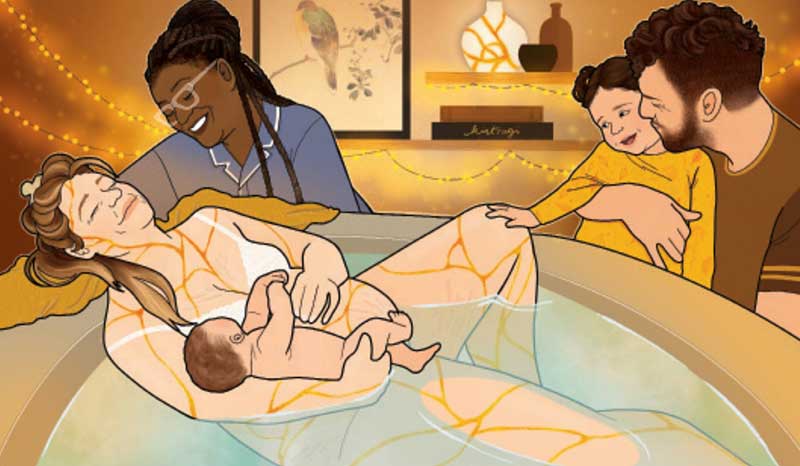
Amy: I got the phone call I had been waiting for early on Easter Monday. Kate was in labour. I went to Kate’s home and performed an initial assessment. Again, I felt that nervousness, that desire, that want for everything to be just right. In a way, I don’t have lots to say about the birth. Kate trusted me, and I trusted Kate to tell me what she needed from me. Camilla, known to Kate, was a great support for Kate, Adam and myself and together, we took labour one step at a time. It was only a matter of hours before Kate gave birth to a healthy girl, in the pool in the middle of her living room. I stayed for a few hours, making sure Kate, Adam and their daughters were safe and comfortable. I popped back in the evening to carry out some monitoring and left that night with a big smile on my face and a happy heart knowing that Kate had experienced the birth she had dreamed of.
Kate: My second daughter’s birth was a radical act of reclamation of my body. The care I had received from Amy during my pregnancy provided multiple opportunities for advocacy and trust building to be demonstrated prior to labour, providing the perfect springboard for a healing birth experience. I knew she was completely invested in helping me rewrite the narrative of what birth can be like. I have never felt safer, more supported, more held, and it was this feeling of psychological safety translating into physical safety which sticks with me most.
After my previous birth, a syntocinon augmentation without pain relief, transition became my most feared part of birth and I had communicated this fear to Amy throughout my pregnancy and during labour. It was only when Camilla, who was attending the birth alongside Amy, said that I had already gotten through transition that it hit me that the thing that I feared most in birth had passed. The feeling of utter relief will stick with me for the rest of my life. My daughter was born in a birth pool after just four hours of active labour. Birth can be euphoric, it can be edifying, life-enhancing. I wish I could tell my former self these things – that even someone like me, left reeling after a traumatic experience and always classed as ‘high risk’ – could have the chance to experience the birth of my dreams. As soon as the physiological third stage was over, after just nine minutes, I turned to my husband and said, ‘I could do this every day.’
PRACTICE POINT 3
In your workplace, what support do you need to be able to provide trauma-informed care?
After
Kate: I view my second postpartum as a period of recombobulation, the reassembling of the broken pieces of me. The first year of my eldest’s life, which I lost from the fallout of her traumatic birth and the subsequent formal complaint, was able to be reclaimed as I threw myself with gusto into being a mother of two under two. Amy encouraged me to train as an infant feeding peer supporter and I completed the training in my fourth trimester. For a month after the birth, Amy continued to come to my house for appointments, ensuring that I was supported and my emotions validated.
During my first postpartum, I had felt like I was invisible and that my recovery didn’t matter, with midwife weigh-ins for my baby being replaced with health visitor weigh-ins at a week old. With Amy, a midwife who knew me in every facet, I was always honest and open and unashamedly real about the intensity of the immediate postpartum, both physically and psychologically. Postpartum didn’t have to be textbook perfect for it still to be a healing experience, and Amy continued to ensure that I had all of the tools to not only survive this period but to thrive.
Being signed off from midwife-led care was bittersweet. Although together we’d achieved everything we had planned to achieve and more in this birth, it was hard to say goodbye to someone who had had such a monumental impact on my life. The legacy of a good birth is far reaching. Even though Amy is no longer my midwife, the impact of her care and approach to midwifery practice will never leave me. I feel so lucky that our paths crossed. The song For Good from my favourite musical Wicked captures my feelings about this journey:
I’ve heard it said
That people come into our lives
For a reason
Bringing something we must learn
And we are led
To those who help us most to grow
If we let them
And we help them in return
This process of surrendering, this willingness to grow and challenge preconceptions, was made possible by the deep trust continuity of carer allowed us to build.
Amy: I was able to continue to provide care for Kate and her family in the postnatal period. Kate was calm, confident and had taken on the role as a mother of two comfortably. I found great satisfaction and joy in being able to support Kate and her family through that transition. The postnatal period wasn’t all straightforward, as her daughter required an admission for jaundice. Initially this had worried me as I was concerned how Kate would cope being in a hospital environment. However, I soon realised there was no need to worry. The experience Kate, her family and I had shared meant that she felt safe and able to participate fully in decision making about her daughter’s care.
Discharging Kate at 28 days was an emotional moment. I was able to see how far Kate and I had both come since that initial phone call. It was incredibly satisfying to see what we had achieved together, and an experience that will stay with me forever. Our work together has not ended and I am pleased to continue to work with Kate and maternity and perinatal mental health psychologists as we take steps to improve care for women and their families accessing our maternity services.
Conclusion
We continue to speak regularly, discussing maternity care and how women and birthing people can be empowered to have the pregnancy, birth and postnatal experience they desire. One point we always come back to is the notion of informed consent. As Kate says, what do we call it when a woman chooses not to consent? Informed dissent?! We much prefer the term ‘informed decision making’ and hope that going forwards, all health care professionals involved in the childbearing cycle will support women to make informed decisions about the care they receive. The Birth Trauma report2 calls for those who disclose trauma to be offered trauma-informed care. We argue that the principles of trauma-informed care – safety, trustworthiness, choice, collaboration, empowerment and cultural consideration – are the foundation of good midwifery care and should be available to all.
PRACTICE POINT 4
In your workplace, do you feel equipped to support women to make informed decisions about their care?
Footnote
Since writing this article, Kate has gone on to have another pregnancy and home birth where Amy was Kate’s midwife. Having shared the experience of Kate’s second pregnancy and birth, Amy and Kate were able to navigate this third pregnancy and birth with ease, resulting in a positive experience for both Kate and her family, and for Amy. TPM
1. Working definition of trauma-informed practice. Office of Health Improvement and Disparities. https://www.gov.uk/government/publications/working-definition-of-trauma-informed-practice/working-definition-of-trauma-informed-practice. Published November 02, 2022. Accessed August 25, 2024.
2. All-Party Parliamentary Group on Birth Trauma. Listen to Mums: Ending the Postcode Lottery on Perinatal Care. https://www.theo-clarke.org.uk/sites/www.theo-clarke.org.uk/files/2024-05/Birth%20Trauma%20Inquiry%20Report%20for%20Publication_May13_2024.pdf. Published May 13, 2024. Accessed August 25, 2024.

