









Unmasking Pregnancy: Autistic Voices Online
Hayley Coffey (she/her) – Senior Lecturer, Canterbury Christ Church University
Social @Hay.coffey
Published in The Practising Midwife Volume 29 Issue 2 March 2026, Pages 24-28
https://doi.org/10.55975/ZHBX9896
Summary
The purpose of this qualitative study was to explore the sensory, emotional and social challenges experienced by autistic women during pregnancy and the postnatal period, using narratives shared on Reddit. The method used was thematic analysis of posts from r/AutismInWomen using Braun and Clarke’s framework. Findings include six themes being generated: sensory overload, emotional wellbeing, support, cultural expectations, coping strategies and unmasking. Online peer support was a key resource.
Introduction
Pregnancy and the postnatal period bring significant physiological, psychological and social changes. For autistic women who experience the world through distinct sensory and emotional lenses, this time can present increased risk. Despite growing recognition of gendered differences in autism presentation, autistic women are still underrepresented in both clinical literature and maternal health research, with limited attention to how intersecting identities affect care.1 Autism spectrum disorder (ASD) is a neurodevelopmental condition marked by differences in social communication, sensory processing and behaviour.2 Autistic women often experience heightened sensory sensitivities, emotional dysregulation and difficulties accessing appropriate maternity care.3,4 However, few studies have centred the voices of autistic women themselves in exploring how these experiences unfold during pregnancy and early motherhood.
This study draws on Reddit, an international social media platform where users share personal reflections anonymously. The subreddit r/ AutismInWomen provides a peer-support space in which autistic women discuss pregnancy and parenting. Digital data from these spaces are increasingly recognised as valuable sources of naturalistic, first-person accounts that may not appear through traditional interviews or surveys.5 Although poster location cannot be determined; the challenges described are consistent with UK maternity priorities.6,7 They also align with research documenting autistic women’s sensory sensitivities and difficulties in maternity care care.3,4
These findings, therefore, remain highly relevant to UK midwifery practice. By analysing posts written by autistic women during or after pregnancy, this study addresses a key gap: how sensory, emotional and social challenges are described in their own words. Prior research8 has highlighted the importance of online narratives in understanding autistic motherhood. However, further work is needed to capture the full range and depth of experiences.
Research aims
To explore how autistic women describe their sensory, emotional and social experiences during pregnancy and the postnatal period within an online peer- support community.
Research questions
- What sensory and emotional challenges do autistic women report during, pregnancy and the postnatal period?
- How do they describe support needs, identity changes and coping strategies?
- What are the implications for autism- informed maternal healthcare?
- By centring autistic voices, this study offers practical insights for midwives and maternity services and contributes to a more inclusive understanding of pregnancy and neurodiversity.
Methodology
Study design
A qualitative thematic analysis was employed to explore the sensory, emotional and social experiences of autistic women during pregnancy and the postnatal period. This approach identifies patterns and themes in qualitative data, offering nuanced insight into lived experiences.
Data source
Data were sourced from the Reddit community r/AutismInWomen, a forum where autistic women discuss various aspects of their lives, including pregnancy and motherhood. Reddit was chosen for its anonymity and rich user content, offering authentic insights.
Sampling strategy
Purposive sampling was used to identify posts that met the following inclusion criteria:
- The author self-identified as an autistic woman.
- The post discussed experiences related to pregnancy or the postnatal period.
A total of 12,600 words from relevant posts were collected for analysis.
Ethical considerations
Given the public nature of Reddit, the study adhered to ethical guidelines for using online data. Direct quotes are presented without usernames to protect individual identities. The study design was reviewed and approved by the Ethics Committee of Canterbury Christ Church University ensuring compliance with ethical standards for research involving human subjects. Care was taken to avoid sensationalising content or causing harm.
Data analysis
Thematic analysis was conducted following Braun and Clarke’s six-phase framework:9
- Familiarisation: Immersion in the data by reading and re-reading posts to become intimately familiar with the content.
- Initial Coding: Systematic coding of interesting features across the dataset, generating initial codes.
- Searching for Themes: Collating codes into potential themes based on patterns of shared meaning.
- Reviewing Themes: Refining themes by checking them against the coded data and the entire dataset for coherence.
- Defining and Naming Themes: Clearly defining each theme and developing detailed analyses.
- Writing Up: Integrating the analytic narrative with data extracts to contextualise the analysis in relation to existing literature.
This rigorous approach ensured that the analysis was both systematic and reflective of the participants’ perspectives.
Researcher reflexivity
As the sole researcher, I bring a unique dual perspective to this study: I am both autistic and a practising midwife. This positioning offered insight into participants’ experiences, especially around sensory processing, communication and emotional wellbeing. My own experiences allowed for a heightened sensitivity to the nuances of autistic expression and the maternity care context.
At the same time, I remained mindful of the potential influence of my positionality on data interpretation. To enhance trustworthiness, I engaged in reflexive practice, documenting assumptions and considering alternative interpretations. This process was guided by a commitment to honour the authenticity of participants’ voices while recognising the complexity and diversity of autistic motherhood.
Results
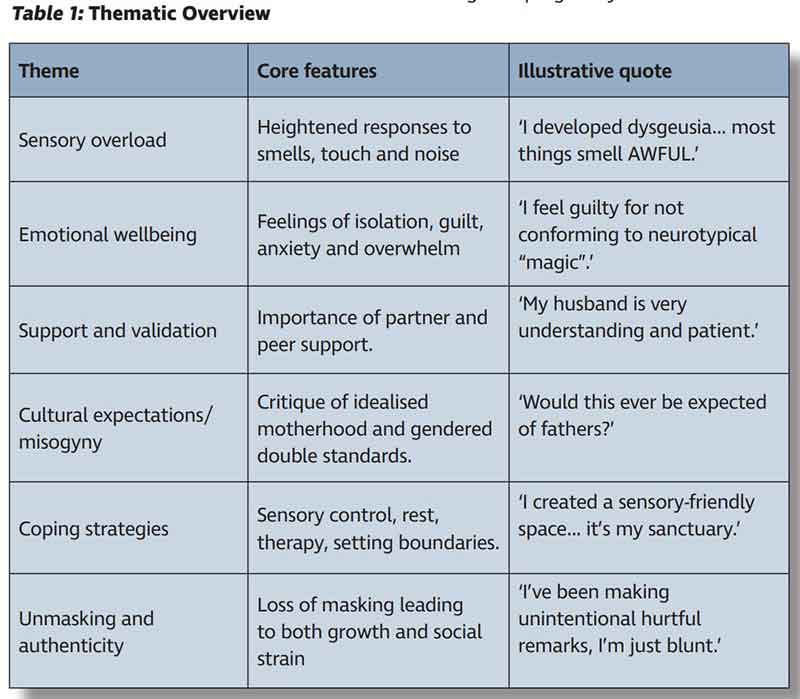
A total of seven Reddit threads and 130 related comments, comprising approximately 12,600 words, were included in the analysis. All posts met inclusion criteria: self-identification as autistic and discussion of pregnancy or the postnatal period. Six overarching themes were identified, each encompassing a distinct aspect of participants’ lived experience.
Sensory overload and discomfort
Participants consistently described heightened sensory sensitivities during pregnancy. Common stimuli like smells, textures and noise were often overwhelming or distressing. These sensations led to functional and emotional distress.
‘I developed dysgeusia… most things smell AWFUL.’
‘I feel claustrophobic in my own body.’
Participants reported panic responses associated with sensory input:
‘Sensory overload manifests in my body as a panic attack. Chest pain, racing heart, it’s terrifying.’
Sensory adaptations such as using earplugs, wearing sunglasses indoors, or modifying the home environment were frequently employed as coping mechanisms.
Emotional wellbeing
Pregnancy was described as emotionally volatile, with participants reporting intense feelings of dread, guilt, frustration and exhaustion. Emotional dysregulation was linked to internal and external stressors.
‘It’s so frustrating, I feel trapped in my house.’
‘I feel guilty for not having those ‘magical pregnancy feelings’ neurotypicals talk about.’
Participants described struggling to meet perceived standards of maternal emotion, often resulting in a sense of failure.
Support and validation
Supportive relationships particularly with partners and peers emerged as vital protective factors. Many participants noted the value of validation in mitigating isolation and self-doubt.
‘Having a supportive partner made a huge difference, he just got it.’
‘Sometimes just hearing, ‘you’re doing great’ from someone made all the difference.’
Peer validation in online communities, including Reddit, was frequently described as more emotionally accessible than traditional support channels.
Cultural expectations and misogyny
Participants critiqued the gendered and neurotypical expectations imposed on mothers, highlighting how these norms exacerbate stress.
‘These double standards and expectations of maternal martyrdom are so harmful.’
‘Would this ever be expected of a father? No.’
Several participants described sensory discomfort related to being touched without consent during pregnancy or feeling pressured to perform emotions they did not feel. These reflections underscored how normative ideals of motherhood often marginalise neurodivergent needs.
Coping strategies
Autistic women described a range of adaptive strategies, from boundary-setting and rest to environmental control and therapy.
‘Sleep as much as you can, it’s the only thing that helps.’
‘I created a sensory-friendly corner in my house. That became my sanctuary.’
Professional support was highlighted as helpful when practitioners were understanding of autistic-specific needs.
Unmasking and authenticity
Participants described pregnancy as a time when their capacity to ‘mask’ autistic traits diminished, sometimes leading to personal liberation and at other times to interpersonal conflict.
‘I’ve lost my ability to mask. It’s hard, but I’ve also become better at setting boundaries.’
‘I’m upsetting friends without meaning to. I can’t hide my bluntness anymore.’
Unmasking was often framed as a double- edged sword, facilitating self-advocacy while also risking social tension.
Discussion
These findings have direct implications for midwifery practice, especially in antenatal communication, personalised care planning and the development of sensory- sensitive service environments. This study explored the sensory, emotional and social experiences of autistic women during pregnancy and the postnatal period by analysing naturalistic data from the Reddit community r/AutismInWomen.
The findings show that pregnancy can intensify challenges related to sensory processing, emotional regulation and social communication. Six themes were identified: sensory overload and discomfort, emotional wellbeing, support and validation, cultural expectations and misogyny, coping strategies and unmasking and authenticity.
Amplified sensory and emotional challenges
Consistent with previous research3,4,8 participants reported pronounced sensory sensitivities, particularly to smell, physical sensations and noise. These sensitivities triggered panic symptoms and limited daily engagement. While sensory difficulties are a well-documented feature of autism,8 this study illustrates how they are intensified by the physiological changes of pregnancy.
Emotional volatility, especially anxiety, guilt and overwhelm, was also pervasive. Some participants felt emotionally inadequate for not experiencing the joy expected of pregnant women, echoing literature on neurotypical-centric narratives in maternal healthcare.10 This aligns with evidence that unaddressed psychological distress can increase risk for postnatal depression.11 These insights reinforce the need for a broader conceptualisation of maternal emotional wellbeing that includes neurodivergent experiences.
The importance of support and validation
Supportive relationships, especially with partners and online communities, were described as critical buffers against stress. Participants valued validation from those who understood their needs. This supports findings by Chang and Locke,12 who emphasised the value of peer affirmation in autistic social spaces. Notably, participants often described feeling more emotionally safe online than in face-to-face interactions, highlighting a potential avenue for digital peer-support interventions.
Cultural expectations and misogyny
The theme of cultural expectations and misogyny revealed how societal ideals of motherhood can be especially alienating for autistic women. Many critiqued expectations that mothers be nurturing, emotionally expressive and physically accessible, often at odds with autistic traits. These findings align with feminist critiques of maternal norms12,13,14 and extend them to neurodivergent motherhood, highlighting the intersection of gendered and neurotypical expectations.
Coping, identity and the experience of unmasking
Participants described a range of coping strategies, from creating sensory-friendly environments to seeking therapy and asserting boundaries. Notably, many described losing the capacity to mask autistic traits during pregnancy. While this unmasking was often liberating, it also disrupted social relationships and heightened vulnerability. This aligns with emerging literature on autistic masking and identity15 and emphasises pregnancy as a key transitional moment when identity renegotiation may occur.
Contributions to literature
This study builds upon and extends prior work by Thom-Jones and colleagues8 deepening our understanding of autistic motherhood through the lens of user-generated narratives. The use of Reddit provided access to spontaneous, authentic reflections that might not be disclosed in formal interviews. While limitations regarding self-selection and representativeness exist, the richness of this dataset offers compelling insights into underrepresented voices.
Implications for practice
The findings highlight several practice recommendations:
Autism-informed training designed specifically for maternity care, grounded in autistic women’s lived experiences:4,16,17 adaptation of maternity environments to reduce sensory overload and co-development of flexible, individualised care plans consistent with UK maternity standards.6,7
Flexible, individualised care: Providers should co-develop personalised care plans that account for sensory profiles, communication preferences, and mental health history.
Inclusive emotional norms: Emotional expression during pregnancy should not be pathologised. Autistic women may experience pregnancy differently and require space to define their own emotional landscape.
Validation and peer support: Opportunities for connection with other autistic mothers, particularly through digital platforms, should be encouraged and resourced.
Limitations
The study is limited by its reliance on Reddit data, which may reflect a more digitally literate or self-disclosing subset of autistic women. Posts were self- identified, and diagnostic confirmation was not possible. The cross-sectional nature of the dataset also limits longitudinal interpretation. Despite these limitations, the study offers rich, first-person accounts that illuminate lived experiences often overlooked in clinical settings.
Future directions
Further research is needed to explore the experiences of autistic women across diverse ethnic, socioeconomic and gender identity groups. Longitudinal studies could investigate the lasting impact of unmasking during pregnancy and its influence on maternal wellbeing. There is also a need to develop and evaluate autism-specific perinatal care interventions. The role of online peer support in autistic motherhood deserves further exploration as a maternity resource.
Conclusion
This study highlights how autistic women experience pregnancy and the postnatal period through a distinct lens shaped by sensory sensitivities, emotional regulation challenges, and social expectations. Drawing on personal narratives shared in an online support space, six key themes appeared: sensory overload, emotional wellbeing, support and validation, cultural expectations, coping strategies and unmasking.
These findings underscore the need for autism-informed maternity care that accommodates neurodivergent needs. Midwives play a key role in creating sensory-considerate environments and flexible, individualised support. Listening to autistic voices including those shared in online communities can enhance empathy, reduce harm and improve the quality of care provided. TPM

Acknowledgements
I would like to thank my supervisor, Wendy Iredale, for their guidance and support during the development of this research.
References
- Crenshaw K. Demarginalizing the intersection of race and sex: A Black Feminist Critique of Antidiscrimination Doctrine, Feminist Theory and Antiracist Politics. Univ Chic Leg Forum. 1989;1989(1):139-167.
- American Psychiatric Association. Diagnostic and statistical manual of mental disorders. 5th ed. Washington, DC: American Psychiatric Publishing; 2013.
- Samuel P, Yew RY, Hooley M, Hickey M, Stokes MA. Sensory challenges experienced by autistic women during pregnancy and childbirth: a systematic review. Arch Gynecol Obstet. 2022;305(2):299-311. doi. org/10.1007/s00404-021-06109-4.
- Hampton S, Man J, Allison C, Aydin E, Baron-Cohen S, Holt R. A qualitative exploration of autistic mothers’ experiences I: pregnancy experiences. Autism. 2023;27(5):1271-1282. doi. org/10.1177/13623613221132435.
- Proferes N, Jones N, Gilbert S, Fiesler C, Zimmer M. Studying Reddit: a systematic overview of disciplines, approaches, methods, and ethics. Soc Media Soc. 2021;7(2):20563051211019004. doi. org/10.1177/20563051211019004.
- Standards of Proficiency for Midwives. NMC. https://www.nmc.org.uk/globalassets/sitedocuments/ standards/2024/standards-of-proficiencyfor-midwives.pdf. Updated March, 2024. Accessed December 2, 2025.
- Three-year delivery plan for maternity and neonatal services. London, UK: NHS England. https://www.england.nhs.uk/wpcontent/uploads/2023/03/B1915-three-yeardelivery-plan-for-maternity-and-neonatalservices-march-2023.pdf. Updated April 04, 2023. Accessed December 02, 2025.
- Thom-Jones S, Melgaard I, Gordon CS. Autistic women’s experience of motherhood: a qualitative analysis of Reddit. J Autism Dev Disord. 2025;55(7):2539-2549. doi.org/10.1007/ s10803-024-06312-7.
- Braun V, Clarke V. Using thematic analysis in psychology. Qual Res Psychol. 2006;3(2):77-101. doi. org/10.1191/1478088706qp063oa.
- Bargiela S, Steward R, Mandy W. The experiences of late-diagnosed women with autism spectrum conditions: an investigation of the female autism phenotype. J Autism Dev Disord. 2016;46(10):3281-3294. doi.org/10.1007/ s10803-016-2872-8.
- Dennis CL, Dowswell T. Psychosocial and psychological interventions for preventing postpartum depression. Cochrane Database Syst Rev. 2013;(2):CD001134. doi.org/10.1002/14651858.cd001134.pub3.
- Chang YC, Locke J. A systematic review of peer-mediated interventions for children with autism spectrum disorder. Res Autism Spectr Disord. 2016;27:1-10. doi. org/10.1016/j.rasd.2016.03.010.
- Rich A. Of woman born: motherhood as experience and institution. New York, NY: W.W. Norton; 1976.
- Hays S. The cultural contradictions of motherhood. New Haven, CT: Yale University Press; 1996.
- Pearson A, Rose K. A conceptual analysis of autistic masking: understanding the narrative of stigma and the illusion of choice. Autism Adulthood. 2021;3(1):52-60. doi.org/10.1089/aut.2020.0043.
- Moore L, Foley S, Larkin F. Understanding the experiences of receiving and providing maternity care for autistic adults: a multi-perspectival interpretative phenomenological analysis study. Autism. 2025;29(2):435-446. doi. org/10.1177/13623613241274518.
- Westgate V, Sewell O, Caramaschi D, O’Mahen H. Autistic women’s experiences of the perinatal period: a systematic mixed methods review. Rev J Autism Dev Disord. Published online 2024. doi.org/10.1007/ s40489-024-00461-2.

