







‘We Need to Talk about Race’: A reflection on the RCOG’s International Women’s Day conference
Alicia Burnett – Student Midwife and Co-editor of The student Midwife Journal (@aiti4aitiys)

Why do we need to talk about race?
Although reports of disparities surrounding the pregnancy outcomes of BAME women in the UK date as far back as 1991,1 and activists such as Mars Lord (@_marslord) and Elsie Gayle (@elsiegayle) have been raising awareness about them for years; the mainstream public’s outcry only became audible following the publication of the 2018 Mothers and Babies: Reducing Risk through Audits and Confidential Enquiries across the UK (MBRRACE-UK) report. In this report, MBRRACE-UK found that Asian women are more than twice as likely to die during or soon after pregnancy, whilst black women are five times more likely to experience perinatal mortality than white women.2 Moreover, the RCOG has found that BAME babies are at increased risk of neonatal death, stillbirth, pre-term birth and low birth weight, whilst women of mixed ethnicity are three times more likely to have poor pregnancy outcomes than their white counterparts.3 All of the above strongly implicate racial bias and discrimination as contributors to BAME maternal mortality in the UK – and things are not getting better: the 2019 MBRRACE-UK report mirrored the BAME maternal mortality statistics of the 2018 report.4
We need to be able to use the words ‘racism’ and ‘racist’, rather than avoiding calling out discrimination for fear of making others uncomfortable
What was said?
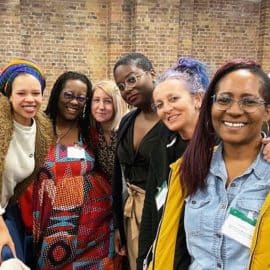
Everyone needs the capacity for introspection – an ability to look inwards and recognise the unconscious and explicit biases that we hold. Biases such as racism. One criticism of the MBRRACE-UK reports2,4 was that they did not explicitly cite racism as the cause for BAME maternal health inequalities.5 However, the message I took away from the conference was quite clear: we need to be able to use the words ‘racism’ and ‘racist’, rather than avoiding calling out discrimination for fear of making others uncomfortable. Professionals within maternity services need to acknowledge both structural and internalised biases, and continually work to overcome them, to avoid exposing BAME women and their babies to the unacceptable risk of these prejudices colouring their interactions with healthcare professionals, compromising the care they receive, and putting their lives in danger.
Dr Christine Ekechi (@dr_christine_ekechi), consultant obstetrician and gynaecologist, made the pertinent point that the solutions to health inequalities are not ‘singular, pretty or neat’, and highlighted the need for medical professionals to integrate cultural competency, cultural safety, cultural sensitivity and cultural humility into their provision of care for women. I would like to extend this challenge to my student midwife and qualified midwife colleagues because as author Candice Brathwaite (@candicebrathwaite) revealed, through her candid narration of her shocking experiences of racism from midwives in the UK, midwifery care in the UK and those in receipt of it, would greatly benefit from adopting the principles proposed by Dr Ekechi. Interestingly, it has been suggested that the attainment of cultural safety is compromised by a lack of diversity within the midwifery workforce.6 Therefore, I would argue that employers within maternity services must focus on addressing this imbalance, in order to improve BAME women and babies’ health outcomes.6
Catherine Nestor (@CatN101), co-Vice Chair of the RCOG’s Women’s Network also identified that BAME women themselves have a role to play in the improvement of the care they receive. Nestor stated that BAME women’s voices and experiences should shape maternity and women’s healthcare policies, clinical guidelines and education. This position was echoed by a number of attendees, who also emphasised the importance of keeping BAME women at the centre of the care they receive. For example, FivexMore co-founder Tinuke (@mumsandtea) stressed that grass-roots campaign groups like hers, which provide safe spaces for BAME women to share their experiences, should play a role in the development of maternity and women’s healthcare services.
What now?
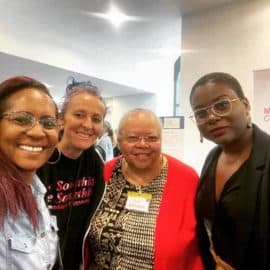
Social media has been buzzing in the wake of the conference, and many attendees including Dr Ria Clarke (@thedoctormummy), have expressed the hope that race and the eradication of systemic and structural racism remains on the agenda across the NHS and private sector, not just for International Women’s Day or the rest of 2020, but for the foreseeable future. I reinforced this hopefulness in a tweet of my own and my latest Instagram post. With regard to my own practice as a student, and my future practice as a qualified midwife, I desperately hope to see urgent, meaningful, sustained and active institutional and individual responses to the UK’s BAME maternal mortality crisis.

References
- Historical Data. https://fivexmore.com/page/2/. Accessed 8 March 2020.
- Knight M, Bunch K, Tuffnell D, Jayakody H, Shakespeare J, Kotnis R, Kenyon S, Kurinczuk JJ (Eds.) on behalf of MBRRACE-UK. Saving Lives, Improving Mothers’ Care – Lessons learned to inform maternity care from the UK and Ireland Confidential Enquiries into Maternal Deaths and Morbidity 2014-16. Oxford: National Perinatal Epidemiology Unit, University of Oxford 2018
- Royal College of Obstetricians and Gynaecologists (RCOG). RCOG calls for government action to tackle racial inequalities in women’s healthcare. News. https://www.rcog.org.uk/en/news/rcog-calls-for-government-action-to-tackle-racial-inequalities-in-womens-healthcare/. Published March 6 2020. Accessed 8 March 2020.
- Knight M, Bunch K, Tuffnell D, Shakespeare J, Kotnis R, Kenyon S, Kurinczuk JJ (Eds.) on behalf of MBRRACE-UK. Saving Lives, Improving Mothers’ Care – Lessons learned to inform maternity care from the UK and Ireland Confidential Enquiries into Maternal Deaths and Morbidity 2015-17. Oxford: National Perinatal Epidemiology Unit, University of Oxford 2019.
- Lokugamage, A. Amali Lokugamage: Maternal mortality—undoing systemic biases and privileges. The BMJ Opinion. https://blogs.bmj.com/bmj/2019/04/08/amali-lokugamage-maternal-mortality-undoing-systemic-biases-and-privileges/. Published April 8 2019. Accessed March 8 2020.
- Lokugamage, A, Meredith, A. Women from ethnic minorities face endemic structural racism when seeking and accessing healthcare. The BMJ Opinion. https://blogs.bmj.com/bmj/2020/03/05/women-from-ethnic-minorities-face-endemic-structural-racism-when-seeking-and-accessing-healthcare/. Published March 5 2020. Accessed March 8 2020.