








What Happens When You Don’t Fit the Assumptions?: The Experiences of a Transgender Midwife
Nathan Welch [he/him] – Registered Midwife, East Sussex NHS Trust
Instagram: @transmidwife18
Published in The Student Midwife Volume 5 Issue 02 April 2022, Pages 15-18 https://doi.org/10.55975/KAGU8066
Summary
In this reflection, Nathan Welch outlines his experience becoming a midwife as a queer, transgender man. He explores how the current hyper-feminised world of midwifery can cause deep psychological distress to transgender service users and staff alike, and how it is an ongoing trauma that he lives with every day. In light of his experiences coming out as a transgender man twice in the midwifery world, once at university, and again at work, this article proposes there is a big cultural and language change that needs to happen to improve access, protect mental health and reduce trauma.
Lived experience
“I’m a boy sometimes,” I said nervously. “Aww, no you’re not, don’t say that about yourself,” she replied, as we sat and had tea in the day unit.
“I have sex with women sometimes,” I said, they raised their eyebrows and turned away from me in the classroom.
“You can’t be a boy with cleavage like that,” she said, openly laughing at my body, as I arrived at the lecture.
“Are you going to have surgery?” they asked, as I sat down for my lunch break.
“What about your husband? Is your husband okay with it? Will you stay married?” they asked, as I tried to draw up intravenous medication.
“So what are you now? Gay or straight?” they asked, while I tried to document in patients’ notes.
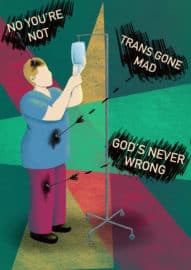
“It’s transgender gone mad” they laughed on labour ward.
On a busy antenatal ward, she said to me, “but… God doesn’t make mistakes.”
The calm before the storm
I know, without any doubt, I was born a trans person. But, the fact that I was raised in a hippy, home education community by queer people meant that when I began to notice some signs that I was trans, I was not in conflict. I was able to be myself, exactly as I am.
In hindsight, I think this lack of anyone trying to fit me into one of society’s two small boxes, ‘girl’ and ‘boy’ actually delayed me working out that there was something out of alignment. Sometimes you need to come up against a brick wall to realise that you need to try going in the other direction. I was comfortable, safe and free to explore and be all of myself, regardless of the body I was in, until I moved away from home to study midwifery at university.
Survival mode
 Suddenly, this young queer person was thrust into a classroom of sixty people and lots of staff who all appeared to be women. It was a confusing world of expectations and rules that I had never experienced before. It quickly became apparent that something was very wrong. It was as though my eyes were a little out of focus, like the world didn’t make sense anymore. I felt like a square peg in a round hole. Where I used to make everyone laugh, people thought I was being rude.
Where I used to get on with everyone and be the leader of the group, suddenly I was sitting alone. Where people used to ask me what I liked, who I liked, who I was, suddenly these things were assumed. If I didn’t fit the assumption, I was looked at like I was an alien. It wasn’t cool to be different, it was weird. So, as any young and confused human would, I adapted. And I adapted fast. I became the pretty little student midwife everyone expected me to be.
There is a deeply concerning dynamic and work culture, seemingly built into the foundations of midwifery, around the expectations placed on student midwives while they are at work. There is a significant power imbalance – the more the practice supervisor likes you and the way you work, the better your grade, and the more likely you are to pass your placement.
You end up in a perpetual state of trying to please the qualified midwives and, of course, they are all different! I lost myself in it completely; all I cared about was being what was expected of me. Unfortunately, that was appearing cisgender, straight, femme, bright, smiley, amicable, agreeable, and polite. I took criticism so hard I would regularly fall to pieces and sob at work. I was trying desperately hard to be what they wanted, my sense of self was so fragmented and insecure that failure to meet expectations felt devastating.
If I ever mentioned anything that was closer to my truth, I was looked at like I was a freak and people would stop talking to me and turn away, so I was left in awkward silence and feeling deeply and personally embarrassed and ashamed. Then, I would have to smile and keep working. At work I was met with confusion, inappropriate questioning, constant misgendering and jokes.
The aftermath of having been an outsider
This work culture and dynamic is fine for plenty of students of course, they are able to be themselves because who they are fits with the expectations. But what it does for people who don’t fit the culture; the queers, the neurodivergent, the gender benders, the witches, the weirdos, is deep, psychological harm and bullying.
 I tried to come out as a transgender man for the first time at university, it felt as though overnight I went from being one of a cohort, to being the outsider, the strange one. I could feel people actively avoiding me and when I didn’t know where to sit, no one reached out.
At university, I was met with the deepest, loudest, most sickening silence and loneliness that I have ever experienced. It felt suffocating and deeply painful. When I asked the tutors and some of the students why it was happening, I heard the same answer over and over again. “They’re just worried about getting it wrong, they don’t want to offend you”. But I can safely say, any connection would have been better than deafening silence.
What I didn’t know at the time was that every little comment, every moment where I was made to feel like who I am was wrong and didn’t fit the expectation, was chipping away at a deeply-rooted sense of my professional self. My work “persona” was being chiselled into the wrong shape. A work persona so completely at odds with who I am as a person, it would cause a huge amount of distress, pain and confusion. It took years to undo the damage and be able to be myself in the workplace.
Finding my place
When I qualified, I changed maternity services. This was very challenging, but also very positive as it felt like a blank slate, and I was able to leave some of my performance behind. I had finally accepted myself as a transgender man in my personal life, with my family and friends. I knew the next hurdle was coming out at work again.
I told a few of my colleagues and was met with acceptance and encouragement; it gave me strength. I announced it on Facebook, and the very next day I arrived at work and was asked to come to my manager’s office. I will never forget her; she told me she wanted to do anything she could to support me, she took my name and pronouns and became my champion with the rest of the staff. She took my ID badge and got my name changed on it for me and she made it so I could sign my name as myself. She was a warrior of an ally and so starkly different from what I had experienced in university.
That one person’s encouragement gave me a robust feeling of security that meant I pushed forwards and didn’t look back this time.

Being you is valuable
 If you also don’t fit the expectations and assumptions, I don’t want you to hide away and crumple like I did. Midwifery needs you, and the culture is changing fast. Being yourself may get you some funny looks and careless comments but it will not take your career away from you.
In fact, having an alternative lived experience to your colleagues can mean certain service users feel more comfortable under your care. In this way, owning your truth, even in the workplace, can make you shine brighter. That said, remember that no matter who asks, you can decline to answer any questions that make you feel uncomfortable.
Have pre-prepared sentences ready such as, “I would rather not talk about that”. It’s not on your shoulders to educate people for free. Finally, it’s okay to only have the energy to survive sometimes, but you can also always speak up, go to management, and confide in safe people. Your experience matters and you deserve a joyful journey in your career.
Conclusion
Midwifery as a profession and a collective, needs to embrace and celebrate each person for what makes them who they are. We, as LGBTQ+ healthcare professionals, need to allow ourselves to bring our truth and reality into the workplace. We deserve our work persona to feel comfortable and safe. It’s time for perinatal services to realise that the more varied and colourful the face of midwifery is, the more we are mirroring the glorious rainbow of service users that we care for. TSM

