








When a Baby’s Feet Tell you Everything – World Prematurity Day
Laura Godfrey-Isaacs, artist, midwife and birth activist
What appears to be a small bean or peanut emerges on the screen. An animated creature that moves, dances and evades the stenographers grasp.
I am in a darkened room being scanned as my belly is far too big for this stage of pregnancy and I’m in pain. 2 or 3 scanners fail to discern the problem. The professor then enters and without much introduction repeats the scan. My baby, the bean, the peanut, the fetus, moves again and defies the gaze.
Then, brutally, he gives a verdict – ‘I always look at the baby’s feet to see if it will survive and your baby’s feet look great’, and he diagnoses the problem – a huge tumour is growing on the baby’s left kidney, depressing her stomach so she can’t swallow amniotic fluid. I’m filling up with excess fluid and in danger of going into premature labour.
Later, we are taken into a private room and the condition is explained more fully, but there is no less uncertainty unfortunately.
For the next 6 weeks I go back and forth to the fetal medicine department to have fluid drained and the progress of the tumour monitored. Each time a scan reveals an ever-growing baby – more defined and human-like. Once she reaches and grabs the needle that is inserted into the womb to drain the fluid – we laugh and congratulate her on being so assertive, but we are afraid she won’t survive. Eventually I go into premature labour at 34 weeks. The baby does survive, the tumour is removed and another part of the mothering/nurturing begins, with us as two separate entities.
This eye into the womb – the scan, is now a common experience in Westernised maternity. The 12 weeks before the first scan is filled with uncertainty until we ‘see’ that image – we are at once divorced from the embodied experience of pregnancy and delighted by the technology that confirms it.
However, the image of the baby, suspended and floating like an astronaut, is deceptive. It removes the baby from the mother’s body, increases the sense of autonomy of the fetus and positions it as separate and in need of medical intervention – measurement, interrogation, observation. Whereas actually the baby is part of the mother’s body, attached by the umbilical cord, and fed by a miraculous new organ, the placenta, which is created collaboratively by fetus and mother.

What does this picturing of the inside and private space of the mother and child do to our consciousness? Does it increase respect for women, birthing people and mothers’ bodies? Does it help us realise how interconnected we are as human beings? Does it increase our understanding and wonder of reproduction? Well maybe yes, and maybe no.
 Babies can now survive outside the womb from 24 weeks gestation and recently a 22 week old baby survived. Talk of artificial wombs is in the air – experiments with animals are ongoing. Will we eventually dispense with the messy, uncertain process of pregnancy and birth? Will we deliver babies earlier to save them from the mother’s imperfect body, that might fail? Will we enter a new era of industrialised birth, with babies grown in giant laboratories. It might sound like science-fiction, but some see it as viable progress, particularly for those at high risk of premature birth, as recently discussed in ‘Sex Robots and Vegan Meat’ by Jenny Kleeman. Reminiscent of industrialised farming – plants in organised rows, monitored and managed by machines.
Scans, which used to take place maybe once during a pregnancy now routinely happen three times and, in some circumstances, such as my own, are serial. In my first pregnancy in the 1990’s this technology was just starting to be routine – before that, we relied on the mother’s observations of the baby within, plus signs and symptoms, some from ancient knowledge, some modern. We don’t yet know the impact of frequent scanning , however some studies reveal an increase in left-handed children who have undergone such surveillance (Sample, Byrom, Buckley). My daughter herself is left-handed.
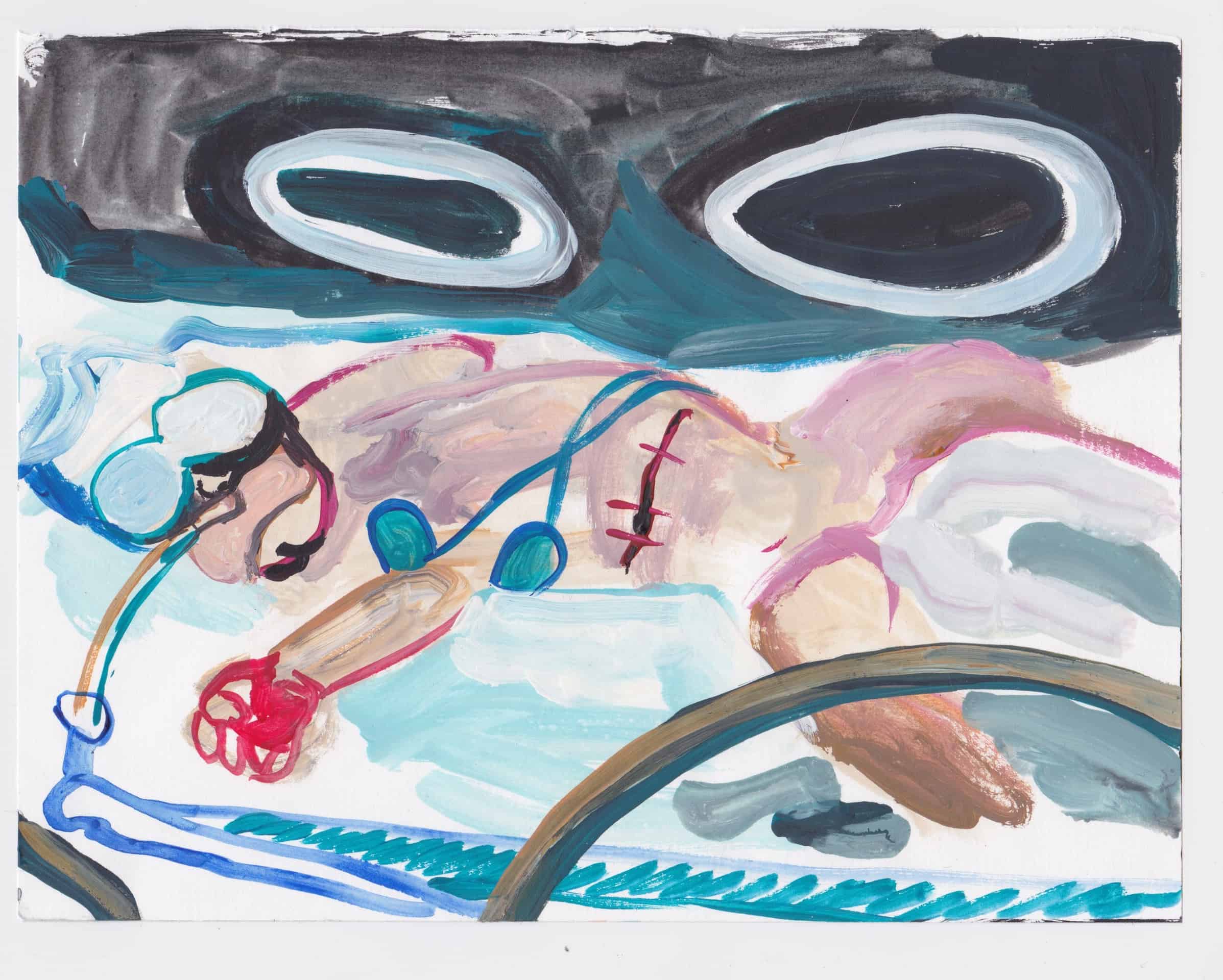
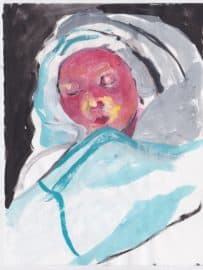
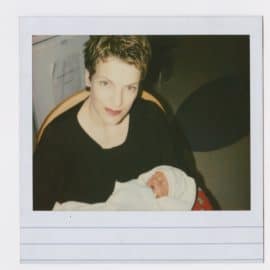 Mirabelle was born at 34 weeks via emergency Caesarian Section (CS) when my waters eventually broke, after repeated procedures to drain excess amniotic fluid. Six weeks early, she looked small, fragile, thin-skinned, beautiful and vulnerable. She was unattached from me surgically, and then reattached to medical forms of life-support after a major operation – wires and monitors replaced the placenta and life-support I was providing in-utero. However, she survived, in most part because of the constant surveillance and medical interventions.
I remember the first time I saw her after the operation – coincidently it was the first day of the Iraq War in 2003 – the days of ‘shock and awe’, when the Americans were bombing Iraq – and I was full of shock and awe too. Shock, due to the emergency birth, traumatic operation, and the vulnerability of my small beautiful baby, and awe at the medical team who were looking after her. The irony of human beings at their most altruistic, looking after tiny defenceless babies in one part of the world, whilst bombing and destroying in another, was not lost on me – both using the most sophisticated high-tech equipment and skills.
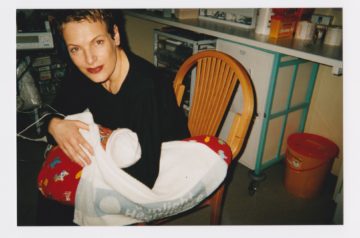 Now working as a midwife, I enter the same fetal medicine department where Mirabelle and I were treated, to support women and birth parents going through pregnancy. They are sometimes reassured by the scan and sometimes worried by it. Sometimes it saves lives and sometimes it causes unnecessary concern. And I see those same small, vulnerable creatures suspended in their mother’s wombs, full of anticipation and seemingly autonomous, but actually tethered to their mothers for survival.
Culturally this picturing of the unborn, as an autonomous being, brings some worrying aspects. It feeds into fetal rights campaigns that can be seen to erode women’s reproductive autonomy and right to choose. Similarly, it seems to have done nothing for the status of mothers who are still woefully unsupported and expected to live up to unrealistic and damaging stereotypes of perfection, self-sacrifice and culturally heteronormative and Eurocentric standards.
However, does it make people connect and fall in love with their babies at an earlier moment in the pregnancy, rather than waiting for the ‘quickening’ (around 20 weeks, when people tend to feel the baby moving in-utero)? Does it help partners connect with the new life? Does it increase our wonder of the process happening inside our bodies and the fragility of human life?
 Some women refuse scans, and many routinely decline to be informed of the sex of the baby, which used to be ubiquitous a few years ago. There are other questions too around the ethics of chromosomal testing that accompanies the first scan (at around 12 weeks). Are we in danger of selecting out anyone who doesn’t conform to ableist views of what constitutes a valuable life, whilst at the same time ‘saving’ babies born early that may go on to have life-long disabilities – a paradox of modern fetal medicine. There are also long held concerns and well-rehearsed arguments about the risks and practice of sex selection – nearly always leading to femicide.
When my daughter was born, her life was uncertain, but at that moment I would have given anything for her to survive and I didn’t care what might be the consequences of prematurity or the major and risky operation she underwent.
My little bean grew up and is now a 5ft 9” healthy young woman, her feet her most valued asset, as a dancer – but the images of her in-utero grasping for the needle, swimming freely in fluid, whilst reliant on my body for survival, will never leave me.
 Laura Godfrey-Isaacs is an artist, midwife and birth activist
@godfrey_isaacs

