









Giving Birth Like a Cow – a reflection on a visit to Bulgaria
Sheena Byrom Midwife OBE Consultant & Director, All4Maternity
The Zebra Midwives
I’ve just returned from Sofia, Bulgaria where I was invited to speak at a medical and midwifery symposium. Midwives Yoana Stanecha and Ilona Neshkova asked me to speak about midwives and midwifery, to consider ‘A World Without Midwives’. I have a good relationship with these wonderful midwives. I first met Yoana in June 2015 when she came to the Normal Labour and Birth conference in England. Yoana attended after being personally invited by the event founder Prof Soo Downe to explain how maternity care was provided in Bulgaria, and the desperate situation for mothers and midwives. Yoana gave a heart-rendering keynote address, and she asked for help to positively influence her country. In a nutshell, midwifery leader Dr Tracey Cooper MBE and I were amongst those who offered to support Yoana, and Tracey has been key in facilitating the development of Yoana and Ilona’s midwifery skills as they created and progressed Zebra Midwives. You can read more about this here.
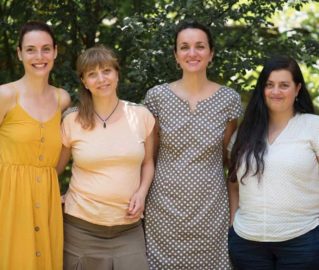
Far right Yoana and Ilona now joined by Viktoria and Plamena
Four years later, and following and amongst constant resistance, Zebra Midwives are successful in their plight to provide holistic, humanised, woman centred care. They do this within the constraints of a private hospital – but it is happening – against a back-drop of maternity care that is dehumanised and hostile, and non-evidence based. There are now four of them! Very recently midwives Viktoria Nikolova and Plamena Gyurova joined the team, which is exciting.
Earlier in the year, Midwifery Leader Kim Parekh, Head of Midwifery Tracey Cooper and I travelled to Bulgaria to input into the organised event, to share knowledge and evidence on midwifery, midwives, continuity of care and lithotomy position for second stage of labour. In Bulgaria, most if not all women give birth in lithotomy position, on their backs, and Tracey’s talk demonstrated the importance of supporting women to be upright and active during labour, and why it matters both physically and psychologically. We could never envisaged the response from delegates, including senior midwives and midwifery educators. Their response could only be decribed as hostile – a sign of oppression maybe, but also of acute resistance to change.
The heckle
The comments started as Tracey was still speaking, sharing evidence relating to positions in labour. When slides displayed images of women upright, on all fours and leaning over to give birth delegates laughed out loud and started to heckle. One of the delegates proclaimed loudly:
‘She’s giving birth like a cow!’
The midwife delegates were genuinely worried – with questions and comments such as:
‘What would we do with our hands?’
and
‘How will we be viewed as professionals and experts?’
There is a particular manoeuvre, resembling the Ritgen manoeuvre, that midwives in Bulgaria apply when delivering the head. The manoeuvre is considered to be one of the most essential midwifery competencies in the local context and cannot be applied in a position different from the lithotomy position. Naturally, midwives’ most prominent skills go hand in hand with lithotomy and make it impossible to imagine another position for birth in which midwives can use their expertise and be helpful to women. Hence, the conference ended in a noisy mess of half- and fully voiced frustrations and disapproval.
Ilona and Yoana, in the end, respectfully invited the delegates to reflect on their reactions, and to try to be open to change, for the sake of mothers and babies.
For me, it was another situation where I left a building and later a country where I witnessed the silencing of women by other women – where cultures and social influences oppress women’s rights at the most vulnerable times of their lives.
But this visit also gave me great hope. I saw the raw passion of the two midwives Ilona and Yoana, spending their lives making incredibly important transformations for childbirth in Bulgaria. With their doula suporters, journalist friends and childbirth activist allies, they are also influencing the world – and for some amazing twist of nature – I get to witness it and be a small part of their journey.
Before revealing the detail of the success of Zebra practice, I want to give you a glimpse of what childbirth is like for most women in Bulgaria:
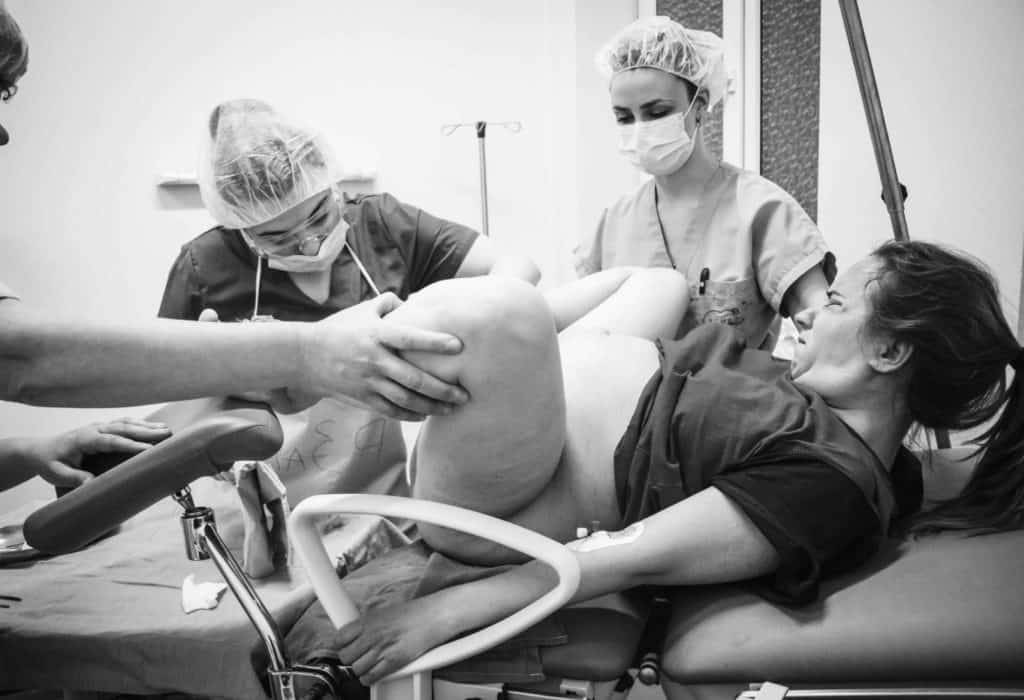
A birth in Bulgaria – photo Radina Petrova
- As mentioned above, most women do not have freedom of movement in labour, are confined to a bed or trolley when pushing, with their feet strapped in lithotomy
- Most women are asked to refrain from drinking water and eating light snacks. IV fluids are offered for boosting energy.
- Most women will be offered or given an episiotomy to avoid natural tears which are considered more damaging. In an Facebook survey of 3000 women who gave birthed vaginally 65% of them have had an episiotomy.
- Many women report that they were given general anaesthesia for the period after birth to examine the cervix and vagina for tears and the subsequent stitching.
- Many hospitals may keep mothers and babies separated for the period immediately after birth or follow a timetable when moms and babies are reunited throughout the hospital stay (3 days for normal births and 5 days for CS).
A new way for Bulgaria
This is an inspirational story. It’s one of leadership, courage and compassion and whilst these midwives are incredibly bashful and don’t believe they are remarkable, I want to shout what they are doing from the rooftops. Even when presented with huge barriers, inconceivable to us practising midwifery in the UK, Zebra Midwives have created a new way.
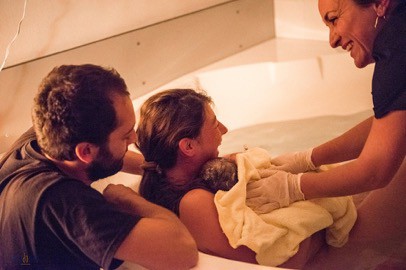
Birth with Zebra Midwives – photos Miroslava Philipova
In their facility the Zebra Midwives have supported 107 women to give birth and the outcomes are outstanding:
- 65% of all births have been low-risk at onset;
- 10.7% CS rate among low-risk women;
- 21% CS rate among all;
- 64.2% VBAC success rate;
- 65% of normal birth have been in an alternative position, other than lying on back;
- 9% episiotomy or perineotomy of all vaginal births; –
- 50% of all women have used water for pain relief and/or birth;
- 14% induction rate;
- 98% breastfeeding initiation rate within an hour after birth.
For midwives working in supported environments, where they are autonomous and able to provide some choice to women – these statistics may seem unremarkable, but they are significant when comparing the status quo in Bulgaria. If you would like to hear more about these phenomenal midwives, you can listen to their All4Maternity Podcast here.
Zebra Midwives you are changing the face of birth in Bulgaria and the world – you are role models, innovators and leaders and I am honoured to stand in your shadow.
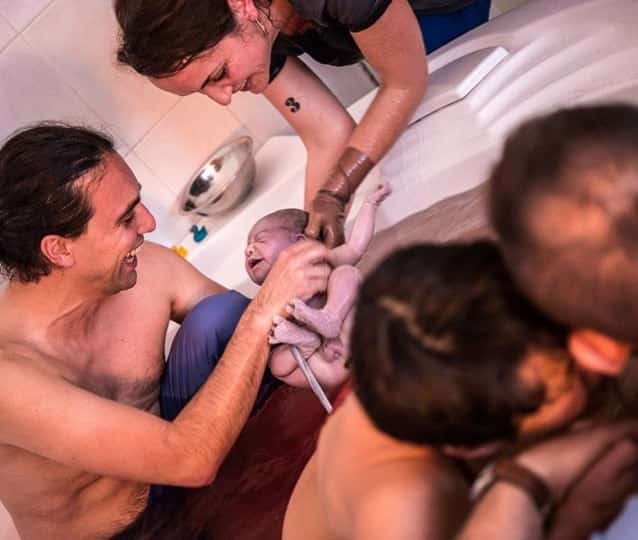
Black and white photos: Radina Petrova
Coloured photos: Miroslava Philipova

