









Understanding consent and mental capacity
Study sheet aim and key information:
Central to respectful, humanised care is the active recognition of women’s bodily autonomy. This means that women have the only and final say on what happens to their body. In the UK, we have strong legislation that supports women’s human rights in childbirth. Fundamental to these rights is the application of meaningful consent in all aspects of our care, this includes respecting women’s decisions should they decline recommendations of care. This study sheet will offer direct guidance regarding consent, and while a UK focused paper it can be applied to other contexts.
 Learning objectives:
- To identify the human rights legislation.
- To define consent and to describe the dimensions of consent.
- To understand what acquiescence means.
- To understand mental capacity.
- To explore the midwives’ role in supporting women’s rights during pregnancy and childbirth.
Duration: 30 mins
Keywords: birth, rights, consent, mental capacity


Human rights awareness, consent and mental capacity assessment: a user-friendly guide for midwives
Stephen Hamilton – Psychiatric Nurse, Tutor, Author and Associate Lecturer at Queen’s University Belfast
Keith Mitchell – Third Year Midwifery Student at Queen’s University Belfast
Published in The Practising Midwife Volume 22 Issue 5 May 2019
Introduction
A main tenet of the Nursing and Midwifery Council (NMC) Code is that informed consent must be obtained before carrying out any procedure (NMC 2015). Given the litigious environment in which midwives find themselves, this requirement is broadly understood and abided by in most settings. As well, midwives are becoming attuned to the challenges presented by varying cultural interpretations of informed consent (Mitchell and Spence 2018). However, perhaps less acknowledged by midwives is their responsibility to understand the importance of the dimensions of mental capacity and its assessment, as well as how it relates to informed consent (NMC 2015). Regardless of whether the procedure in question is as minor as measuring a woman’s blood pressure or as major as performing a caesarean section, a woman who lacks the mental capacity to make a decision cannot provide informed consent.
The European convention on human rights
 The journey towards what we now refer to as the European Convention on Human Rights (ECHR) formally began, following the end of World War II, with the introduction of the Universal Declaration of Human Rights in 1948. This international agreement set the stage for other protocols such as the Declaration of Helsinki (World Medical Assembly [WMA] 1964), which was introduced specifically in order to protect research participants following flagrant human rights abuses like those that resulted from Stanley Milgram’s work on obedience studies, and the Tuskegee Experiments carried out in Alabama by the United States of America Public Health Agency from 1932 to 1972. The Nuremberg Code (1965) (cited by Shuster 1997) was introduced on the back of the Nuremberg Trials, which exposed the horrific human rights abuses that many people experienced at the hands of the Nazis. The Human Rights Act (Her Majesty’s Government [HMG] 1998) is a key piece of legislation in the United Kingdom, with its creation being further fuelled by the introduction of the European Convention on the Prevention of Torture as well as the International Convention on Civil and Political Rights.
Despite the United Kingdom’s seemingly pending withdrawal from the European Union (EU), we are still subject to European Law, and therefore the ECHR remains the default position. Furthermore it is anticipated that the UK will simply adopt current EU law in an unaltered state upon departure from the EU. The ECHR contains absolute rights, limited rights and qualified rights which, despite being numbered, are not in any ascending or descending order of importance (See Table 1 for a full list). Absolute rights are just what they state – absolute – and are not subject to negotiation. For example, the right to life and to have one’s life protected is absolute. Limited rights are those that individuals have a certain amount of freedom to express but if there is a breach of civil, common or indeed criminal law, authorities can put restrictions on that person. For example, if a person breaks the law while exercising their freedom of expression, there are consequences, and s/he may go to prison.
Mental capacity assessment is every health and social care practitioner’s business, contrary to popular myth and opinion. It does not fall within the purview of a select few and is certainly a responsibility of midwives. We cannot talk about mental capacity assessment without addressing the area of consent, as these areas are inextricably linked in the context of the day-to-day running of the health service. When midwives are asked, “Whose job is it to obtain informed consent from a woman for a procedure, or indeed to assess a woman’s mental capacity to make a specific decision?” the reply often is “…psychiatry or psychology deals with that type of thing…”
Dimensions of consent
Every human being of adult years and sound mind has a right to determine what shall be done with their own body, and any health and/or social care professional who carries out any intervention without the person’s consent commits an assault, for which s/he is liable in damages. Let us examine what constitutes legal consent: firstly, it has to be given voluntarily; secondly, the person must demonstrate and show sufficient decision-specific mental capacity; and thirdly, the person must have knowledge of the decision s/he is being invited to make. All three of these inter-dependent elements must be present if the person’s consent is to be considered legal. The term ‘knowledge’ refers to the options, risks, benefits and consequences of either accepting or declining a treatment or intervention. The word ‘refused’ should no longer be used in contemporary times, as it implies that the individual does not have a choice in the matter; ‘declined’ more accurately infers that s/he does have a choice.
Simply because a person wants to make a decision that is perceived by a health professional to be a bad one does not necessarily mean the person lacks the mental capacity to make the particular decision. When a practitioner attempts to obtain consent from an individual for a procedure, s/he must furnish them with the relevant information needed in order for that person to make that decision. There are three main types of consent: express written consent; express oral consent; and implied consent (such as where a person holds out their arm in order to have their blood pressure checked, without actually saying anything). The age of consent in Northern Ireland (NI) is 16 years of age as per the Age of Majority Act (NI) (HMG 1969) and applies to a person of sound mind. It is essential that all healthcare practitioners (without exception) document in the appropriate records a patient’s consent or indeed lack of consent.
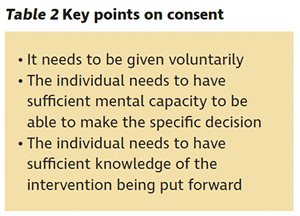 The term ‘acquiescence’ refers to when the patient, woman or service-user simply goes along with what is suggested; this does not constitute legal consent on any level. ‘Acquiescence bias’ assumes that the patient, when unsure of how to answer, inherently agrees with the healthcare professional. Very often coercive questioning styles can generate the notion of acceptance and may lead to infringement of a patient’s rights. In addition, no individual can consent on behalf of anyone who is unable to consent for him or herself. Table 2 lists criteria for consent to be valid.
The dimensions of mental capacity and its assessment
Mental capacity pertains to decision-making ability and it is important to note that this is not the same as detention under the Mental Health Order. Detained patients can retain decision-making capacity; a lack of decision-making capacity equally does not give grounds for detention. Capacity is presumed for any adult aged 16 or over, and people have capacity if they have sufficient intelligence and understanding to make that particular decision/choice.
Making a bad decision is not indicative of mental incapacity and it must also be remembered that physical dependence is also not in any way indicative of mental incapacity.
The late Professor Stephen Hawking is a perfect example of someone who was extremely physically dependent upon others for his basic needs, while simultaneously being one of the most intelligent individuals ever to grace the planet. As we illustrate below, mental capacity assessments are not ‘done on’ an individual, but rather carried out with that individual.
A person’s mental capacity cannot be ‘general’ or indeed ‘generalised’. What’s more, mental capacity assessment should not be invoked simply to satisfy the curiosity of a midwife or other healthcare professional, or indeed for decisions that a person does not need to make in the present. Importantly, one cannot nor should even contemplate assessing a person’s mental capacity in anticipation of future events. A patient, therefore, may have several capacity assessments relating to different decisions. Practitioners must have grounds for questioning a person’s capacity, as capacity is presumed under law. Before a mental capacity assessment is initiated, there must be evidence of mental impairment that impacts upon the person’s decision-making ability (for example: depression; psychosis; dementia; delirium; learning disability; being under sedation/anaesthesia; or in a coma).
A person’s capacity cannot be questioned on grounds of physical dependency, and clinical diagnosis per se is not an indicator of incapacity; the appropriate scales must be used to assess the person’s level of impairment, (Clifton assessment procedure for the elderly; Mini-mental state examination; Bristol activities of daily living; Neuro-psychiatry inventory; Brief psychiatric inventory; Montreal cognitive assessment; Positive and negative symptoms of schizophrenia scale; Cornell depression scale; and Becks depression scale, to list some of the more common scales and tools to establish and evidence a person’s level of impairment, if any). Diagnosis may give grounds to query a person’s mental capacity to make a specific decision, but it is not indicative in itself of mental incapacity.
From a legal perspective the United Kingdom remains a signatory to the ECHR as well as the Deprivation of Liberty Safeguards. In Scotland, the Adults with Incapacity Act was established in 2000 (Scottish Executive [SE] 2000), with England and Wales bringing in their Mental Capacity Act and Deprivation of Liberty Safeguards in 2005 (HMG 2005). We here in Northern Ireland are still awaiting the implementation of similar legislation in the absence of a health minister to sign off on it. The British Medical Association and the British Psychological Association have collated some excellent guidelines pertaining to mental capacity assessment, as indeed have the Northern Ireland Human Rights Commission and the Medical Protection Society. Despite the hiatus here in Northern Ireland, we are still subject to European law with the Department of Health, Social Services and Public Safety for Northern Ireland (DHSSPSNI) (2010) issuing a directive advising and reminding health and social care professionals across the spectrum that they are still subject to good practice regarding assessing mental capacity and the maximisation of patient autonomy. Northern Ireland is attempting to combine mental health order legislation with mental capacity legislation, incorporating the criminal justice system, which is considered ground-breaking by the other United Kingdom jurisdictions. The Executive Summary of the Draft Capacity (Northern Ireland) Bill is available for viewing and perusal on the DHSSPSNI website.
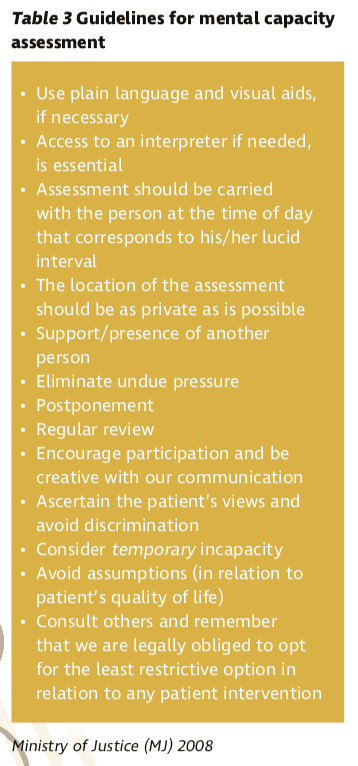
A mental capacity assessment is decision-specific and has two distinct stages. Stage 1: diagnosis/level of impairment; and stage 2: understanding, retention, utilisation and communication. In other words, is the person able to understand, retain, use and communicate the decision s/he has to make? Even though a person may have an ‘axis one’ disorder, for example, schizophrenia does not mean that s/he is unable to make a decision. Mental capacity assessment is only valid at the time of the assessment and is based on the balance of probabilities; the assessor must tick ‘yes’ to each of the sections in stage 2 in order for the assessor to deem that person to have sufficient capacity to make the respective decision in question. There are some useful guidelines for assessors to consult in order to maximise the objectivity of the assessment and promote patient autonomy, as listed in Table 3.
In order to minimise the potential for misuse or abuse, the recommendation is that assessment of mental capacity and decision-making in best interests are two separate functions and should be conducted by two different practitioners.
Practitioners often ask, “What if a person’s mental capacity fluctuates: how do we decide if s/he has the mental capacity, as a result of this fluctuation?” The answer is to carry out the mental capacity assessment when s/he is at their best, so to speak, on more than one occasion. If the outcome is inconsistent, then the practitioner must conclude that the individual does not have the mental capacity to make the specific decision. Equally, the converse is applicable.
Midwives have a crucial role to play in regard to upholding the human rights of women as well as in relation to consent and mental capacity assessment, a role that is inherently essential to safe and effective, woman-centred midwifery practice.
Traditionally, midwives may not have seen this as their role. It is, however, very much within their remit as healthcare professionals and should be kept in mind whenever initiating a procedure or intervention. TPM
References
Age UK (2014). Arranging for someone to make decisions about your finance or welfare: factsheet 22, Jan 2014, London: Age UK.
DHSSPSNI (2010). Deprivation of liberty safeguards (DOLS): interim guidance, Belfast: DHSSPSNI.
HMG (1969). Age of Majority Act (NI), London: Crown.
HMG (1998). Human Rights Act, London: Crown.
HMG (2005). Mental Capacity Act, London: Crown.
MJ (2008). Mental Capacity Act 2005: Deprivation of liberty safeguards: code of practice to supplement the main mental capacity Act 2005 code of practice, London: Crown.
Mitchell K and Spence D (2018). Challenges faced by midwives when obtaining informed consent in an ethnically and demographically diverse community: a student’s perspective, Dublin: INMO and RCM All Ireland Annual Conference.
NMC (2015). The Code. Professional standards of practice and behaviour for nurses and midwives, London: NMC. http://www.nmc.org.uk/standards/code/
SE (2000). Adults with incapacity (Scotland) Act, Edinburgh: Civil Law Division.
Shuster E (1997). ‘Fifty years later: the significance of the Nuremberg code’. The New England Journal of Medicine, 337(20): 1436-1440.
WMA (1964). Declaration of Helsinki: recommendations guiding doctors in medical research, Helsinki: WMA.
FURTHER READING, VIDEOS AND LINKS
Montgomery vs Lanarkshire ruling
Basic legal and ethical concepts
Birthrights, the leading charity in the UK solely dedicated to women’s rights during childbirth has a wealth of resources including downloadable factsheets and informative videos regarding consent and the law:

The download button below enables you to be able to print off and complete the study sheet, alternatively, you might want to annotate the PDF and save to your computer, ready for adding to your student portfolio or for midwifery revalidation
-
Extend your learning by looking through the further reading, videos and links above
Activities
- Identify the key European Convention of Human Rights ‘articles’ that would primarily relate to maternity care.
- Explain the key points of consent and mental capacity.
- Identify and describe the dimensions of consent and how mental capacity is assessed.
- Define acquiescence.
- Imagine you are explaining to a friend, can you describe the role of the midwife in protecting women’s human rights in childbirth- what it means, what it looks like, and what type of activities would constitute protecting those rights.
